

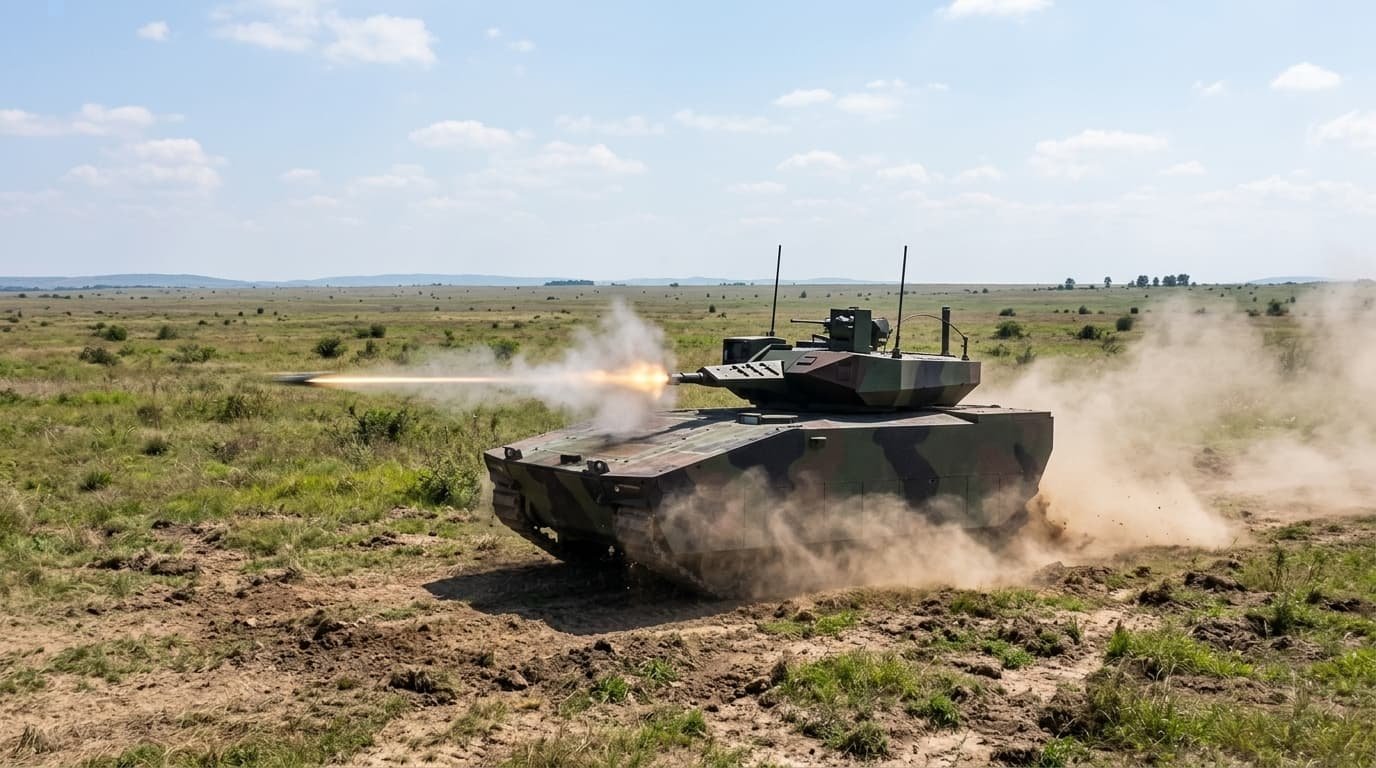
The XM30 Combat Vehicle is being built around a simple idea: the U.S. Army needs more firepower without sacrificing the protection and mobility its infantry depends on. Its biggest visible change is a 50mm cannon, twice the caliber of the Bradley’s 25mm gun. But the real story goes beyond a bigger weapon.
The Army wants an infantry fighting vehicle that can handle modern threats while supporting a growing load of sensors, digital systems, and future upgrades. That’s why the XM30 Combat Vehicle combines an uncrewed turret with a hybrid-electric powertrain and a design intended to accept new technology over time.
Two companies are developing competing prototypes. General Dynamics Land Systems has its Wolf, while American Rheinmetall is building the Lynx XM30 Combat Vehicle. Both have entered Army testing, but the service has not selected a winner.
The challenge is making all these systems work together outside a test facility. A 50mm cannon means little if ammunition storage limits how long the vehicle can fight. Extra electronics are useful only if the power system can support them reliably. And advanced protection must not make the vehicle too heavy or difficult to maintain.
The XM30 Combat Vehicle could give Army infantry units a major upgrade over the M2 Bradley, which entered service in 1981. Yet its success will depend less on impressive specifications than on what soldiers discover during testing. The Army needs a vehicle that works under pressure, stays ready for repeated missions, and can be fielded in useful numbers.
What Is the XM30 Combat Vehicle?
The XM30 Combat Vehicle is designed to help Army infantry fight alongside tanks without relying on an aging vehicle that has limited room for further upgrades. Its job isn’t just to carry soldiers. It must also provide direct fire, protect its crew, and support the wider armored force as battlefield threats change.
The program was first known as the Optionally Manned Fighting Vehicle, or OMFV. The Army later adopted the XM30 Combat Vehicle designation as the project moved toward prototype development. The goal is to replace the M2 Bradley in Armored Brigade Combat Teams, where infantry fighting vehicles help troops move under protection and engage threats during combined-arms operations.
That role sets the XM30 Combat Vehicle apart from an armored personnel carrier. An armored personnel carrier mainly transports troops, while an infantry fighting vehicle also carries weapons intended to support them during combat.
The Bradley follows this model with its 25mm cannon and anti-tank missile system. The XM30 is expected to build on that role with a larger main gun and more advanced onboard systems.
The Army also wants the vehicle to work with robotic and semi-autonomous systems. These could help units gather information or extend their reach without putting soldiers in every exposed position. The exact operational methods will depend on how these systems develop and integrate with the vehicle.
The XM30 Combat Vehicle competition has two contenders: General Dynamics Land Systems’ Wolf and American Rheinmetall’s Lynx XM30. Both have delivered prototypes for Army evaluation, but neither has been selected as the final design.
The Army’s XM30 Combat Vehicle program office outlines the program’s role in future ground combat. The harder question is whether the vehicle can deliver that role without becoming too complex to maintain or too costly to field across armored units.
XM30 Combat Vehicle Specifications and Design
The XM30 Combat Vehicle’s design brings more firepower and onboard technology into one vehicle, but every added capability creates a new demand for space, power, or maintenance. The Army is trying to avoid the limits that have made further upgrades to the Bradley increasingly difficult.
The program’s published requirements give us a useful picture of the intended vehicle. Some details, however, remain unconfirmed because the competing prototypes are still undergoing evaluation.
| Specification | XM30 Combat Vehicle |
| Vehicle type | Tracked infantry fighting vehicle |
| Primary role | Replace the M2 Bradley |
| Main armament | XM913 50mm cannon |
| Turret | Uncrewed turret |
| Crew concept | Two soldiers, with capacity for six infantry troops |
| Powertrain | Hybrid-electric |
| Protection | Integrated protection systems and modular armor |
| Additional weapons | Planned options include anti-tank missiles and loitering munitions |
| Electronics | Advanced optics, fire control, and digital systems |
| Architecture | Modular Open Systems Approach (MOSA) |
The two-soldier crew concept is worth a closer look. Earlier Bradley configurations generally require a larger crew to operate the vehicle, while the XM30 Combat Vehicle aims to use advanced optics, electronic controls, and an uncrewed turret to reduce the number of soldiers needed inside.
The design also plans space for six infantry troops, keeping dismounted soldiers central to the vehicle’s role. The Army outlined these core requirements when it awarded prototype contracts in 2023.
The uncrewed turret moves the weapon crew’s work inside the hull, where they can operate through cameras and displays. That can improve protection, but it also makes sensor reliability critical. Damaged cameras or failed displays could limit what the crew can see, even if the armor remains intact.

The XM30 Combat Vehicle also uses a Modular Open Systems Approach, or MOSA, to make future upgrades easier. In practice, new equipment still needs enough power, cooling, and physical space. The Government Accountability Office has already identified immature battery and starter motor generator technologies as risks to the program.
That is why the Army must judge the XM30 Combat Vehicle as a complete system, not simply as a Bradley with a bigger gun.
How Does the XM30’s Hybrid-Electric Powertrain Work?
The XM30 Combat Vehicle’s hybrid-electric powertrain is meant to provide more than fuel savings. It must support a vehicle packed with sensors, digital displays, communications equipment, and weapons while preserving the mobility soldiers need in the field.
The system combines a conventional engine with electric drive technology. That setup can help deliver power to the tracks while supplying electricity to onboard equipment. It may also let the vehicle run selected systems with the engine switched off, a feature often called silent watch. For a crew waiting behind cover, reducing engine noise can make the vehicle less noticeable and cut fuel use during stationary periods.
The benefits could extend beyond quiet operation. Hybrid systems can provide more electrical power for equipment and may improve acceleration and control.
American Rheinmetall’s Lynx prototype uses an electric hybrid system supplied by Allison Transmission, while the XM30 Combat Vehicle program requires both competing designs to meet the Army’s broader mobility and power needs. The Army has also explored hybrid technology in other tactical vehicles to assess silent operation and onboard power generation.

But this technology brings a serious engineering challenge. The vehicle must manage battery weight, heat, electrical demand, and the risk of faults in high-voltage components. A battery system that performs well in mild weather may behave differently in extreme cold or heat. Crews and maintainers need a system they can trust across those conditions.
The Government Accountability Office reported in 2026 that two XM30 technologies, high-voltage high-power-density batteries and a starter motor generator, had not yet reached maturity. The contractors were still building prototypes and preparing them for tests. The GAO warned that immature technologies can force redesigns, raising costs or delaying schedules.
That is the trade-off behind the XM30 Combat Vehicle’s powertrain. Silent watch and greater onboard power could be useful advantages, but the Army must first prove that the system can handle repeated field use without becoming a maintenance burden.
How Will the XM30 Protect Its Crew Against Modern Threats?
The XM30 needs more than thick armor to survive modern combat. Its protection must combine physical armor, warning sensors, active defenses, and a clear view of the battlefield. A vehicle that detects a threat early has more options than one that only relies on its armor after being hit.
The Army plans to equip the XM30 Combat Vehicle with an active protection system (APS). This system is designed to detect and track incoming anti-tank threats, then use countermeasures to stop or disrupt them before they reach the vehicle. The XM30’s protection concept also includes fitted armor and signature management, which aims to make the vehicle harder to detect.
But active protection has limits. Its sensors must identify a threat, track its path, and react within a short window. The system also needs enough warning and a suitable countermeasure for the type of weapon approaching. It cannot guarantee protection against every attack, especially when threats arrive from several directions.
Drones create a separate problem. Small unmanned aircraft can observe vehicle movements, while loitering munitions can approach from angles that traditional defenses may not cover well.
A September 2026 report from the Congressional Research Service raised a key question: it remains unclear whether the XM30 will have its own dedicated counter-drone capability. An APS built to counter anti-tank missiles does not automatically provide reliable defense against small drones.

The vehicle’s cameras and thermal sensors will also matter. They help crews spot threats, but damaged optics or failed displays can reduce awareness even if the armor remains intact. Backup sights and power systems can help, provided they work when needed.
The XM30 Combat Vehicle’s protection should therefore be judged by more than its armor package. Army testing needs to show how the vehicle handles threats from different angles, keeps its sensors working, and protects crews when one layer of defense fails. The Congressional Research Service’s XM30 overview identifies counter-drone protection as an issue that still needs attention.
The Army’s XM30 Combat Vehicle testing program must prove that the vehicle can handle repeated field use, not just perform well during a demonstration. Engineers need hard data on reliability, weapon performance, protection, and repair time. Soldiers need to show whether the vehicle is practical to operate under pressure.
The Army is using two main locations for the current evaluation. Aberdeen Proving Ground in Maryland supports technical work, including safety checks and assessments of ballistic hulls and turrets. Fort Hood, Texas, is the focus for soldier evaluation and field trials with the 1st Cavalry Division.
The test plan changed in October 2026, removing the previously planned rotation at the National Training Center in California. According to the 2026 report, field evaluations could run through February or March 2027.
The Army’s test program covers several key areas:
- Mobility and reliability: Can the vehicle travel over rough terrain and keep operating through repeated use?
- Weapons and safety: Do the cannon, fire-control system, and related equipment work as intended?
- Survivability: Can the hull, armor, and protection systems meet the Army’s requirements?
- Soldier feedback: Can crews use the displays, controls, and sensors effectively during realistic missions?
- Maintenance: How quickly can technicians identify faults and return the vehicle to service?
That last point deserves more attention. A vehicle may perform well during a short trial but become difficult to support after repeated movement, firing, and exposure to harsh conditions. The Army needs to measure those demands before committing to a design.
The schedule also matters. The Army’s FY2027 budget requests $546.99 million for up to 19 XM30 vehicles, hulls, and turrets. The request supports the next stage of the program, but it does not mean a winning contractor has been chosen. The Army currently targets Milestone C for the first quarter of fiscal year 2028, according to its FY2027 budget documents.
The key result isn’t a successful test day. It’s evidence that the XM30 can keep working, remain maintainable, and meet the Army’s needs over time.
Can the XM30 Replace the Bradley Successfully?
The XM30 Combat Vehicle will succeed only if the Army can field a capable vehicle without letting cost, technical problems, and schedule delays undermine the program. A bigger cannon and a modern powertrain look good on paper, but soldiers need equipment that works reliably and can be maintained across an entire armored brigade.
The Bradley has served since 1981, and repeated upgrades have helped it remain useful. Yet added armor and electronics have increased demands on its weight, space, and power capacity. The XM30 Combat Vehicle is intended to address those limits with a new design, including a 50mm cannon, an uncrewed turret, and a hybrid-electric powertrain.

The Army has tried to replace the Bradley before. The Future Combat Systems program and Ground Combat Vehicle effort both ended without delivering a new infantry fighting vehicle. Their histories show how ambitious requirements and technical challenges can consume time and money before troops receive new equipment.
The XM30 Combat Vehicle still faces technical risks. In its 2026 weapon systems assessment, the Government Accountability Office identified the high-voltage battery and starter motor-generator as technologies that had not yet reached maturity.
If testing reveals problems, the Army may need design changes that affect cost or timing. The vehicle’s ability to support new electronics and weapons will also depend on whether its power and cooling systems work as planned.
The Army’s FY2027 budget request of $546.99 million for up to 19 vehicles, hulls, and turrets signals that the program is moving toward its next acquisition stage. It does not mean the Army has selected a winner or approved full-rate production.
The right measure of success is straightforward: can the XM30 Combat Vehicle prove reliable in testing, remain affordable to support, and reach units in useful numbers? Until those answers are clear, its most advanced features remain promises to be tested, not results to take for granted.
