

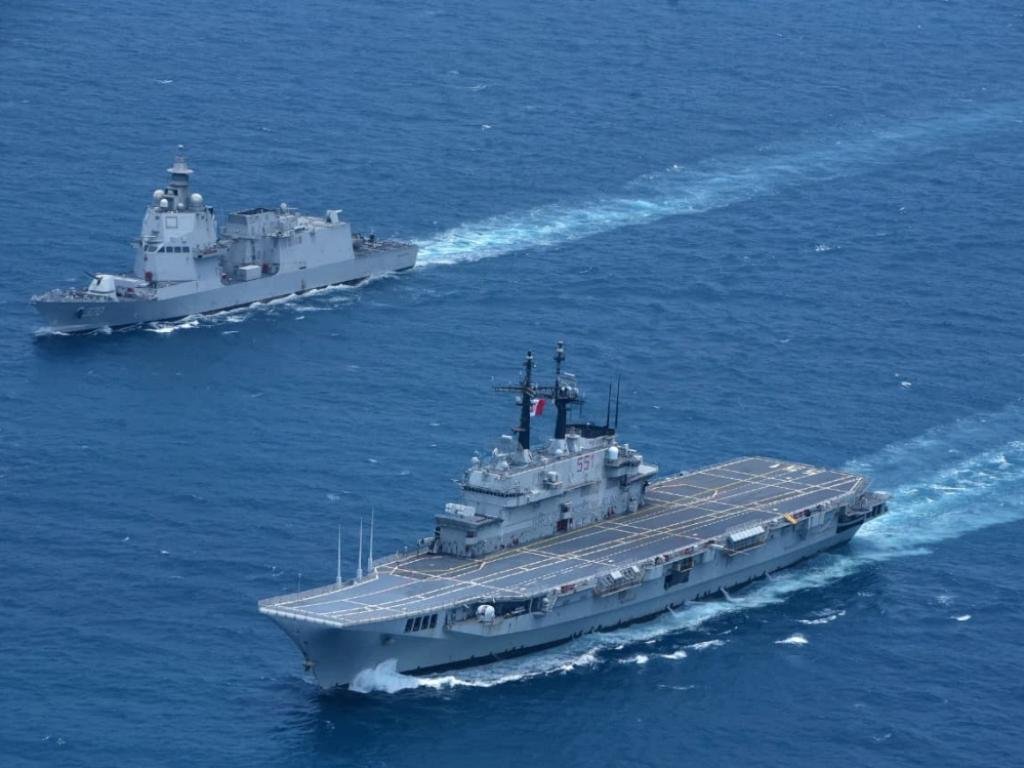
Indonesia has taken delivery of the former Italian Navy carrier Giuseppe Garibaldi, and it duly commissioned the vessel as KRI Sriwijaya (pennant number ‘100’) on 25 September 2026. This gives the Indonesian Navy (TNI-AL) a new, but second-hand, aviation-capable platform.
The transfer makes Indonesia the second Southeast Asian navy to operate an aircraft carrier-sized vessel, after Thailand’s Spanish-built HTMS Chakri Naruebet.
Italy approved the free transfer of Giuseppe Garibaldi to Indonesia in May this year, avoiding the costs associated with maintaining the vessel or dismantling it for disposal. Jakarta will, however, bear the cost of modifying and modernising the 41-year-old ship.
Indonesia’s Ministry of Finance has earmarked approximately US$450 million for the vessel’s modernisation, although local lawmakers have told reporters that the eventual cost could actually reach US$900 million.
PT PAL and Fincantieri will undertake this upgrade work. The two companies have signed a memorandum of understanding to cooperate on the modernisation programme, and to determine the most effective approach for the carrier’s future configuration.
Admiral Muhammad Ali, the Chief of the TNI-AL, said the vessel’s existing NATO-standard communications equipment is incompatible with Indonesian systems, and so they will be replaced with domestically supported equipment. He estimated the communications replacement alone will take 4-5 months, although the start date for the broader modernisation programme has not been determined.
Ali also said the Indonesian Navy expects KRI Sriwijaya to remain in service for 15-20 years.

Photographs taken following the vessel’s delivery show that Sriwijaya retains much of its original equipment, including the Mk 29 launcher for Aspide surface-to-air missiles, and Leonardo Twin 40L70 Dardo close-in weapon systems. The Aspide missile is no longer in production, and it remains unclear whether Indonesia intends to retain the launcher or replace the system with a newer air defence weapon.
Before the transfer, Indonesian President Prabowo Subianto said the ship could operate up to ten medium-sized helicopters, including for forest firefighting missions. This would provide Indonesia with an additional platform for disaster response and humanitarian operations across its extensive archipelago.
The ship’s badge unveiled during the commissioning ceremony also provides an indication of possible future aviation capabilities. The badge features the front profile of a Baykar Bayraktar TB3 uncrewed combat aerial vehicle alongside a helicopter, suggesting the TNI-AL is considering fixed-wing UAV operations from KRI Sriwijaya.
by Chen Chuanren
