

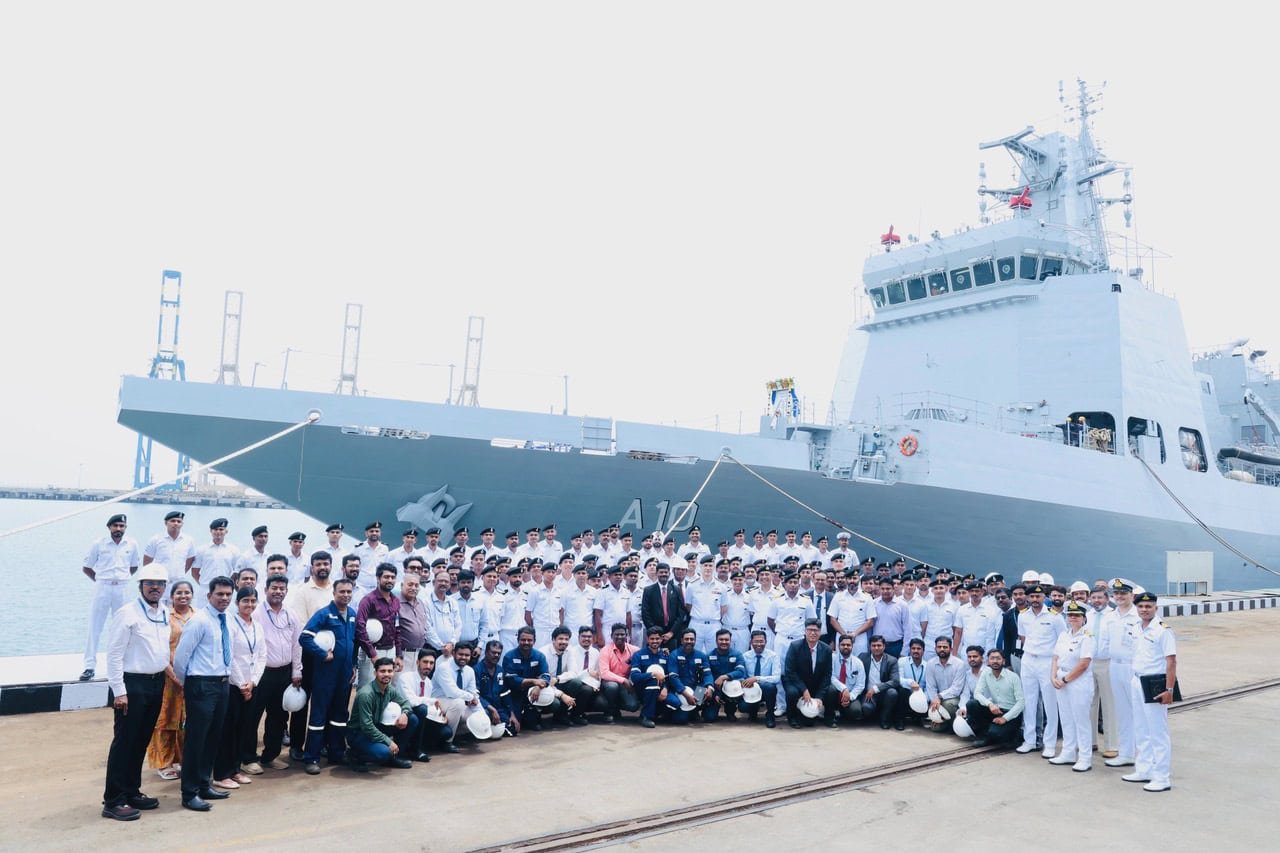
The Indian Navy has taken delivery of INS Samarthak (pennant number ‘A10’), the first of two multipurpose vessels designed to support indigenous naval weapons development and a range of operations other than war.
The INR8.87 billion ($93.2 million) programme was awarded to Larsen & Toubro in March 2022. However, Samarthak was handed over on 27 August 2026, around a year later than originally planned.
Displacing 3,750 tonnes and measuring 107m in length and with an 18.6m beam, the vessel is designed to support the test and evaluation of new naval weapons, sensors and other systems. It can also recover aerial, surface and underwater targets used during gunnery and anti-submarine warfare exercises.
Additional roles include salvage operations, humanitarian assistance and logistical support to India’s island territories.
The Ministry of Defence said the vessel incorporates 75% indigenous technology and systems, supporting Delhi’s wider “Buy Indian” initiative and efforts to reduce reliance on foreign suppliers for critical naval capabilities.
Separately, on 31 August the navy commissioned INS Nipun, the second and final Nistar-class diving support vessel.
Displacing 9,350 tonnes, Nipun is equipped with a deep submergence rescue vehicle, a submersible decompression chamber, self-propelled hyperbaric lifeboat and other submarine rescue equipment. The vessels provide the Indian Navy with a dedicated submarine rescue capability, reducing its reliance on chartered commercial vessels to deploy and operate rescue systems.
The lead ship, INS Nistar, was commissioned in 2025 and it is based at Visakhapatnam on India’s eastern coast. Nipun will be assigned to the Western Naval Command in Mumbai, providing the navy with dedicated submarine rescue coverage on both coasts.
The development of this capability comes as India’s submarine fleet is expected to expand. The navy is pursuing additional diesel-electric submarines under its Project 75I programme, with Germany’s ThyssenKrupp Marine Systems reportedly among the leading contenders.
by Chen Chuanren
