

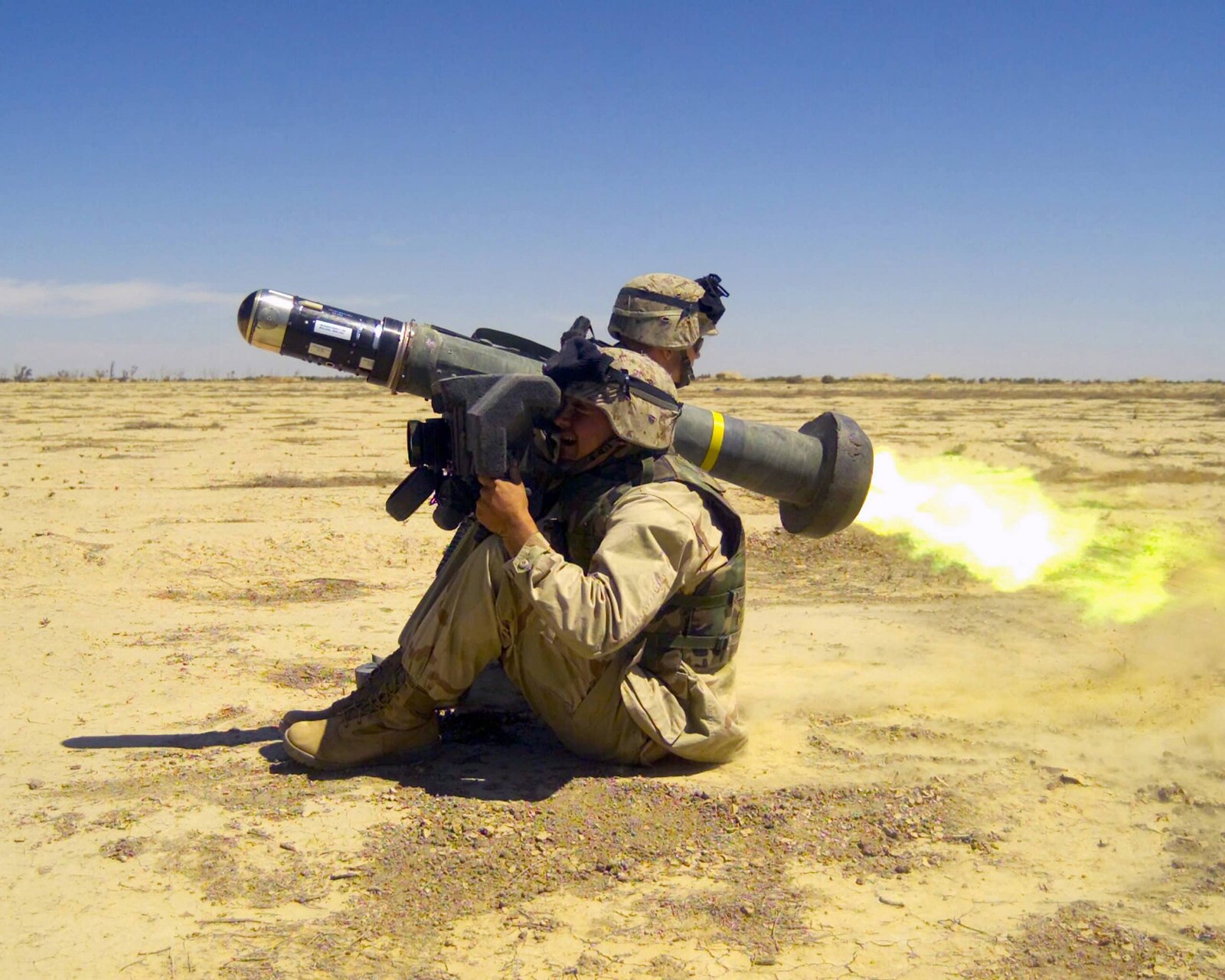
Sergio Gor, the US Ambassador to India, announced in a 28 August 2026 online post that the Indian Army “plans to buy the battle-tested Javelin antitank system”. His post followed the Indian Army reportedly signing a letter of offer and acceptance to purchase the US-manufactured FGM-148 Javelin missile via the Foreign Military Sales programme.
The purchase is understood to cover 25 Lightweight Command Launch Units (LWCLU) plus 60 missiles. It follows a 2025 Indian Army request for Javelins that was approved by the US State Department on 19 November that year.
This Indian Army procurement being executed under emergency procurement powers is valued at INR2.92 billion (US$30.5 million). Deliveries are to begin by the end of 2026 or in early 2027.
The army is making the purchase to fill immediate antitank capability gaps in India’s border areas. This is reflected in both the limited numbers being acquired and the lack of reference to potential purchase options, as might be expected.
Furthermore, information has not yet been released on which version of the FGM-148 is being provided (the latest Spiral 3 development is the more capable FGM-148G).
For background, state-owned Bharat Dynamics Limited had a past agreement with the Javelin Joint Venture alongside Raytheon and Lockheed Martin to explore building the missile in India. Previous negotiations in 2010 with the USA on Indian co-production and manufacturing encountered obstacles, with Washington DC unwilling to provide the level of technology transfer sought by Delhi.
The stringent technology transfer restrictions prevented sharing the missile’s core seeker technology, which was a major consideration for India under its self-reliance policy.
As a result, the army pursed the Israeli Spike and acquired a small number of these. However, here again a local production agreement could not be reached.
In the meantime, the state-owned Defence Research and Development Laboratory (DRDL) has been developing its own third-generation Man-Portable Anti-Tank Guided Missile (MPATGM). This indigenous development has been the army’s primary focus, despite its field evaluations of other missiles such as the Javelin.
On 30 August 2026, Javelin Joint Venture announced it had signed a memorandum of understanding with Tata Advanced Systems Limited (TASL) to explore establishing a Javelin final assembly and integration facility in India.
The framework suggests subassembly kits and guidance electronics units being provided by US facilities. These would be shipped to India for final assembly and integration. It is unclear if this approach is considered adequate towards meeting Delhi’s economic and technology development aims.
In addition, such a programme would not appear to take advantage of India’s favourable production economics, thus having limited impact on the Javelin’s unit price which has increased substantially. Recent sales of the LWCLU have been at around US$250,000, with missiles costing US$240,000 each.
In the meantime, DRDL Hyderabad successfully fired its MPATGM in a top-attack profile against a moving target at KK Ranges in Maharashtra in January 2026. The indigenous MPATGM uses an imaging infrared homing seeker, an all-electric control actuation system and a tandem warhead to defeat modern armour.
The MPATGM has a 4km range, and it can be launched from a tripod or a military vehicle.
Given the history of India’s antitank guided missile efforts, it is difficult to predict with any certainty the direction of the Indian Army’s future pursuit. Much depends on further progress toward realising the viability of the MPATGM, as well as the government’s assessment of the adequacy of the present TASL-JJV agreement in meeting defence self-sufficiency goals.
by Stephen W. Miller
