

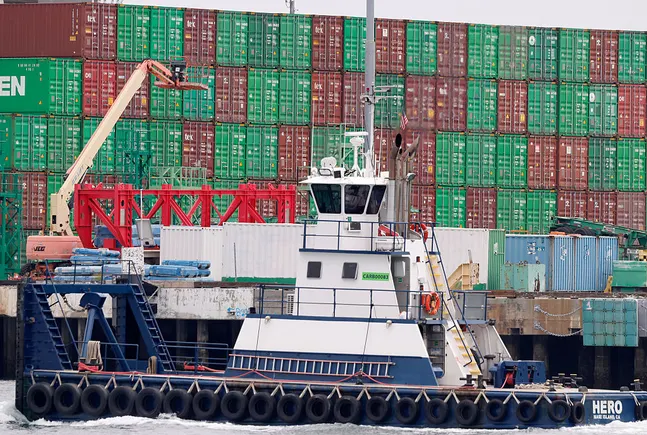
Importers should consider filing lawsuits to secure their rights to potential refunds after a trade court ruled President Donald Trump illegally imposed a temporary 10% global tariff, trade lawyers told Supply Chain Dive.
The May 7 ruling by the U.S. Court of International Trade applied to only three plaintiffs challenging Trump’s use of Section 122 of the Trade Act of 1974 to impose global levies. The federal government filed an appeal the next day, and the court this week agreed to allow the tariffs to be collected during the process.
Before the latest ruling, the court appeared to be “quietly broadcasting that the relief is limited to the named plaintiffs, and so, if you want help, you have to come and get it,” Alexander Schaefer, a partner at Crowell & Moring, said. “That’s going to mean filing complaints and asking for an injunction, getting the same relief that the plaintiffs in this case got.”
Schaefer had also predicted that the administration would likely ask the appellate court to continue collecting the tariff during the legal proceedings.
“They’ll certainly ask, and they certainly may well get it,” Schaefer said.
Nevertheless, importers should not be deterred from filing lawsuits, as there are no guarantees of success. The Supreme Court’s rejection in February of Trump’s use of the International Emergency Economic Powers Act to impose global tariffs could also work in importers’ favor in the current case, Brittney Powell, partner in the International Trade Practice Group at Fox Rothschild, said.
“We’re in a different posture here now,” Powell said. “We’ve seen now there’s a little bit of a track record of using these tools to obtain tariffs, and they’re not lawful, so the likelihood of success on the merits is very high.”
However, not all lawyers agreed that importers should file lawsuits now.
Devin Sikes, an international trade lawyer and partner at Akin Gump Strauss Hauer & Feld, said there’s a two-year statute of limitations on filing a lawsuit, so there’s no rush to file one now, especially since the ruling could be overturned on appeal.
“But, ultimately, the bottom line is that if the Court of Appeals and/or the Supreme Court agree with its [CIT] conclusion, we would likely see some sort of refund process similar to what we’re seeing with the IEEPA tariffs,” Sikes said. “But we’re quite a ways from that ultimate conclusion.”
By law, the Section 122 tariffs Trump imposed in February will expire on July 24, and the administration is expected to replace them with Section 301 tariffs under the Trade Act of 1974, which allows tariffs in response to unfair trade practices.
Despite being temporary, a significant amount of money will be collected from importers over the 150 days the Section 122 tariffs are in place.
“What a lot of importers are going to be asking themselves — asking their lawyers and brokers and so on — is what do we do to preserve our rights so that if this ultimately holds up through the appeal process, we have the ability to recoup these duties that we’ve been paying since the middle of February,” Schaefer said.
Editor’s note: This story was updated following an appeal to the U.S. Court of International Trade’s ruling.
