

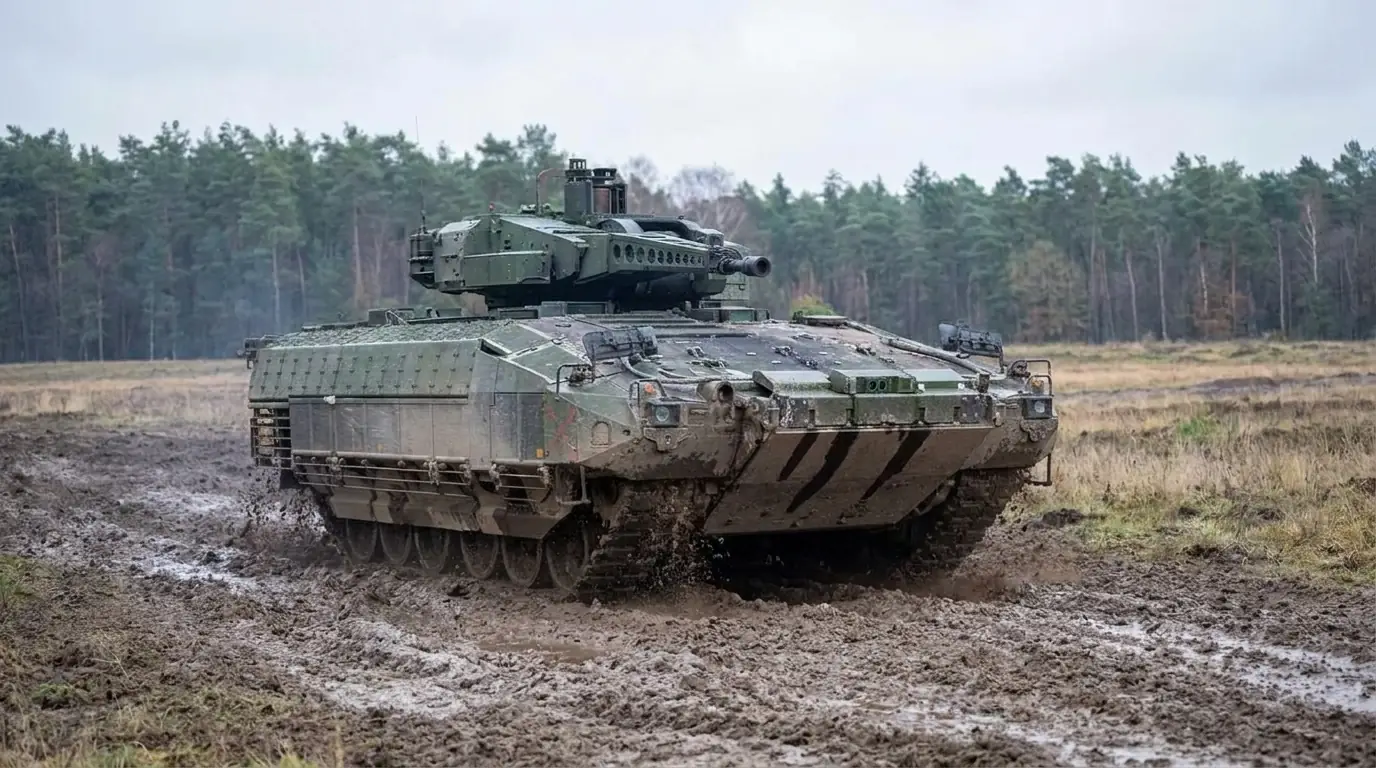
A 43-tonne infantry fighting vehicle with a 1,088-horsepower engine sounds more like a light tank than a troop carrier. Yet that’s what Germany built with the PUMA, a vehicle designed to move infantry into dangerous areas while giving them heavy fire support.
Its main weapon is a 30 mm automatic cannon. It also carries advanced sensors, modular armor, and a system designed to help protect it from incoming anti-tank threats. On paper, the PUMA has nearly everything a modern infantry fighting vehicle needs.
But raw specifications don’t tell the whole story.
The PUMA was built to protect its crew and deliver serious firepower while keeping pace with German armored units. Its thick armor and advanced electronics support that goal, but they also bring extra weight, higher costs, and demanding maintenance needs. Those trade-offs matter when a vehicle has to operate for days in the field rather than perform during a short demonstration.
So, how powerful is the German PUMA IFV? Its cannon, protection systems, and battlefield sensors make it one of Europe’s most capable infantry fighting vehicles. Whether it delivers that potential consistently depends on reliability, crew training, and the support available behind the front line.
The real test isn’t how impressive the PUMA looks on a specification sheet. It’s how well its weapons, armor, and mobility work together when the fighting starts.
What Is the German PUMA IFV?
The PUMA was built around a simple idea: German infantry shouldn’t have to choose between heavy protection and serious firepower. That’s why the vehicle combines a heavily protected hull with a powerful cannon and advanced sighting systems.
Developed by Projekt System & Management, a joint venture between KNDS Germany and Rheinmetall, the PUMA was designed to replace the aging Marder infantry fighting vehicle. It serves as the main vehicle for Germany’s armored infantry, known as Panzergrenadiere.

The difference becomes clear when you look at how the vehicle operates. The PUMA carries three crew members and six infantry soldiers. Once they reach the fighting area, those soldiers can leave through the rear ramp and fight on foot while staying in communication with their vehicle.
That arrangement matters in forests, towns, and other places where armored vehicles cannot safely move everywhere. The PUMA provides mobile fire support while its infantry deal with threats that the vehicle’s sensors or weapons might not handle alone.
Its turret is unmanned, which means the commander and gunner remain inside the armored hull rather than sitting in the turret itself. This helps the design protect the crew without giving up a powerful main weapon.
But there’s a trade-off. The PUMA is a specialized infantry support vehicle, not a tank built to lead every assault. Its job is to help infantry move, fight, and survive alongside heavier vehicles such as the Leopard 2.
That distinction explains the thinking behind the design. The PUMA doesn’t need to replace a main battle tank. It needs to make the infantry fighting beside one much harder to stop.
German PUMA IFV Specifications: How Powerful Is Its Engine?
The PUMA’s engine produces 1,088 horsepower, but its real achievement is moving a heavily armored vehicle without turning it into a slow target. That matters when German armored infantry must keep pace with tanks and change positions under fire.
The vehicle uses a diesel engine rated at 800 kilowatts, paired with a tracked drive system. Its maximum road speed is about 70 km/h, giving it enough pace to move with other mechanized units. Combat weight varies with the protection fitted, reaching roughly 43 tonnes in its heavier configuration.
Here are the main figures worth knowing.
| Specification | German PUMA IFV |
| Combat weight | Up to approximately 43 tonnes |
| Engine power | 1,088 hp (800 kW) |
| Maximum road speed | Approximately 70 km/h |
| Main gun | 30 mm MK30-2/ABM |
| Secondary weapon | 5.56 mm MG4 machine gun |
| Anti-tank missile system | MELLS, on equipped vehicles |
| Crew | 3 |
| Infantry carried | 6 |
| Length | Approximately 7.54 m |
The power-to-weight ratio helps explain its mobility. At 43 tonnes, the PUMA has roughly 25 horsepower per tonne. That’s a useful figure for a tracked fighting vehicle, although it doesn’t tell us how quickly the vehicle accelerates on soft ground or climbs a steep slope.
Those details depend on terrain, vehicle load, track condition, and the protection package fitted. A vehicle moving across firm roads faces very different demands from one crossing wet soil or broken ground.
And there’s a catch. Heavy armor improves crew protection, but it also raises the load on the engine, transmission, suspension, and tracks. More power helps offset that burden, but it can’t remove the added strain.
The PUMA’s mobility is impressive for its weight. The more telling question is how well its mechanical systems cope with long operations, where fuel use, repairs, and spare parts matter as much as top speed.
How Powerful Is the PUMA IFV’s Firepower?
The PUMA’s 30 mm cannon gives it a serious advantage over infantry armed with rifles and machine guns. It can engage light armored vehicles, enemy positions, and exposed troops without calling on a tank for every target.
Its main weapon is the MK30-2/ABM automatic cannon. The gun uses a dual-feed system, allowing the gunner to switch between two ammunition types without first emptying the belt. That matters when a lightly armored vehicle appears, followed by infantry taking cover behind a wall.

Armor-piercing ammunition is designed to penetrate suitable armored targets. Programmable airburst ammunition offers a different advantage. Instead of relying solely on a direct hit, the projectile can burst near a target, sending fragments into an exposed area. This can make it useful against infantry using cover, depending on the target and conditions.
The gun is also stabilized, so the PUMA can engage targets while moving. The German Army reports an engagement range of up to 3,000 meters under suitable conditions. That doesn’t mean every shot will hit at that distance. Visibility, target movement, ammunition, and crew skill all affect the result.
The vehicle also carries an MG4A1 5.56 mm machine gun for targets that don’t require cannon ammunition. On suitably equipped versions, a MELLS launcher provides another level of firepower through guided anti-tank missiles. The missile system can engage heavier armored threats that the 30 mm cannon may struggle to defeat.
Here’s the key distinction: the PUMA isn’t powerful because it carries one oversized gun. It’s powerful because it can use different weapons against different threats. The cannon handles many battlefield targets, while the guided missile adds an anti-armor option.
That flexibility makes the PUMA dangerous. But it doesn’t make the vehicle invincible, especially against modern tanks or threats attacking from above.
How Strong Is the PUMA IFV’s Armor and Protection?
The PUMA’s armor is a major part of what sets it apart from lighter infantry fighting vehicles. Germany designed it to protect its crew and infantry against serious battlefield threats, even when that protection adds substantial weight.
The vehicle uses modular armor, allowing its protection level to change with the mission. In its lighter configuration, the PUMA is easier to transport. Add the heavier protection package, and the vehicle gains more defense against certain threats, but its combat weight rises. That flexibility is useful because a training exercise, a long road march, and a high-threat combat mission don’t demand exactly the same setup.

Protection extends beyond the main armor plates. The hull is designed to improve crew survival against mines and explosive threats beneath the vehicle. The crew also sits inside the hull, while the unmanned turret keeps the gunner and commander from having to occupy the turret itself.
Then there’s MUSS, the PUMA’s missile warning and soft-kill protection system. It uses sensors to detect certain incoming threats and can respond with countermeasures, including infrared jamming and smoke. The goal is to interfere with an attacker’s ability to guide a missile onto the vehicle.
But soft-kill protection has limits. It doesn’t physically destroy every incoming missile, and its effectiveness depends on the threat, the attack angle, and the type of guidance system involved. A system designed to disrupt one missile may not defeat another.
The same caution applies to armor. Strong frontal protection doesn’t mean equal protection on every surface, and no IFV can shrug off every anti-tank weapon. Mines, top-attack missiles, artillery, and drones can all pose serious risks.
The PUMA’s approach makes sense: combine armor with warning systems and countermeasures rather than rely on steel alone. Its protection is sophisticated, but survival still depends on how the vehicle is deployed, supported, and used alongside infantry.
What Makes the PUMA IFV’s Technology So Advanced?
The PUMA’s biggest advantage may not be its cannon or armor. It’s how quickly the crew can spot a threat, understand what they’re seeing, and bring the right weapon onto the target.
That process begins with its sighting systems. The commander has a stabilized panoramic sight with thermal imaging, a daylight camera, and a laser rangefinder. These tools help the crew find targets in darkness and poor visibility, when relying on ordinary vision would leave them at a serious disadvantage.

The PUMA also supports a system known as hunter-killer. The commander acts as the hunter, scanning the area for threats. Once a target is found, the weapon system can be directed toward it so the gunner can engage. While that happens, the commander can continue searching for the next threat.
This matters because finding a target and hitting it are separate tasks. If the commander must wait for the gunner to finish every engagement before looking elsewhere, another threat could go unnoticed. Sharing those jobs helps the crew respond faster.
The PUMA’s digital communications also link the vehicle with its infantry and wider unit. Soldiers outside can report what they see, while the crew can share information that helps the infantry understand the situation. In wooded areas or built-up terrain, that exchange can be just as useful as another layer of armor.
Still, advanced electronics aren’t magic. Cameras can be blocked, sensors can be damaged, and smoke or weather can reduce visibility. The crew must also know how to interpret the information rather than trust every display without question.
The PUMA’s technology gives its crew better tools for making decisions under pressure. Its real value comes when trained soldiers use those tools to act faster than the enemy, not simply when the screens light up.
How Does the PUMA IFV Compare With Other Fighting Vehicles?
The PUMA is a formidable infantry fighting vehicle, but it isn’t automatically better than every rival. Its strongest features are crew protection and advanced electronics. Other vehicles offer different advantages, from a long combat record to varied weapon options and simpler designs.

The M2 Bradley is the most useful comparison for American readers. It uses a 25 mm automatic cannon and carries TOW anti-tank missiles on many versions. The PUMA’s 30 mm gun offers a larger caliber, but caliber alone doesn’t decide which vehicle performs better. Ammunition, fire control, target type, crew training, and battlefield conditions all affect the outcome.
The Bradley also has decades of operational experience behind it. The PUMA has a more modern design, but a newer vehicle doesn’t automatically have a better record in every combat role.
The Swedish CV90 is another close rival. It comes in several versions with different weapons and protection packages, making it adaptable to different army needs. Some versions carry 30 mm or 35 mm cannons, while others use larger guns. Comparing a PUMA with a CV90 therefore requires naming the exact variant, not treating the CV90 as one fixed design.
The Russian BMP-3 takes a different approach. Alongside its 30 mm cannon, it carries a 100 mm gun that can fire conventional rounds and guided missiles. That gives it a distinctive mix of firepower, though its design makes different trade-offs in protection and troop space.
Is the German PUMA IFV Effective in Modern Warfare?
The PUMA has the weapons and protection to perform well in modern combat, but its biggest weakness has been getting all that technology to work reliably in the field. That’s the difference between a powerful vehicle and one an army can depend on every day.

Germany learned this lesson during the PUMA’s readiness tests. In 2020, serious faults affected the vehicle’s turret, communications, and sighting systems. These problems were significant enough to prevent approval for a planned NATO rapid-response role. The Army later reported improvements to the upgraded VJTF version, including more reliable sights, better communications, and changes to the weapon system.
The newer S1 configuration builds on those upgrades. In 2024, the Bundeswehr began testing this version to assess its combat performance and the strength of its supply and repair systems. That focus matters. A vehicle can have excellent armor and weapons yet still fall short if mechanics struggle to diagnose faults or replacement parts arrive too slowly.
Modern battlefields bring another challenge. Drones can spot vehicles from above, while mines and anti-tank weapons threaten them from several angles. The PUMA’s armor and warning systems help, but they cannot remove those risks. Crews still need infantry support, careful movement, and protection from enemy surveillance.
The vehicle also carries fewer infantry soldiers than some older designs. Its six-person troop compartment reflects a choice to prioritize protection and advanced systems over carrying a larger squad.
So, is the PUMA powerful? Absolutely. Its cannon, guided missiles on equipped versions, and advanced sensors make it a serious fighting vehicle. But its true value depends on whether Germany can keep enough upgraded vehicles ready for combat.
When judging the PUMA, look beyond horsepower and armor thickness. The best measure is how reliably a fully equipped unit can fight, communicate, repair its vehicles, and return to action.
