

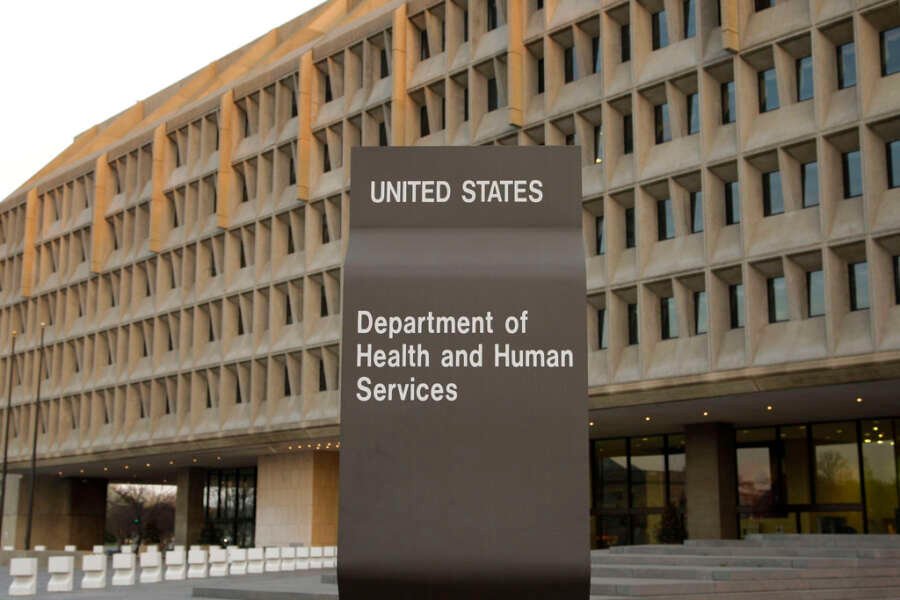
Last year, HHS repealed all existing accommodations that included telework in order to comply with the Trump administration’s return-to-office mandate.
The Department of Health and Human Services is looking to temporarily reassign mid-career and senior staff to chip away at a monthslong backlog of reasonable accommodation requests submitted by employees with disabilities.
HHS faces a departmentwide backlog of more than 9,000 reasonable accommodation requests, Federal News Network first reported earlier this month.
Typically, staff at its component agencies would review these requests, but HHS centralized this work as part of a new policy it implemented last year. Under this new policy, all reasonable accommodation requests require the approval of an HHS official at the assistant secretary level or above.
Last year, HHS repealed all existing accommodations that included telework, in order to comply with the Trump administration’s return-to-office mandate for federal employees.
In an email obtained by Federal News Network, HHS is requesting nominations for GS-12 and GS-13 employees to serve on 90-day or 120-day detail assignments to process the backlog of reasonable accommodation requests.
“HHS is seeking support from operating divisions as part of our ongoing effort to improve and streamline the HHS reasonable accommodations program,” the email from the HHS Enterprise Management and Programs Office states. HHS component agencies have until Wednesday to nominate employees for these temporary details.
According to the email, employees must get approval from their supervisors and executive officers. They must also hold a moderate-risk public trust suitability determination.
“Selected detailees will receive training to ensure they meet all qualifications and are equipped with the necessary skills to effectively perform assigned duties,” the HHS email states.
Employees at the Centers for Disease Control and Prevention account for a third of the backlog.
Earlier this month, the CDC eased some restrictions on medical telework, although telework remains a last resort to accommodate an employee’s disability or medical needs.
CDC supervisors have regained authority to grant telework as an interim accommodation, while employees wait for their reasonable accommodation request to be reviewed by HHS leadership.
HHS expected it would take about six to nine months to clear the CDC’s backlog of 3,000 reasonable accommodation requests. It’s not yet clear how long it will take to clear the entire backlog of 9,000 cases. HHS did not respond to requests for comment.
Linnet Griffiths, a former senior advisor to CDC’s chief operating officer and equal employment opportunity director at CDC and HHS, who left the agency in April 2025, told Federal News Network that the agency had a robust system for processing reasonable accommodations, but said many employees who carried out this work were targeted by reductions in force.
“That is a tremendous amount of work for a staff that was already stretched and very limited and already had a backlog,” Griffiths said.
Griffiths said that reasonable accommodation requests often took months to get approved during her tenure at CDC, but said the agency granted full-time telework as an interim accommodation, when deemed necessary by an employee’s doctor.
“For that amount of backlog, it would take a year or more to effectively and accurately process this level of request. I don’t know how they are going to manage that,” she said.
Jodi Hershey, a former FEMA reasonable accommodation specialist and the founder of EASE, LLC, a firm that helps employers and employees navigate workplace accessibility issues, said it was a “positive and overdue move” for the CDC to restore telework as an interim accommodation option for employees, and that those interim measures are meant for situations like this, “when long delays cause real harm.”
“What I see every day is that when agencies rush accommodation decisions or rely on assumptions instead of individualized assessments, everyone loses. Taking the time to understand an employee’s functional limitations and whether a proposed alternative truly allows them to perform essential duties benefits both the employee and the agency and reduces risk over the long term,” Hershey said.
If you would like to contact this reporter about recent changes in the federal government, please email jheckman@federalnewsnetwork.com, or reach out on Signal at jheckman.29
Copyright
© 2026 Federal News Network. All rights reserved. This website is not intended for users located within the European Economic Area.
