


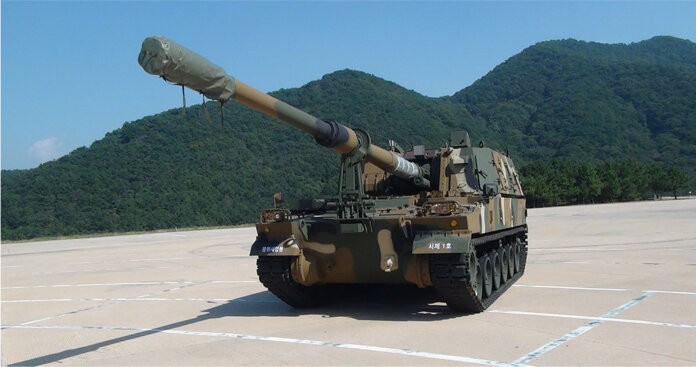
The Spanish Army’s modernisation of its tracked self-propelled artillery will be provided by a South Korean-developed system.
On 24 March 2026, Spain’s Indra Group and South Korea’s Hanwha Aerospace executed a binding agreement to jointly develop and manufacture new tracked self-propelled artillery systems based on Hanwha’s K9 artillery system, which integrates Spanish technologies. The programme will deliver 128 tracked 155mm self-propelled howitzers, 120 tracked forward ammunition resupply vehicles, 11 command-and-control vehicles, and 21 recovery vehicles. It has a budget of €4.55 billion (US$5.3 billion). The K9s will replace the US-designed M109A5E with L39 calibre cannon, which is outclassed facing modern artillery threats.
According to the joint announcement, vehicles will utilise the K9’s tracked chassis, which will be manufactured in Spain. Indra will supply and integrate various mission support systems, battlefield management systems, communications, and situational awareness. It will also be responsible for the design of the command vehicle and the integration of selected vehicle subsystems. Spain will assume design, production, and lifecycle support responsibilities for the systems. This approach is similar to other NATO army K9 fieldings in Norway, Poland, Finland, Romania, and Estonia.

The Indra-Hanwha agreement also includes an investment of €130 million (€150 million) to support upgrades to Indra’s manufacturing facility in Gijón and the establishment of an additional integration facility. These will support the development, evaluation, production, and fielding support of the K9 systems.
The introduction of the K9 Thunder 155mm/52 calibre self-propelled howitzer, together with its accompanying mobile ammunition resupply vehicle, will greatly enhance the capabilities of the Spanish Forces. It offers a range of thirty kilometres with standard ammunition and forty kilometres with rocket-assisted rounds. Moreover, the digitally integrated networked fire controls, onboard navigation, automated loading, and rapid resupply enable more responsive and survivable fire support. Its ability to move, halt, and fire accurately in under 60 seconds, as well as to fully replenish its 48-round magazine from the resupply vehicle in less than 18 minutes, provides valuable tactical advantages.
Modernising the Spanish Armed Forces is a priority for its government. A key element of these investments is supporting domestic defence capabilities, as demonstrated by the K9 project. Spain’s artillery update has received special attention. In addition to the recently announced tracked howitzer programme, Spain has also budgeted €2.9 billion for wheeled self-propelled artillery. This programme has recently been outlined with several potential solutions suggested by industry teams.
by Stephen W. Miller
