

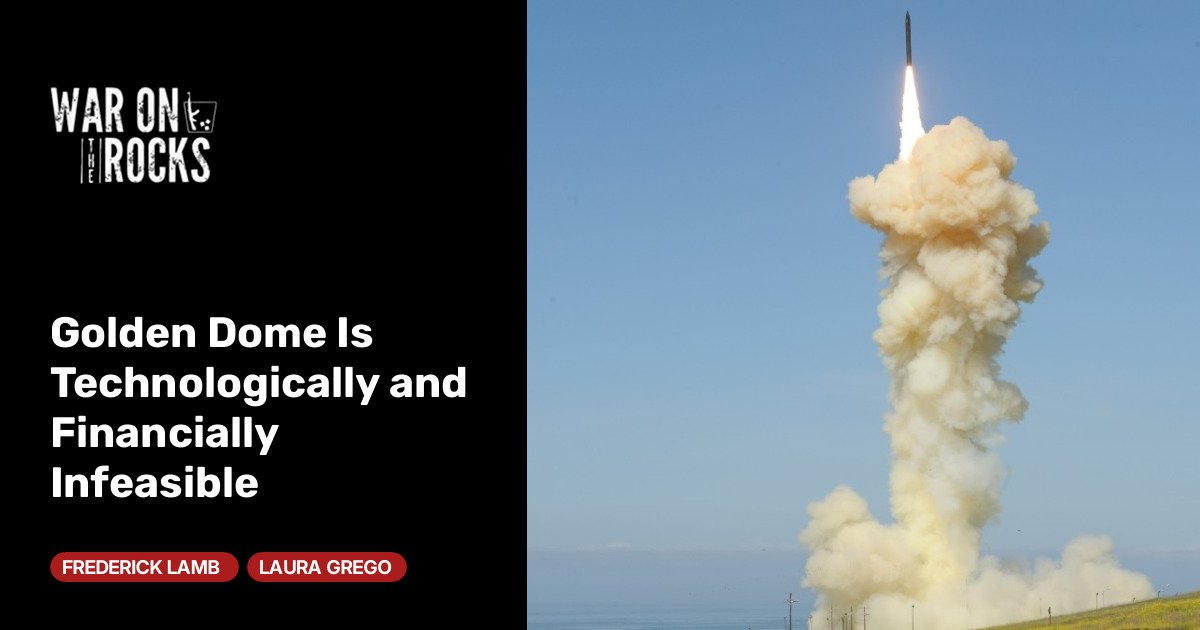
For as long as nuclear-armed, intercontinental ballistic missiles and submarine-launched ballistic missiles have existed, strategists and engineers have pursued a seductive idea: a shield effective enough to diminish — or even block — a ballistic missile attack. The appeal is obvious. A state that could reliably intercept ballistic missiles could protect its cities from these terrifying weapons and reduce its adversaries’ leverage.
But defenses against strategic ballistic missiles have a long history of disappointments. Over roughly seven decades, the United States has spent more than $500 billion (in 2025 dollars) on missile defenses, much of it to defend against intercontinental ballistic missiles. And yet, the ability of any of these systems to intercept even a single missile or warhead under the conditions expected during a nuclear attack has not been demonstrated.
Most recently, the Trump administration has proposed “Golden Dome” — an ambitious proposal for a comprehensive, layered defense with ground, sea, and space-based elements. It is supposed to protect the United States and its allies and deployed forces not only against attacks by ballistic missiles, but also by cruise missiles, hypersonic boost-glide vehicles, aircraft, and drones launched at any time from anywhere by any adversary, including peer adversaries.
There is no prospect of deploying a missile defense system capable of successfully defending against a major ballistic missile attack by Russia and China for the foreseeable future. Such a system would have to be able to destroy hundreds or thousands of nuclear-armed long-range ballistic missiles or their warheads in the face of sophisticated countermeasures, dozens of decoys, and salvo tactics, as well as new delivery systems specifically designed to defeat it.
Because such a defense is technologically and financially infeasible, some experts have instead advocated deploying systems to defend the United States against a smaller attack. Examples include a full-scale attack by an emerging ballistic missile state such as North Korea, a purely accidental launch or an unauthorized attack by missiles from North Korea, Russia, or China, a limited raid intended to coerce the United States, or a ragged retaliation. Such systems would be much smaller and less capable than the system proposed in the Golden Dome executive order.
The size of a smaller attack would depend on its purpose. North Korea may soon be able to launch an attack with 20 intercontinental ballistic missiles having multiple warheads, accompanied by sophisticated countermeasures. An unauthorized attack by a Russian submarine could launch 16 ballistic missiles carrying about 100 warheads, and a limited coercive strike by Russia or China could have a dozen ballistic missiles carrying 60 warheads. A single missile launched accidentally by Russia, China, or North Korea could carry five to 10 warheads. Defending against such attacks could require disabling or destroying a dozen or more ballistic missiles and tens of warheads accompanied by sophisticated countermeasures.
Although details of the Golden Dome are still unclear and largely secret more than a year after it was announced, its leaders have now said it will focus first on defending against a strike by nuclear-armed long-range ballistic missiles on United States leaders or a strike by an emerging ballistic missile state against its territory. We focus here on these goals.
Even with planned improvements, the current ground-based midcourse defense system is not expected to provide a robust or reliable defense against more than a small number of ballistic missiles equipped with simple countermeasures for the next 15 years. Other U.S. land- and sea-based missile defense systems were not designed to defend against nuclear-armed intercontinental ballistic missiles, and it is unclear when if ever they could work against even a small number of them.
Space-based boost-phase interceptors would not make up for these deficiencies. Instead, they would add a hugely expensive, complex, ineffective, and destabilizing layer to the system. Because it is likely to provoke responses that increase the danger to the United States, the space-based interceptor program should be canceled now.
Rather than spending billions of dollars on terrestrial strategic missile defense layers that have little chance of protecting against even a limited attack by long-range ballistic missiles, let alone the hundreds or thousands of missiles and even more warheads in a large-scale attack, the United States should instead focus its resources and attention on reducing the threat of nuclear weapons using risk reduction strategies and arms control agreements. Difficult as such agreements are to negotiate, they have been the only historically successful approach to reducing the nuclear threat to the United States.
Sign Up for Our Newsletter
The Fundamental Problems
A successful strategic missile defense would have to disable or destroy attacking missiles or warheads during one or more of the three phases of flight. During a missile’s boost phase, its rocket motor is burning, it is accelerating, and its warheads have not yet been deployed. This phase lasts for less than three minutes for modern, solid-propellant ballistic missiles. The midcourse phase begins once the missile’s warheads have been deployed. A missile could deploy its warheads and countermeasures, such as decoy warheads, within seconds. These then travel together through space on ballistic trajectories for 30 to 45 minutes. The terminal phase begins when warheads start to re-enter the atmosphere and lasts about 30 seconds.
Each of these phases poses a different challenge for missile defense. Boost-phase defense is a race against time and distance. Midcourse defense is a battle to discriminate warheads from decoys and overcome other countermeasures. Terminal defenses face very short engagement times and can at best defend only small areas.
Existing terminal missile defense systems, such as the Terminal High Altitude Area Defense, were not designed to defend against intercontinental-range ballistic missiles, are too slow to engage them except near their target, and could be defeated by penetration aids. The war in the Middle East has shown that even firing several of these exquisite interceptors at each medium-range ballistic missile does not ensure interception.
These expensive systems would not be able to successfully defend the United States against a limited attack by nuclear-armed strategic missiles. They would have to be significantly upgraded even to be tested in such a role, an effort that would take a decade or more. Developing cheaper and more capable new systems would take even longer, if it is even possible. Scores of such systems would be required to attempt to defend only selected leadership and command and control sites, strategic infrastructure, and population centers against even a limited attack.
The Aegis Standard Missile 3 Block IIA midcourse-intercept system was designed for regional defense against medium- and intermediate-range missiles, not defense of the United States against nuclear-armed strategic missiles. Its 2020 intercontinental ballistic missile-class intercept was a scripted developmental demonstration against a simple target under favorable conditions, not an operationally realistic test against long-range, nuclear-armed missiles using decoys, penetration aids, multiple warheads, salvo launches, or modern intercontinental missile trajectories. To defend the United States against even limited intercontinental ballistic missile attacks, this system would have to be significantly upgraded and tested, which would take a decade or more. Even then, it would face the still unsolved technical challenge of discriminating decoys from warheads.
The small number of tests of the Ground-based Midcourse Defense system have been scripted and designed for success, and have not considered realistic attacks with multiple warheads, sophisticated decoys and other countermeasures, or attacks on the system’s sensors. This system has yet to demonstrate a solution to the technical challenge of discriminating decoys from warheads. Even in the absence of complex countermeasures, the current system is assessed to have only some capability against a very limited attack.
To reduce costs, Space Force General Michael Guetlein, who leads Golden Dome, has advocated building directed-energy weapons. But developing and deploying directed-energy weapons with the power, beam focusing, tracking, dwell time, and durability required for a weapon that would be useful against intercontinental-range ballistic missiles or nuclear warheads would take decades, if such weapons are feasible.
Boost-Phase Intercept and the Tyranny of Time
The unsolved deficiencies of existing midcourse and terminal defense systems appear to be the main motivations for including space-based interceptors in the Golden Dome proposal. Space-based boost-phase defense has been abandoned many times because of insurmountable challenges. But space-based interceptors have now entered prototype development, and are slated for flight demonstrations in 2027 and integration into the Golden Dome architecture by 2028. Contracts worth up to $3.2 billion that mandate on-orbit tests by 2028 have been awarded to 12 firms. The program has identified a need for interceptors that would attack missiles during their boost phase, would disable or destroy warheads during their midcourse phase, or attack hypersonic-glide vehicles within the atmosphere.
With midcourse discrimination unsolved and no effective terminal strategic defenses in existence, boost-phase defense is often presented as a better way to prevent the warheads of long-range ballistic missiles from striking their targets, because the booster is relatively large and its exhaust plume is bright and easy to see. Hit the missile early, the argument goes, and you might be able to prevent its warheads and decoys from ever being deployed. But intercepting a missile during its boost phase is not easy.
The technology required to home on and collide with a cold missile body near or inside a bright exhaust plume has not yet been demonstrated. In addition, the attacker can employ decoy rockets and other countermeasures to confuse or overwhelm attempts at boost-phase intercept.
But the most challenging aspect of boost-phase defense is the very short time available for intercept. Everything the boost-phase defense must do — detect the launch of a missile, compute its initial trajectory, decide whether it is a threat, and if it is, fire interceptors that are fast enough to reach and collide with the accelerating and maneuvering missile — all this must happen before the attacking missile’s motor shuts down. The resulting time pressure is extreme.
The full burn times of most modern intercontinental ballistic missiles and submarine-launched ballistic missiles are already short, typically three minutes or less. They can be made even shorter, and the missiles don’t need to use their full burn times to deliver their warheads to many targets in the United States. Furthermore, new missiles are being designed with even shorter full burn times.
The full burn time of North Korea’s Hwasong-18 intercontinental ballistic missile is about 170 seconds, but it would only need to burn for about 158 seconds for its warhead to strike Seattle and only about 137 seconds to strike Fairbanks. Russia’s RS-24 Yars intercontinental ballistic missile would need to burn for only about 150 seconds to strike Seattle or Boston from the closest Russian missile garrisons or silo fields and only about 145 seconds to strike Fairbanks. (We follow the 2003 American Physical Society, 2012 National Research Council, and 2025 American Physical Society reports in using their solid-propellant intercontinental ballistic missile computer model S1 to estimate burn times.)
A modern solid-propellant ballistic missile cannot be reliably detected by infrared space sensors until it rises above any clouds over the launch site, which typically takes about 30 seconds. Computing its trajectory with sufficient accuracy to generate an interceptor firing solution takes another 15 seconds or so. To gather the information needed to decide whether to fire interceptors — in particular determining whether the missile is a short- or medium-range ballistic missile or space launch vehicle, or an intercontinental ballistic missile or submarine-launched ballistic missile on an attack (not a test) trajectory — takes a further 30 seconds or more. Only then — at least 75 seconds after launch — can the defender confidently fire interceptors. For the examples just given, the interceptors would have only 45 to 75 seconds to fly out and strike the accelerating and maneuvering missile before it deploys its warheads. The decision time would be only a few tens of seconds, increasing the risk of serious mistakes in a crisis and accidental escalation to nuclear war.
But the time constraint is likely to be even more brutal. Even today, a submarine-launched ballistic missile launched from Arctic, Atlantic, or Pacific waters could strike an American city after burning for only about 100 seconds. And Russia is reportedly developing a “Yars-M” variant that deploys multiple “reentry” vehicles, each with its own rocket motor and guidance. These would separate from the second stage only about 100 seconds after launch. A boost-phase defense would have to intercept the missile before then or face a more challenging “many targets” problem. In these situations, interceptors would have only 25 seconds to reach the missile, a practical impossibility.
Adversaries could deploy fast-burn ballistic missiles with even shorter full-burn times to defeat the system. The 2012 National Research Council report used a burn time of 150 seconds for reference. The 2003 American Physical Society study constructed an intercontinental ballistic missile model (its solid-propellant missile S3) having a full burn time of only 130 seconds. And a 1985 Office of Technology Assessment report found that an MX-sized intercontinental ballistic missile could be designed to burn out in less than 60 seconds, and described a design with a full burn time of 50 seconds. It would not require new technology to substantially shorten the burn time.
Building a boost-phase defense would create a strong incentive for U.S. adversaries to deploy “fast burn” ballistic missiles, launch them from closer to U.S. cities, fly them on faster, depressed trajectories, and design them to be harder to intercept. Assuming they will not do this would be a classic example of “the fallacy of the last move.”
Space-Based Intercept Would Require Enormous Numbers of Interceptors
How can a boost-phase defense have any chance of reaching attacking ballistic missiles within such short interception windows? It is only possible if the system’s interceptors are based very close to the boost-phase trajectories of the missiles they will seek to defend against, which requires basing them in space.
However, there is a fundamental problem with basing interceptors in space: they are almost never where you need them to be. The reason is that to remain in space, space-based interceptors must orbit Earth, and Earth rotates underneath their orbits. When a threatening missile is launched, most interceptors are too far from the attacking missile’s boost-phase trajectory to reach the missile before it deploys its warhead(s). This is the “absentee” problem, and it’s why huge constellations of space-based interceptors are needed even to counter a limited attack.
How huge? Well, calculations using the well-verified analytical framework developed by the 2003 American Physical Society study (which was also used by the 2012 National Research Council study, the 2025 American Physical Society study, and Wright 2026) indicate tens of thousands: Defending the lower 48 states against just four solid-propellant intercontinental ballistic missiles launched within about 200 seconds from the same area of North Korea, or from the same missile garrison or silo field in northern Russia (and preventing spoofing of the defensive system), would require a constellation of about 24,000 space-based interceptors with 5g accelerations and burnout speeds of five kilometers per second. This assumes only one interceptor is assigned to each attacking missile, and that no attempt is made to defend cities in Alaska.
Russia has practiced launching its submarine-launched ballistic missiles in salvos since 1991, when it launched 16 only a few seconds apart from a submerged submarine. It has continued to practice two- and four-missile salvos. To defend the lower 48 states against a salvo of even 10 such missiles would require a constellation of at least 60,000 such space-based interceptors.
A reliable, resilient space-based system would require many more interceptors. Failing to intercept even a single inbound missile would be a catastrophe. Expecting interceptors to work perfectly after being exposed to the harsh environment of space for several years without servicing would invite failure. In the recent conflict with Iran, Israel and the United States have typically fired two to five highly capable interceptor missiles at every incoming Iranian missile, even though the Iranian missiles are much less capable than intercontinental or submarine-launched ballistic missiles. Similarly, Ukraine typically fired two to four highly capable interceptor missiles at every incoming Russian missile until its supply of interceptors ran low. Ukraine then began firing only one, which led to many attacking missiles getting through to their targets. Increasing the probability of success by firing three space-based interceptors at each target missile in the previous example would require 180,000 space-based interceptors.
Increasing the acceleration and speed of the interceptors in the constellation could in principle greatly reduce the number required, but at great cost. Extremely high-acceleration 10 kilometers per second interceptors, for example, would each be tens of times more massive, with a corresponding increase in cost. And the consequences of a failure or an attack on such a system — which would have a much smaller number of much higher-value interceptors — would be far more serious. With many fewer interceptors, clusters, or garages, each loss would degrade the system faster and give the attacker a larger window to launch its ballistic missiles without risk of intercept.
A recent Congressional Budget Office report estimated the expected cost of the strategic missile defense component of a Golden Dome system at about $1.2 trillion. Despite requests, the Department of Defense did not provide information about its planned Golden Dome architecture. The budget office, therefore assessed the costs of a much more limited system that could be multiplied to approximately estimate Golden Dome’s full cost. The costs listed in the report are accordingly vastly smaller than likely for a system like Golden Dome.
The report also dramatically underestimated the number of system elements that would be required for the modules to be effective. For example, it estimated that 7,800 space-based interceptors would be needed to defend against one salvo of 10 missiles, assigning two interceptors to each attacking missile, but the report did not state its other assumptions. One can arrive at such a small number only by making very unrealistic assumptions: for example, that the interceptors are fired with zero decision time and have very high accelerations and terminal velocities, and that the attacking missiles use only very old technology. But firing interceptors with zero decision time would make the system vulnerable to spoofing and mistakes. Using interceptors with very high accelerations and terminal velocities would make them heavy and expensive, and the system more vulnerable to attack. And assuming attacking missiles use only very old technology is unrealistic.
These facts make clear that creating a robust, space-based system that is only capable of defending the United States in principle against a very limited attack would cost trillions of dollars over 20 years. A comprehensive defense would cost much, much more.
How Countermeasures Can Make a Boost-Phase Defense Fail
Given the stakes, an adversary has every incentive to design attacks and deploy technologies to confuse, overwhelm, or otherwise defeat the defensive system of its opponent.
Launching a salvo of ballistic missiles to overwhelm the defense is one such tactic. An adversary could also overwhelm the defense with an intercontinental ballistic missile that has only two stages that burn out quickly and then deploys many reentry vehicles, each with its own motor and guidance system, a missile like the “Yars-M” missile Russia is already developing. Or it could launch a salvo of smaller, less expensive missiles to trick the defense and exhaust its supply of interceptors; fire rocket-propelled decoys, flares, and jammers during the flight of the missile’s upper stages to confuse the defense and deplete its interceptors; have upper stages execute evasive maneuvers while at the same time releasing decoys; and deploy reentry vehicles before the final stage burns out. These measures would push requirements beyond those calculated above, and any boost-phase defense program would need a credible plan to deal with them.
An adversary could also attack the defensive system and its sensors directly, using anti-satellite weapons. Even successfully intercepting a direct-ascent anti-satellite weapon would cost the system an interceptor. Alternatively, an adversary could explode nuclear weapons in space or salvage fuze their reentry vehicles so they detonate when an interceptor strikes them. This would damage the defensive system’s sensors and electronics or overwhelm or confuse them, making it difficult or impossible for the system to home on other targets.
Conclusion
There is no prospect of deploying a missile defense system within the next 15 years that could reliably protect against even a limited but effective raid intended to coerce the United States, let alone a substantial attack by an emerging ballistic missile state such as North Korea or a major attack by Russia or China.
Current ground-based systems struggle against even relatively small and unsophisticated missile threats. Increasing the number of interceptors (or kill vehicles) to attempt to address more sophisticated missile threats, including more sophisticated countermeasures, would be costly and unlikely to stay ahead of the offensive capability. Space-based interceptors will not solve this problem, given their extremely unfavorable cost-exchange ratio and the many straightforward countermeasures an adversary could use. The conclusion of the 2012 National Research Council study that the United States should not invest any more money or resources in systems for boost-phase missile defense remains valid.
We therefore recommend that the proposed space-based interceptor program be canceled. We also assess that midcourse intercept is and will remain ineffective against limited but sophisticated missile attacks. The United States should shift resources and attention to diplomatic efforts to reduce the nuclear threat, the only approach that has been successful in the past.
Write for Cogs of War
Frederick Lamb is the Brand and Monica Fortner Chair of Theoretical Astrophysics Emeritus and a core faculty member in the Program in Arms Control and Domestic & International Security at the University of Illinois. He co-chaired the American Physical Society’s 2003 study of boost-phase missile defense and chaired its 2025 study of strategic ballistic missile defense. He is a member of the American Academy of Arts and Sciences and a fellow of the American Physical Society.
Laura Grego, Ph.D., is a senior scientist and the research director in the Global Security Program at the Union of Concerned Scientists. She is a fellow of the American Physical Society, co-chaired its 2025 study of strategic ballistic missile defense, and was awarded its Leo Szilard Lectureship Award in 2023.
Image: Lisa Simunaci via DVIDS.
