

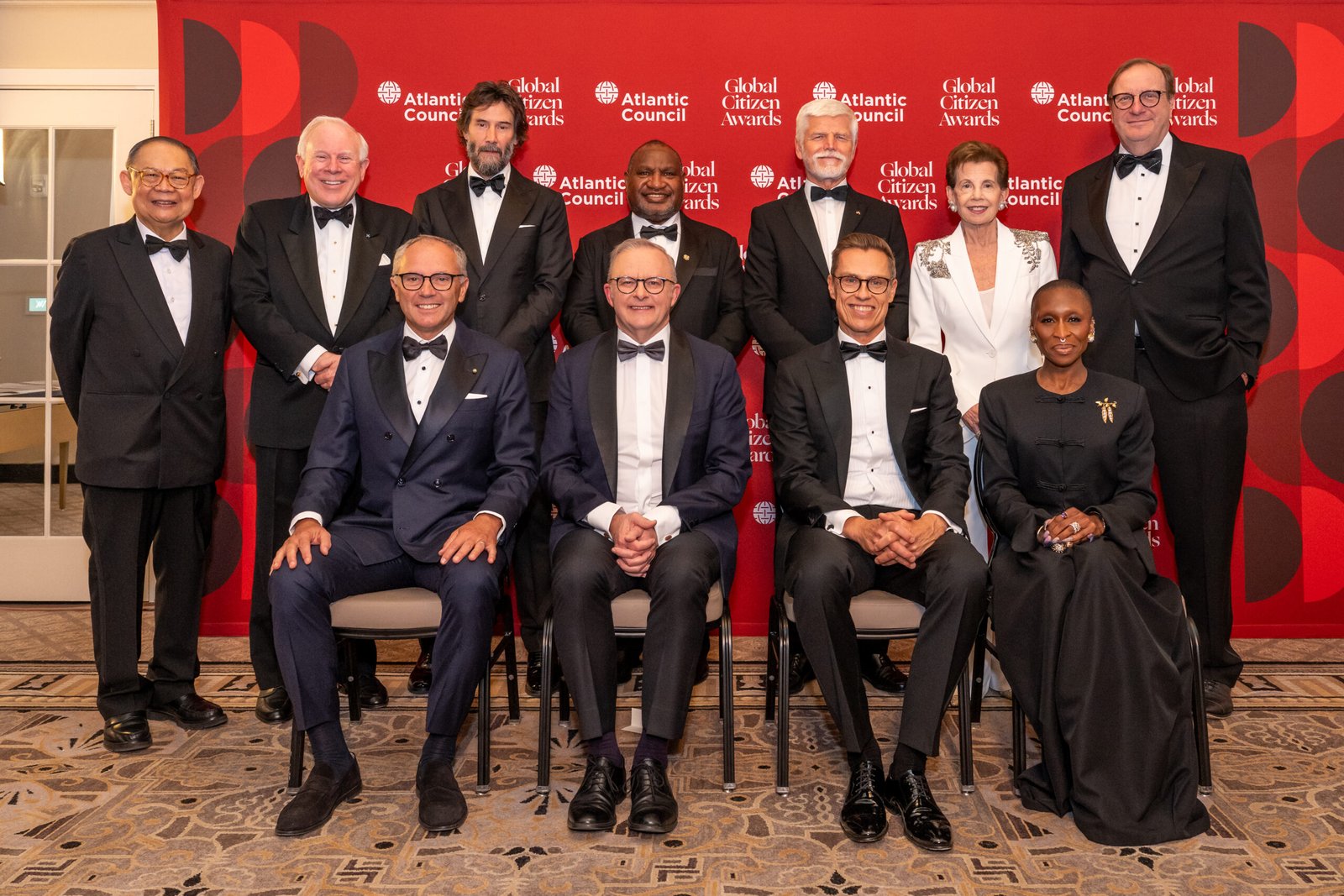
Watch the event
Event transcript
Uncorrected transcript: Check against delivery
JOHN F.W. ROGERS: Good evening. Your Excellency, distinguished guests, ladies and gentlemen, and friends of the Atlantic Council, let me begin tonight by thanking all of my fellow board members, our International Advisory Board, and we are very happy to have all of our co-chairs here, who’s without support this dinner wouldn’t be possible. So thank you.
One year ago, we came together, and that I said that we stood at a critical juncture in history. And I said that we could no longer afford complacency. Tonight I want to take that argument just one step further. What we are experiencing today is not simply another period—another period of geopolitical turbulence. The deeper change is that the international system that has shaped much of our lives has been transformed. The institutions that created after the Second World War, they were built around a particular distribution of power. The decades that followed brought unprecedented economic integration. And after the Cold War, there was a period in which many believed that globalization, democracy, and open markets would continue to expand together.
I thought that. But that assumption is no longer sufficient. Power is becoming more distributed. China has become a central economic and strategic power. India and other emerging countries are demanding greater influence. Middle powers are pursuing greater strategic autonomy. And countries that once felt compelled to choose between competing blocs increasingly want the freedom to work with different partners on different issues. This is not a return to the Cold War. It is something much more complicated. It’s a world, there are multiple centers of power, overlapping alliances, and shifting partnerships. A world in which countries cooperate in one arena and they compete in another. A world in which economic relationships are increasingly shaped by national security, and technology has become an instrument of geopolitical power.
Some analysts describe this as multipolarity. Others speak of fragmentation, strategic autonomy, or multi-alignment. Whatever language we use, the underlying reality is the same. The old rules no longer command the same authority, while the new rules have yet to be fully established. We are living in between world orders. And that is the defining challenge of our time. It creates uncertainty, but it also creates responsibility. Because when an old system is weakening and a new one is emerging, leadership is not simply about defending what has existed. It is about deciding what is worth carrying forward and what must change. There is a reason for confidence, however, because our alliances have not disappeared. They have adapted.
Across the Atlantic, nations are investing more seriously in their common defense. The recognition that security is not something that can simply be outsourced, that peace requires strength, preparedness, and burden sharing is becoming even more concrete.
Diplomacy has not disappeared either. In Ukraine, despite the continuing violence and the enormous distance still to travel, efforts move towards negotiations. They remain important. Because even when peace has not yet been achieved, the willingness to pursue itself is in itself an act of leadership.
And in the Middle East, ceasefire efforts have demonstrated that, again, diplomacy can change human reality on the ground. But they have also demonstrated something equally important—a ceasefire is not the same thing as peace.
Peace requires more than the absence of fighting. It requires security, it requires institution, it requires reconstruction, and a credible future for the people who have endured the conflict.
So we should recognize progress without confusing progress with resolution, and we should understand that the challenge before us is larger than any single conflict. The question is what kind of international system can function in a world where power is more widely distributed, interests are more concentrated and contested, and trust is more difficult to sustain, and I believe that begins in accepting several realities.
The first reality is that power still matters. For too long, parts of the international community operated on the assumption that economic interdependence would steadily reduce the importance of hard power.
We now know that the assumption was incomplete. Military capability matters, but other things matter. Energy security matters. Cybersecurity matters. Supply chains matter. Control over critical technologies matter. The ability to withstand economic coercion matters.
National resilience is no longer simply an economic concept. It’s a strategic one. But strength has a purpose. The purpose of strength is not domination; it is preserve the conditions in which nations and individuals can live freely and securely.
The strongest nations should, therefore, also be among the strongest advocates for preventing war, not because they are incapable of conflict but because they understand its consequences.
The second reality is that sovereignty and interdependence are no longer opposites. Every nation has the right and responsibility to pursue its own interests. But no serious country can secure those interests entirely by itself.
Capital crosses borders. Viruses cross borders. Cyberattacks cross borders. Energy markets cross borders. And artificial intelligence cross borders and climate and migration cross borders and, increasingly, the consequences of war cross borders.
The answer is not to abandon sovereignty. It is to redefine what effective sovereignty means. A country is more sovereign when it has resilient institution, diversified sources of energy and critical goods, strong alliances, productive businesses, and the ability to act when circumstances demand it.
Partnership is that sense, is not a surrender of sovereignty. It can be an instrument of sovereignty, and that is particularly important as globalization changes. For decades, the dominant assumption was that greater economic integration was almost always beneficial.
And today governments are asking different questions, not simply what is most efficient but what happens if we can no longer rely on it. That does not mean abandoning trade or globalization. It means making globalization more resilient.
Open markets remain important. Competition remains important. Investment remains important. But critical dependencies need to be understood and, in some cases, reduced.
The third reality is that technology has become part of the structure of power itself. Artificial intelligence may transform productivity, medicine, science, education, on a scale that we have only beginning to understand.
But technology is no longer simply a tool that sits outside of geopolitics, because semiconductors and data and cloud computing, telecommunication and artificial intelligence, they’re strategic assets. Technology is shaping not only what economies can produce, but what governments can see, and what militaries can do, and what citizens believe, and how societies organize themselves. That creates a profound question of accountability. And when an algorithm influences what we see, what we believe, what we buy, how we work, and eventually how we make decisions, who is responsible?
And the answer can be, nobody. We should neither fear technology, nor worship it. We should govern it. And that means protecting innovation while preserving human agency. It means encouraging competition, while addressing concentration. And it means allowing technology to expand human possibility would allow—without allowing technology to become substitute for human judgment.
And the fourth reality is this, perhaps the most important, no international order can survive without legitimacy. This is true within countries, and it is true between them. Democracy cannot survive on nostalgia. People do not defend institutions simply because they are told those institutions matter. They defend them when those institutions work, when government is capable, when opportunity is real, and when the law applies fairly, and when people believe their children can have a better future.
The same principle applies internationally. An international system cannot sustain indefinitely if large parts of the world believe that its rules were written for an earlier distribution of power and no longer are responsive to today’s realities. That does not mean that every criticism of the existing system is justified. It does not. It does mean that institutions need the capacity to adapt, because if citizens lose faith in democratic institutions at the home level it becomes much harder for democratic countries to defend those institutions abroad.
Legitimacy, therefore, cannot be assumed. It has to be earned. And that is why the future of the international system will not be determined only by military power or economic size. It will be also determined by whether countries can build institutions that people believe are fair, effective, and worth defending. This is where the role of business becomes especially important. The private sector is no longer separate from geopolitics. Companies make decisions about where to invest, where to build, what technologies to develop, which supply chains to rely upon, and how to manage data. And those decisions increasingly have strategic consequences.
Business leaders therefore have a responsibility that extends beyond quarterly performance. That does not mean turning every company into a foreign policy institution. You can stay with the Atlantic Council. It means recognizing the environment in which business now operates. Resilience is a business issue. Trust is a business issue. Cybersecurity is a business issue. Technology governance is a business issue. And increasingly, geopolitical risk is a business issue. The same is true for governments. They cannot ask businesses to absorb every geopolitical risk without providing regulatory clarity, infrastructure, and partnerships necessary to manage it.
“The old rules no longer command the same authority, while the new rules have yet to be fully established,” says Atlantic Council Chairman John F.W. Rogers at #GCA2026.
“We are living between orders… And that is the defining challenge of our time,” he adds.#ACAwards pic.twitter.com/NO1b9tHbLO
— Atlantic Council (@AtlanticCouncil) September 23, 2026
The future will require a closer conversation between governments and business, science, and society. Not because they will always agree, but because the problems we face increasingly cross the boundaries between them. And that brings me back to democracy. One of the great risks of a fragmented world is that fragmentation does not remain geopolitical. It remains social. Our technologies have made communication instantaneous, but they have not necessarily made understanding easier. And algorithms that can reward outrage more than understanding, political disagreement can become personal hostility, citizens can increasingly inhabit separate information environments. That is dangerous, because democracy requires more than freedom of expression. It requires the ability to disagree without treating the other side as an enemy.
And international cooperation requires the same discipline. We need to recover the habit of talking to people with whom we disagree. Diplomacy ultimately depends on something very old-fashioned: people sitting around a table listening, arguing, and finding the areas of agreement; discovering that the person on the other side is not an abstraction.
That is why gatherings like this matter—not because everyone in this room agrees, because I’m sure we don’t, and maybe we shouldn’t; but they matter because disagreement can coexist with dialogue, and dialogue can create the possibility of action.
So where does that leave us tonight? I do not believe the task before us is to restore the world exactly as it was. History does not work that way. The world of the last several decades was shaped by conditions; they no longer exist. The task is to build what comes next. That new system should preserve what worked in the old one: open trade, international cooperation, the rule of law, individual freedom, human dignity, and peaceful resolution of disputes. But it must also change to the realities that the old system was not designed to manage. It must accommodate a wider distribution of power, it must make institutions more representative, and it must recognize that economic security and national security are increasingly interconnected. It must establish responsible rules around technologies that did not exist when many of our institutions were created. And most importantly, it must leave room for countries to cooperate without requiring them to agree on everything.
And that may be the defining characteristic of this next international order—not uniformity, not permanent alignment, but managed difference: A world in which countries can compete without making conflicts inevitable, a world in which they can trade without becoming strategically dependent, and a world in which they can disagree without abandoning diplomacy, and a world in which technology expands freedom rather than constraining it, and a world in which national interest and international responsibility are understood not as opposing ideas but as connected ones.
And that is what I believe global citizenship means. It does not mean having no country; it means understanding that the love of country and responsibility to a wider world can reinforce one another. It means recognizing that what happens in one part of the world can affect security, prosperity, and freedom of thousands of people miles away. And above all, it means accepting that we have agency. We are not spectators to history.
All of the people, the several hundreds of people who are gathered in this room tonight, we are not spectators. The next year, it’s just not going to be easy. And there will be a temptation to retreat—pessimism or protectionism or isolation, and some form of certainty. But history has never offered us certainty; it has offered us choices. Our responsibility is to make the choices that leave the next generation with more freedom, more security, and more opportunity, and more peace than we inherited.
So, tonight, let us recognize the progress that has been made, let us be honest about the work that remains, and let us recognize that we are living through something larger than a period of instability. We are living through a transition between these international orders.
The Atlantic Council celebrates its sixty-fifth anniversary this year since its founding, built on an enduring conviction that free nations standing together are stronger than any force arrayed against them. Notably, this milestone arrives at the very same time that the United States has marked its 250th anniversary, reminding us that nations, like institutions, persist only through the deliberate and the generational work of protecting the better world that free people build together.
The Atlantic Council has borne witness to and helped shape some of the defining chapters in this history. And through it all, we have remained exactly what our founders intended: nonpartisan in our politics, but never neutral in our principles. And across twelve US administrations, Democratic or Republican alike, the Atlantic Council has offered clear-eyed analysis rather than partisan comfort. We have supported those administrations when support was warranted. We have offered constructive criticism when it is not. And in doing so, we have helped civil society navigate an increasingly complex world with clarity and conviction. Not because it was easy, but because ceding that ground to cynicism or silence was never acceptable.
And amid a world of profound uncertainty, it would be easy to retreat inward. But history has taught us otherwise. In moments of fracture we need leaders who look outward, who build bridges instead of walls, who choose partnership over isolation, and who bend the arc of events towards something better and brighter. Progress, after all, is never inevitable. It is chosen, and again and again, by those willing to do the harder thing. That is the work of this institution. And that is the work embodied by these honorees that we celebrate tonight. It is upon their shoulders that we once again find the same spirit to meet this moment and continue the work of shaping a brighter future together.
Now, our honorees. Growing up in a household of two languages and cultures, he learned early about the strength of different perspectives, a lesson that he now carries into his leadership as president of Finland, anchored in Europe’s unity and alliances. Raised in public housing by a single mother of modest means, he carried humility and resolve and fierce belief in opportunity into a lifetime of public service, now leading Australia towards a more resilient and connected future.
A child of the racetrack, who would watch and dream from the sidelines, he would one day rise to become the president of Formula 1, steering it into a global phenomenon that spans borders and inspires a new generation of fans. But he captures the full power of sports. And a daughter of a single mother, raised through faith and resilience, she turned an early love of song into a voice for storytelling and human rights that empowers, connects, and uplifts audiences around the world.
Ladies and gentlemen, with extraordinary contributions to transatlantic partnership, to global leadership, international enterprise, and, most importantly, the arts, these are tonight’s global citizens. Thank you.
ANNOUNCER: And now please direct your attention to the screens to learn about our first honoree.
PETR PAVEL: Excellencies, distinguished guests, ladies and gentlemen, it’s a great honor to be here with you tonight and to introduce Alexander Stubb, a president, a European, a committed transatlanticist, and to me above all mentally a very close human being.
First and foremost, I have to say that Alex is a man of courage to pick me up to present his laudation without knowing what I’m going to say. But as Keanu Reeves has been already booked for the next awardee, he had probably no other choice, so it’s up to me.
And on a more serious note, introducing Alex is not an easy task. His CV is considerably longer and richer than the time I have been given tonight. Before becoming a president of Finland in 2024, he served as prime minister, held three ministerial portfolios from foreign affairs through European affairs and foreign trade up to finance, sat in both European and Finnish parliaments, and served as the vice president of the European Investment Bank.
Alongside politics and public service, he has maintained a strong academic career—a graduate from the College of Europe, a PhD from the London School of Economics, and later professor and director of the School of Transnational Governance at the European University Institute.
Only a few people have seen Europe from so many different angles, from the lecture hall to the European and Finnish parliament, from national government to the highest office in Finland. That breadth of experience has given Alex something that is very difficult to learn, perspective.
He has a remarkable ability to analyze complex situations, understand the forces shaping them, and anticipate where they may lead; not simply what Europe and the world face today, but what we may need to be ready for tomorrow.
And Alex has been thinking about tomorrow for quite some time. More than twenty-five years ago, his doctoral research focused on flexible integration, on how Europe could remain united while allowing countries to integrate at different speeds and to different degrees.
Back then, it was, largely, an academic question. Today, it is very much part of the political conversation about Europe’s future. We see the same instinct in his recent book, “The Triangle of Power,” where he looks at the changing balance of power in the world and asks what kind of international order may emerge from it.
But with Alex, foresight goes hand in hand with action. His approach is captured well by the idea he calls values-based realism—seeing the world as it is, power, interests and competition included, without losing sight of the values we want to defend.
And in a world defined by competing interests and growing uncertainty, he knows that we cannot do that alone. That is why partnership has been such a defining thread throughout his public life. He made it clear that Europe is stronger when Europeans stand together. A stronger Europe will inevitably be a stronger partner, across the Atlantic and across the world.
Since becoming president, Alex has pursued an exceptionally active international agenda, engaging with partners across the globe. From Europe to North America, to Africa, Asia, the Middle East and Latin America, he has sought dialogue not only with our closest allies but with countries whose perspectives and interests may be very different from our own. That is value-based realism in practice.
I particularly value Alex’s strong commitment to multilateralism and rules-based international order, and at the same time his readiness to challenge the status quo. He emphasizes that for institutions to remain credible they must reflect the world as it is today while standing firm on the principles that must not change—sovereignty, international law, or UN Charter.
“I particularly value Alex’s strong commitment to multilateralism and rules-based international order.”
President of the Czech Republic @prezidentpavel introduces #GCA2026 honoree, President of 🇫🇮 Finland @alexstubb.#ACAwards pic.twitter.com/rBFd4vbabw
— Atlantic Council (@AtlanticCouncil) September 23, 2026
I also have a great respect for Alex’s leadership on European security. He understands that being part of NATO is not just about security we benefit from but about security we help providing, and the responsibility we share for defending Europe and North America.
The same sense of responsibility is at the heart of his unwavering support for Ukraine. He underlines that Ukraine is defending not only its own sovereignty and freedom, but the rules that protect us all. Supporting Ukraine is therefore more than an act of solidarity; it is a defense of the international order itself.
Ladies and gentlemen, Alex’s leadership also carries an important message for countries like Finland or the Czech Republic. We may not be the largest countries in the world, but size does not determine whether your voice matters. Small and medium-sized countries can connect. They can form coalitions. They can bring ideas to the table. They can stand up for the rules. And they can set an example for many, as Finland did during their famous Winter War, from 1939 to 1940.
That is also why this Global Citizen Award is so fitting. Tonight, the Atlantic Council honors Alexander for his leadership in advancing European unity and strengthening Finland’s role in NATO. But I believe we are recognizing something broader as well: A leader who combines ideas with action. A European who looks beyond Europe. A transatlanticist who understands that alliances ultimately depend on trust. And a global citizen who believes that even in a changing world we still have both the ability and the responsibility to shape what comes next.
Ladies and gentlemen, welcoming Alex to Prague earlier this year was a special moment for me. Of course, a friendship is built not only through serious conversations, but also through the moments in between. We went for a morning run through Prague along the river and beautiful sceneries of the Prague Castle and the Charles Bridge.
I quickly learned that friendship with Alex comes with certain fitness requirements. Perhaps I should have known that. This is, after all, a man who has completed a full Ironman in under ten hours. And beyond being a serious runner, he almost became also a professional golfer. If he had made that step, he would probably be receiving different prizes with many more prize money.
But there is an old stereotype about Finns that they are quiet, reserved, and not necessarily in a hurry to waste the words. Anyone who has spent some time with Alex knows that he has done his best to challenge that stereotype. He is curious, energetic, and rarely short of clearly and concisely articulating his mind. And perhaps that is precisely why he’s so good at bringing people together.
Alex, thank you for your leadership, for your commitment to Europe and to transatlantic bond, for your belief in partnership, and above all for your friendship. Congratulations on the Atlantic Council Global Citizen Award.
ALEXANDER STUBB: Oh, man. Thank you very much, Petr. Thank you, ladies and gentlemen.
You have to understand that this is a very awkward moment for a Finn. As Petr was mentioning earlier, Finns are actually quite shy, not very talkative. So when I was given four minutes, I went, what the hell, for that long? So I’ll try to fill that space. You know what the difference is between an introvert and an extrovert Finn? Well, an introvert, when he speaks to you, looks at his own feet, and an extrovert looks at your feet. And I am—you know, when I heard that Petr is doing the introduction, I know I come from the least corrupt country in the world, but I immediately asked for his bank account. And it clearly worked.
Now, on the golf side, I would just like to remind Petr that there is a wonderful meme. And the meme went something like this. Finland had just sold eleven icebreakers to the United States, a very important strategic deal in our transatlantic partnership. And then there was a meme about the best-earning golfers in the world—Tiger Woods, 1.2 billion dollars. Jack Nicklaus, 750 million dollars. And then Alexander Stubb, one round of golf with Trump and six billion dollars. So, Petr, what I’m trying to say is I know I’m just a humble lance corporal, and you’re a general, but don’t belittle my golf.
I’m very humbled by this award. And I’m humbled also because Cynthia, Stefano, and Anthony are getting it during this same day. I’m humbled by it because, for me, what the Atlantic Council does is exactly what I’ve tried to do most of my life. I’m pro-European. I’m pro-American. And therefore, I’m a pro-trans-Atlanticist. I was one of the rare people in Finland who advocated NATO membership ever since the early 1990s. And, you know, I often wonder what it was about. Yeah, I guess it was about interests and it was about values.
But the main reason, I’d argue, is that the United States changed my life. I went to Furman University—or, actually, Furman University in Greenville, South Carolina. And, you know, so I say that I’m Finnish by birth, and Southern by the grace of God. This is this—is just getting worse, isn’t it? So, you know, because I went to Furman in 1989, just at the time when the Berlin Wall fell. And I was going to study business and become a golf professional. But then suddenly, you know, I took a class in accounting, and then I took a class in international relations, and I decided that international relations is my thing. And I also very quickly noticed that—and I was in a tournament with Phil Mickelson—that I don’t have his hands.
Yeah, I play from the right side, not the left, but the point is that I then in in the first year just became a bookworm. I had never been, you know, very books-y. I was never an academic. And basically for the next three and a half years I went to class, and I went to the library, and I studied. And that changed my life. It gave me a life of curiosity, a belief that the more you know, the more you know that you don’t know. It also gave me a belief that international cooperation is the way forward. Remember that during the Cold War, Finland was in an awkward place between the East and the West. And we couldn’t integrate into the institutions that we really wanted to be in.
We joined the European Union in 1995. And then we joined, of course, NATO in 2023. So the grounding for me comes from an American education, from having read most of the Federalist Papers, for being a huge fan of Alexander Hamilton, and actually a huge fan also of John Locke. So getting this global award means a lot to me, because I sort of feel that I’m coming home, not only being here in the United States but also getting it from the Atlantic Council.
I’m humbled by this award “because, for me, what the Atlantic Council does is exactly what I’ve tried to do most of my life.”
President of 🇫🇮 Finland @alexstubb accepts the Atlantic Council’s Global Citizen Award.
Watch live: ➡️ #ACAwards #GCA2026 pic.twitter.com/ZnmfbQDEZy
— Atlantic Council (@AtlanticCouncil) September 23, 2026
Now, I really do want to be short today. And therefore, I’m not going to take up too much of your time. But just sort of piggybacking on what John was saying, I do think that we are witnessing a 1918, 1945, or 1989 moment in international relations, so a moment when the order is changing.
And, of course, after World War I, the League of Nations was a nice idea, but it wasn’t strong enough to uphold world peace. 1945 the UN was founded, of course, in the San Francisco moment, and that was strong enough.
I’m not saying that it was the only reason for the maintenance of relative world peace. There was the balance of power between the Soviet Union and the United States, and a systemic competition between capitalism and communism, and freedom and authority.
But the bottom line is that that was a multilateral world and it functioned. There was an innate belief that you can deal with international things on an international level and do it. And, of course, 1989, I think we got a little bit intellectually lazy, you know, the “End of History” thesis, which I don’t think that Frank Fukuyama really was portraying in the way in which it’s been done.
But there was this innate belief that the whole world will revert to some form of liberal democracy, market economy, and globalization, and I’m very much a child of that era, and I still live in that era and long for that era.
But my message today is that I think Russia’s war of aggression, especially from 2022, made a permanent change, as John said, to the world.
Now, we’re all very good at criticizing this. I think most of the people in this room are probably global internationalists like myself. We’re very good at criticizing it, but I don’t think that’s enough.
The question is how do you then change the world and come back on track, and essentially, I think we have a fairly binary choice. The choice is a multipolar, transactional, and conflictual world where interests drives what you do. I quite often think it’s rather short-sighted.
The other option is much better and that’s multilateralism, which, in my mind, is cooperative. It’s based on international institutions, norms, and rules, and what we’re seeing in today’s world is more or less sixty-five conflicts or active wars. That’s more than at any time since World War II.
So what I ask everyone to do in this room today is to think what kind of agency you have in this world and what you can do to bring it back to the path of cooperation. We have a new power structure in the world and I think that’s basically what we need to attach our hopes in.
Whether you’re in business, whether you are in public service, whether you’re in politics, or whether you’re in the arts, that’s the message we should all have, and there are a lot of people who are extremely worried about the transatlantic partnership right now.
I’m less so. Probably because I’m a Finn I’m supposed to be cool, calm, and collected, and when I get worried, you know, I go to the sauna and take a cold plunge. But the bottom line is that, you know, the transatlantic partnership is not going to die. It’s going to come back and it’s still coming back. So keep that in mind.
And I will finish off by noticing that you might know that Finland is the happiest country in the world for nine years running.
You don’t—you don’t often see that, say, if you spend a November in a tram or bus in Helsinki. People are not necessarily going to be looking very chipper. But that’s how it goes.
But Finland is a really good place. You look at all the world rankings, whether it comes to, you know, press freedom, democracy, environment, quality of life, education, et cetera, et cetera, we’re always top ten in the world, and right now I’m very bullish about what’s going on in Finland in the tech sector.
I know that there are some investors here. Come and talk to me.
But I want to leave you with one idea. I know that America right now is a “hot” country, as President Trump says, but I can tell you that Finland is even cooler than you think.
Thank you very much.
ANNOUNCER: Please turn your attention to the screens for our next honoree.
KEANU REEVES: Good evening. It’s an honor to join the Atlantic Council in recognizing a leader whose influence extends beyond his profession and contributes to a better future.
In today’s world, moments that bring people together feel more valuable than ever. Shared experiences remain one of the most powerful ways to bridge differences and remind us of our common humanity.
Global citizenship is about more than titles or accomplishments. It’s about recognizing that influence comes with responsibility. It’s about creating opportunities, inspiring others, and using a platform to make a positive impact. The strongest leaders help people see what connects us, rather than what divides us.
Stefano Domenicali understands the unique power of sport to transcend borders and bring people together. Under his leadership as president and CEO, Formula 1 has evolved from a global racing championship into a global cultural force. He has expanded the sport’s reach, introducing Formula 1 to new audiences and communities around the world. Through that growth, he has inspired a new generation of fans to connect with the sport in new and meaningful ways. His vision demonstrates that tradition and innovation can coexist, allowing the sport to evolve while remaining true to its heritage.
“Stefano Domenicali understands the unique power of sports to transcend borders and bring people together.”
Actor and Producer Keanu Reeves introduces #GCA2026 honoree, President and CEO of @F1, Stefano Domenicali. #ACAwards pic.twitter.com/meynMJfcxJ
— Atlantic Council (@AtlanticCouncil) September 24, 2026
Formula 1’s influence now extends well beyond the racetrack, sitting at the intersection of sport, technology, business, entertainment, and culture. Its evolution demonstrates how a global sport can create shared experiences across generations, industries, cultures, and continents.
Stefano Domenicali’s leadership reflects many of the qualities celebrated by the Atlantic Council Global Citizen Award: vision, responsibility, innovation, and connection. Tonight we recognize not only what he has achieved, but how he has used his platform to positively impact people around the world.
It is my honor and privilege to present the Atlantic Council Global Citizen Award to my friend, Stefano Domenicali.
STEFANO DOMENICALI: Well, President Kempe—Carol, Fred, members of Atlantic Council, distinguished guests, ladies and gentlemen, first of all, thank you. Keanu, thank you for your kind words and for being here with us this evening. I know that your genuine connection with the world of motorsport and 241. And I’m truly delighted it is you who is sharing such a special moment with me. And what I can say, to begin the evening by listening to messages from friends I hold so dear was a truly wonderful surprise. I thank them for their words, for their affection, and, above all, for choosing to share this moment, even from afar. Well, a special thanks to his serene highness Prince Albert of Monaco for his message and for his friendship, which means a great deal to me.
As you can imagine, receiving a Global Citizen Award is a great honor for me. And I accept it with deep gratitude and, above all, with a strong sense of responsibility. Being here alongside individuals who, through different journeys and experience, have each contributed to society, carries special meaning for me. I spent my entire professional life in sport, and it has taught me one very simple lesson. It is possible to compete at the highest level without ever losing respect for others. You can strive to win, even with great intensity, while sharing the same rules, the same value, and the same love of sport. It is a belief I carried out with me throughout my life, and one that I feel even more strongly today.
We live in a complex time, a time in which differences too often become distances, and distances become divisions. And I believe that sport can remind us of something very simple. We can be different, we can compete, we can even be rivals without ever ceasing to recognize and respect one another. I have the privilege of witnessing this almost every weekend in Formula 1. When I step in our paddock, I see a small world—thousands of people arriving from every corner of the planet. They speak different languages and come from different cultures, histories, and perspectives. Each brings their own colors, their own enthusiasm, and, naturally, their desire to win.
Then the engine starts. On the track, competition becomes intense. Drivers push themselves and their cars to the limit, while teams work for months, sometimes years, to find a few hundredths of a second. There are victories and defeats, rivalries and challenges, sometimes fierce ones. And in the grandstand, something similar happens. Fans come from all over the world. They support different drivers and teams, and experience the race in their own way. Yet, when the light goes out, millions of people, even thousands of miles apart, share the same emotion at the very same moment. To me, this is one of the most beautiful aspects of our sport. Competition does not have to drive people apart. At its best it can do exactly the opposite. It can bring people together.
“It is possible to compete at the highest level without ever losing respect for others.”
President and CEO of @F1 Stefano Domenicali accepts the Atlantic Council’s Global Citizen Award.#ACAwards #GCA2026 pic.twitter.com/ps29fjV8jQ
— Atlantic Council (@AtlanticCouncil) September 24, 2026
That is the power of sport, but it’s also the responsibility that comes with it. Formula 1 spans continents, countries, cultures and traditions. It speaks to changing generations and reaches people who, until just a few years ago, might never have imagined becoming passionate about our world. Yet, whenever we go, something remarkably similar happens. People come together, share an emotion, and, for a few hours, feel part of the same community. This is why I believe sport cannot be limited to entertainment. It must inspire. It must create opportunities. And above all, it must give young people something to believe in, demonstrating through real example that talent and commitment can open paths that once seemed impossible.
We are living through a technological transformation, advancing at a speed never seen before, and Formula 1 has always existed to the frontier of innovation. Technology is part of our DNA. And we look forward with great enthusiasm to what lies ahead. But there is another aspect I care deeply about, one that I consider essential—the centrality of human beings. The further we advance, the more we must remember that technology has real value only when it improves what we do, and when it serves people. Because behind every car, every piece of data, every decision, and every result, there is always a person, someone who thinks, creates, takes risks, makes mistakes, learns, and strives to improve. This is true in sport, true in business, and also true in society.
Perhaps that is also why, after so many years working around the world, I feel my roots so strongly. I was born and raised in Italy, a country where sport is part of our culture and where passion is something we rarely manage to hide. My roots told me the value of a community, creativity, and human relationships. Then my work gave me the opportunity to meet people from all over the world, to experience cultural difference from my own, and to listen to stories, ideas, and perspectives that enriches the way I see things. I’ve always carried with me who I am and where I come from, but I always learn that being proud of your roots doesn’t mean closing yourself off. In fact, it means exactly the opposite. It means having a strong sense of identity, and precisely because of that being ready to encounter and embrace the identity of the others.
That is the meaning I like to give to being a global citizen, knowing where we come from while never losing curiosity and respect needed to understand the others. And for those who have the privilege of leading an organization that speaks to millions of people around the world, this also becomes a great responsibility. Our choices, our behavior, and then the way we address difference, can set an example. We can demonstrate that excellence and respect can coexist, that competition and collaboration are not opposing concepts, and that what makes us different can become a source of strength rather than a reason of division. And we can remind younger generations that progress is not only about moving faster. Sometimes progress also means understanding one another more deeply.
I believe this is one of the great missions of sport in our time, and is a mission that Formula 1 must continue to embrace worldwide. Thank you again, Fred. And thank you to all the members of the Atlantic Council for this recognition. I would like also to extend my sincere congratulations this evening to the other honorees—Prime Minister Anthony Albanese, who shares—we shared the great moment when we were in Australia, President Alexander Stubb, and Cynthia Erivo, who is the hero of my daughter, Viola, who is here with us today. It’s a true honor to share this recognition with individuals who, through their own stories and journeys, have made important contribution to society. I accept it with great pride, as an Italian, as someone who has dedicated his life to sport, but above all with a deep conviction that sport has, now more than ever, the duty and the opportunity to help bring the world closer together.
And before I conclude, allow me a personal note. To my wife Silvia, to my children, Martino and Viola, who are here with me this evening, having them—having them by my side on such an important occasion makes the recognition even more special. To them, as well as to my parents and my assistant, I offer my heartfelt thanks for always being there for me, and for sharing throughout all these years the sacrifice and commitment that my work has required to our family.
Thank you so much, and thanks for your patience, and grazie tutti, and buona serata.
ANNOUNCER: Please welcome co-founder of the Atlantic Council Global Citizen Awards Victor L.L. Chu.
VICTOR L.L. CHU: Good evening, dear friends of the Global Citizen Award community.
This is our fifteenth edition of the Global Citizen Awards. When Fred Kempe and I conceived the idea of this program in 2010, we were inspired by Professor Klaus Schwab’s concept of multistakeholder and global citizenship.
John has articulated very eloquently the essence of global citizenship, and I would maybe add one more point: We live in the best of times, and in some aspects the worst of times. The major problems of today and tomorrow can only be resolved by collaboration and by reaching out to multi-stakeholders. And that means, as President Alexander said, that leaders have to be willing to go beyond their national interest to serve and commit to serve the global common goods.
“The major problems of today and tomorrow can only be resolved by collaboration and by reaching out to multi-stakeholders,” says Atlantic Council Global Citizen Awards Co-Founder Victor L.L. Chu.#ACAwards #GCA2026 pic.twitter.com/RWFaIKdrsI
— Atlantic Council (@AtlanticCouncil) September 24, 2026
What they’ve said—what John and Alex said—really resonate with me. We have a community here that has grown from four hundred guests in 2010, tonight with eight hundred guests. And we had ten co-chairs when we first started, and today we have forty-eight co-chairs.
What that means is collectively, we align to the values that we must collaborate. We must not allow the polarization of factional interests to disturb our pursuit of our common good, and also, as Stefano said, the value of technology advance and innovation is only meaningful if it can serve humanity.
So, ladies and gentlemen, we must proceed with hope, with confidence, with passion—so, hope, faith, and passion. With that, we will overcome all the challenges.
Now, with that, I’d like to invite you to thank our forty-eight co-chairs collectively. Their names are being shown on the screen, and could I invite you to applause a collective thank you to them?
And, finally, please welcome on stage the brilliant Finnish-American tenor Miles Mykkanen. Thank you.
ANNOUNCER: Please welcome president and chief executive officer of the Atlantic Council, Frederick Kempe.
FREDERICK KEMPE: Good evening, everybody, and welcome back. I just want to say two things about the first half of the evening. First of all—and I want to link the two parts of the first half of the evening. Stefano Domenicali probably captured more than anyone I’ve ever heard of the power of sport, and why the Atlantic Council should be embracing it. But so did President Stubb.
So, Alexander, President Stubb, I want to share a moment. We were in the Munich Security Conference together. And you’d come out of the hallway. You had spoken on the phone to President Trump. You’d been introduced to President Trump by Lindsey Graham, Senator Lindsey Graham. And I think we all miss him desperately. And I think we should give a round of applause, please, to the late Senator Lindsey Graham.
So Lindsey Graham introduced you to President Trump on the phone. And he shared your golf expertise. And immediately the president said, well, come play golf. So what you said—and people thought you were joking about the six billion dollars—what you said was actually true, which is you came out and you played golf. I can’t remember what the championship was, but it was some sort of club championship. And you played with Lindsey Graham, Gary Player—does everyone know who Gary Player is in the golf panoply—Lindsey Graham and President Trump. And Lindsey Graham said to me before he passed, you know, the reason I made President Stubb play on a team with President Trump is I knew it would be negative for transatlantic relations if they played against each other and President Stubb won.
And so that’s the power of sport. I mean, how else do you get four hours on a golf course with the commander in chief of the most powerful country in the world? And so I just—there’s just so much going on in the first half of this evening. Thank you so much. We’re so honored to honor you, President Stubb, and honor Stefano Domenicali.
So the eighty-first session of the United Nations General Assembly opened yesterday, amid the greatest geopolitical volatility of our lifetimes. And you’ve heard that from our speakers already. It’s a time of growing economic uncertainty, revolutionary technological change powered by artificial intelligence. Tectonic plates are shifting, geopolitical and technological. It’s also a time—even as we worry about the future, it’s also a time of vast opportunity for human progress. Scientific advances, medical breakthroughs, growing prosperity, advancing education. It’s a time that demands the brand of concerted action that has been the Atlantic Council’s mission for more than sixty-five years of shaping the global future, together with partners and allies.
In a single year, AI has gone from being a novel technology that we all kind of toyed with, and we’re still toying with it today, to the very center of security, defense, and economic strategies not just in the United States but, increasingly, everywhere. We have entered the intelligence age with all of its promise and perils.
We are only really in its first minutes, but its impact is likely to be greater and come at us far faster than the Industrial Revolution.
So I had a dinner not long ago thanks to one of our board members, Karan Bhatia of Google, with Demis Hassabis, the genius who created DeepMind, and I asked him, what do you think? The Industrial Revolution created communism, it created capitalism, it created mechanized warfare that brought us two world wars. It also gave us incredibly positive advances for humankind and explosion of wealth.
How would you compare it? Can the intelligence age have that impact? And he said to me four times the impact at four times the speed.
And so if you think about that for just a minute—four times the impact and four times the speed—it really gives us a challenge at the Atlantic Council. The Atlantic Council is tackling this new set of challenges with the same agency we’ve applied to the great challenges of the last century.
“We have entered the Intelligence Age—with all of its promise and perils,” says Atlantic Council President and CEO @FredKempe.
“Its impact is likely to be greater and come at us far faster than the Industrial Revolution,” he adds.#ACAwards #GCA2026 pic.twitter.com/A7e7rH4b32
— Atlantic Council (@AtlanticCouncil) September 24, 2026
Global citizenship has rarely carried such meaning, and we convened this fifteenth edition recognizing that reality. While the stakes are immense, what I said at this dinner last year remains true. We all have agency. We can shape the future. That’s the notion we sought to advance in New York all this week.
At a number of convenings, public and private, we brought together all week long heads of state, foreign ministers, energy ministers, business executives, civil society leaders, ranging from a conference of nuclear energy leaders to an event where we hosted the Syrian president, Ahmed al-Sharaa.
Few issues have the urgency of the Mideast, which is why tomorrow we’re convening a meeting of top European and Mideast leaders as part of our European Gulf Forum, a partnership with Antenna Group and its chairman, Theodore Kiriakou. That scratches the surface of how the Atlantic Council works to galvanize common cause at this pivotal moment.
So in that spirit, I’d like to ask the following people to rise so that we can give them a round of applause.
Atlantic Council board members, International Advisory Board members, and staff of the Atlantic Council, please rise so we can applaud you.
This is a ritual. We do this every year, and we do this because we want you all to know that it takes a community to do this. This is common cause against a historic moment where nobody can do it alone, and that is the—that is actually the magic of the Atlantic Council.
So now, many of you know I worked for The Wall Street Journal for more than a quarter of a century as a reporter and editor, so I like to make news. So tonight I’m going to make a little news.
I’m delighted to announce the launch of the Atlantic Council Power of Sports Center.
You might ask, if we’re at such a crucial historic moment with the future of international order at stake, isn’t sports a little bit of a distraction? Why would the Atlantic Council choose to do sports when really people are saying the future of humanity is at stake, the future of the international order is at stake?
So we don’t think it’s a distraction at all. We think this is the right time, and if you listen to Stefano Domenicali—if you listen to his words, you’ll actually understand why we’re doing this.
Imagine a world where people from different nations, cultures, backgrounds can come together, not as adversaries but as teammates and as competitors. That is the power of sports. Sports represent the values that leaders hoped would guide the world after the Second World War, when the Atlantic Council was born. Peaceful cooperation, friendly, if fierce, competition, and enduring respect for one another, year-in and year-out, on a fair playing field with agreed-upon rules, where penalties and, yes, red cards are imposed for violations.
The most powerful outcome of sports isn’t the final score, but it’s the bringing together of hundreds, thousands, tens of thousands, hundreds of thousands, millions of people around the world. At last year’s dinner, we honored FIFA’s Gianni Infantino, introduced by football legend Tom Brady. They previewed the World Cup’s arrival in North America. They also argued over which sport should be called football. And it was a lively conversation. And Tom Brady, in front of seven hundred of our friends, conceded that in his entire Hall of Fame career, he had only kicked the football three times.
Tonight, we honored another global sports leader, Stefano Domenicali. By Formula 1’s count, the sport now has more than eight hundred million fans around the world. We become—we have begun to honor sports figures because they are not separate from our community. At their best, they unite cultures, they bridge divides, they build jobs, they create opportunity. So please turn your eyes to the screens for a short video that illustrates what I’m talking about, and also what we’re already doing.
FREDERICK KEMPE: So, by the way, you just saw a very short clip there of everything we’ve been doing, how we feel about it. But you also saw Antonio Rüdiger, who came to the Atlantic Council courtesy of Rama Yade, who runs our sports—she runs our Africa Center. But she was the sports minister for President Sarkozy in France. She brought Antonio Rüdiger to the Atlantic Council. He grew up in Neukölln in Berlin, a very poor area of Berlin, as a refugee. He plays on the German national team. He plays for Real Madrid. And he’s launched his own philanthropic venture to support young people in pulling them out of poverty in Sierra Leone. And we’re helping him to do that. So that is one of the small things we can do through the power of sports.
So tonight, with our six founding partners, we launched the Atlantic Council Power of Sports Center, a flagship platform for sport as a driver of international cooperation, innovation, and economic growth. So I’d like to salute our six founding partners. And please ask them to stand—I’m sorry—I’m asking them to stand. Hold your applause until I’ve named all of them, and then please give them warm applause.
So, first of all, the inimitable Adrienne Arsht, executive vice chair of the Atlantic Council, founder of our Adrienne Arsht Latin American Center.
John F.W. Rogers of Goldman Sachs—chairman of the board of the Atlantic Council.
Ebru Özdemir and Limak Holding. Ebru is a member of our international advisory board.
Sacha Dragic and Super Technologies. Anything you want to know about global chess, just discuss it with Sacha.
Larry Di Rita and Bank of America, a member of the Executive Committee of the Atlantic Council Board.
And Tarek Mansour and Kalshi.
Thank you all for turning our vision into reality. And as Adrienne likes to say to me, start your engines.
With that, ladies and gentlemen, please turn your attention to the screens for the next segment of our program.
ANNOUNCER: Please welcome the prime minister of Papua New Guinea, the Honorable James Marape.
JAMES MARAPE: The chairman of the Atlantic Council, president of the Atlantic Council, distinguished guests, ladies and gentlemen, it is a privilege tonight to introduce not only the prime minister of Australia but someone I’m proud to call a friend, the Honorable Anthony Albanese.
Albo, or Anthony as he’s known to those who are his friends, is a fair dinkum Aussie. Born and bred in Sydney, and raised by a loving mother who instilled in him the values of fairness, hard work, and respect for others, his commitment to the rights and opportunities of people—especially ordinary people, irrespective of status, class, origin—is one of the qualities that has drawn many of us to him.
First elected into office in 1996, he has served in the Australian Parliament for thirty years. His journey from labor movement to Parliament, Cabinet, the leadership of his party, and ultimately prime minister of his country in 2022 is a story of perseverance and public service.
For those of us from the island nations of the Pacific, Australia is a special nation. Its economic strength and international influence give it an important voice across our region and other global states. My brother, the prime minister, understands the responsibility that comes with that. We have sat together as leaders and discussed security, economic development, climate change, and the future of our region and the world.
But beyond these formal meetings, I have come to know a man who values friendship, respects people, understands that leadership is ultimately not about power but about people. That friendship saw Anthony and me walked the Kokoda Track for two days and two nights on historic ground that forever binds Papua New Guinea and Australia. Walking Kokoda reminded us of the terrible human cost of World War II and the extraordinary sacrifices made and bonds forged between our two people.
“His commitment to the rights and opportunities of people, especially ordinary people… is one of the qualities that have drawn many of us to him.”
Papua New Guinea Prime Minister James Marape introduces #GCA2026 honoree Prime Minister of Australia 🇦🇺 @AlboMP. #ACAwards pic.twitter.com/56dIZ1f4yB
— Atlantic Council (@AtlanticCouncil) September 24, 2026
But Kokoda is not only about the past and looking back. As we walked that difficult trail, we reminded ourself of our responsibilities to look forward to ensure our region remains peaceful and that our children never experience war.
That same spirit of trust and shared responsibility is reflected today in Papua New Guinea-Australia Mutual Defense Treaty, what we label the Pukpuk Treaty. We signed that historic treaty in 2025, not to promote war but in defense of peace. Today, the treaty is in force, reflecting our shared commitment to peace, security, and stability in our region. Across the region, Pacific nations are strengthening corporations and building regional security architecture based on a shared commitment to a peaceful and stable Pacific.
Our Pacific is sometimes portrayed as a collection of small island nations, but that is not the full story. We are part of a great blue Pacific continent that has the biggest ocean. Australia is our largest island continent, and the Pacific Ocean connects us rather than separates us. Our ocean helps sustain the planet. Our forest stores enormous amounts of carbon. Our people are custodians of extraordinary biodiversity and cultures that stretch back thousands of years. Yet we are—also are on the forefront of these climate changes.
Prime Minister Albanese understands the importance of taking the Pacific’s climate change message directly to the world. Through Australia’s leadership in the COP31 processes, his government has supported bringing COP—the pre-COP, rather—meeting to our Pacific region, giving global leaders an opportunity to see firsthand the climate challenges confronting island nations, and the solutions our people are developing. This is important because it brings the world to the Pacific, rather than always asking the Pacific to take its concerns to the world. It gives our vulnerable islands, nations, a stronger global voice, and helps ensure the realities of rising seas, changing weather patterns, and climate resilience remain at the forefront of international discussions.
Prime Minister Albanese’s government has also supported Pacific-led responses, including Australia’s foundational one hundred million Australian dollars donation, or contribution, to the Pacific Resilience Fund. Australia continues to also play a leadership role in giving Pacific Island nations and people many opportunities. For instance, the Pacific people’s work learning and skill-building program Australia continues to support, that strengthens human connections between our countries. At a time of conflict, geopolitical competition, climate change, and economic uncertainty, we need leadership that recognizes that international relationships must ultimately improve the lives of people across all borders. My friend Anthony understands this responsibility.
Tonight, I thank the Atlantic Council for recognizing a leader from my part of the world, the Pacific. In honoring Anthony Albanese, he also shines a light on our Pacific, our people, our ocean, our forests, our challenges, our opportunities, and, of course, our contribution to our shared planet. Anthony, as a fellow Pacific Islander, and as your friend, I want to congratulate you. I acknowledge your wife, Jodie, your family, the Australian people, and your colleagues who supported you in carrying the responsibilities of public offices. May you continue to use the Australians’ voice and influence to advance peace, prosperity, security, and a sustainable future. Not only for Australia and for our Pacific, but, more importantly, for our shared world.
Ladies and gentlemen, it is really the greatest honor of my life and privilege to introduce my friend, the Prime Minister of Australia and recipient of the 2026 Atlantic Council Citizen Award, the Right Honorable Anthony Albanese. Please make him welcome.
ANTHONY ALBANESE: Well, thank you so much, my friend, Prime Minister James Marape, to John, to guests, to the extraordinary fellow award winners that I share the stage with tonight, Alex, to Stefano, and to Cynthia. I do thank my brother, a very special man, the prime minister of Papua New Guinea. For those of you who mightn’t know, there are four hundred languages in Papua New Guinea, more languages than any other place on Earth. It is such a diverse country. And James has brought that nation together and has shown incredible leadership, as well as being a very good friend. Thank you, James.
And I really want to thank the Atlantic Council for this great honor. I accept it with humility on behalf of Australia because it is the honor of my life to serve Australians. The contribution that Australia makes to our region and to the world, of course, is not down to any individual.
It depends always on the patience, optimism, respect, kindness, and courage of countless Australians, and on the values that we have of fairness, aspiration, and opportunity for all that they bring with them when they engage in the world: diplomats and educators, aid workers and volunteers, election supervisors and emergency services personnel, people who risk their lives to keep the peace and people who dedicate their lives to the opportunity, prosperity and justice on which lasting peace, of course, depends; Australians who play their part in bringing education and health care, clean water and safe housing to those in need.
And in a world that is less certain and more polarized, everyone who plays their part in reminding us of all that we have in common, building those ties of shared understanding, from students and investors to Australia’s remarkable diaspora communities from every place on the planet as well as, of course, Australia being home to the world’s oldest continuous culture on Earth, our First Nations people.
The world we live in is changing rapidly. Since the end of the Cold War, the prevailing assumptions of international affairs were clear—openness with security, efficiency mattered more than resilience, and international rules would be observed as a matter of course.
Those assumptions rested on the expectation that the influence of the major democratic powers would remain, largely, unchallenged, that the post-1945 world order would continue indefinitely.
Now, both of those expectations are now being tested. The post-’45 world order is no longer fit for purpose. Universal institutions that remain necessary are now not always sufficient for the challenges that we face.
Australia’s response to this is to actively seek to shape and build the order that replaces the old, while preserving the rules that matter most and building the new partnerships, the relationships, and the innovations required to deal with the challenges that we face.
“The post-1945 world order is no longer fit for purpose.
Universal institutions that remain necessary are now not always sufficient for the challenges we face,” says Prime Minister @AlboMP.“Australia’s response to this is to actively seek to shape and build the order that… pic.twitter.com/1uC6AQWGv8
— Atlantic Council (@AtlanticCouncil) September 24, 2026
The most consequential factor shaping the Indo-Pacific is, of course, the strategic competition between the United States and China. Our alliance with the United States is the anchor of Australia’s foreign policy.
For our largest trading partner, China, our approach is also clear. We cooperate where we can, we disagree where we must, but we engage in the national interest. Through sustained leader-level engagement, we’re advancing Australian interests while we’re managing differences.
How Washington and Beijing manage their relationship really does matter profoundly, and we’ve seen that this week. But it cannot be the only lens through which we see the region in which I live.
The Indo-Pacific is not a chessboard on which superpowers move the pieces. Its countries and its people are not spectators. They’re shaping their own future and they’re writing their own script.
Contemporary challenges are driving countries to place greater weight to resilience alongside efficiency in areas like critical minerals, in energy, and new technologies, and we’ve seen why. War and disruption can drive up energy prices and interrupt supply chains far beyond the conflict. The pandemic, of course, taught us the same lessons about vulnerability.
Now, governments must build the capacity to withstand shocks they did not cause and they cannot control, and that is why Australia is strengthening our own sovereign capability. With our partners, we’re strengthening defense but also strengthening economic security and supply chain cooperation, and we’re building redundancy into systems that matter most.
The rules that supported our region’s growth are under real strain. We must strengthen the institutions that give cooperation legitimacy alongside partnerships that give it that practical effect.
ASEAN centrality is the practical foundation of our regional order to our north. Alongside our support for ASEAN, we have concluded a landmark treaty on common security with Indonesia; upgraded partnerships with Vietnam, the Philippines, Singapore, and Brunei; and formed a new partnership with Timor-Leste to help underpin the resilience of ASEAN’s newest member.
To our east, the Pacific is so important, characterized by respect. In our first 125 years as a federation, Australia entered two treaty alliances—the same one, effectively—ANZUS in 1941, but really forged during World War II by another former Labor prime minister, John Curtin, who in our darkest hour said that we turn our head to America.
Now, we added two partnerships in our first alliances in our first 125 years. We have added two more in the last year. And it says a lot about that changing dynamic that is happening in global politics, because the alliance with Papua New Guinea that has now come into force and the alliance with Fiji that we have signed represents a significant breakthrough in that it is for both of those nations their first-ever alliances with any country. We have signed new agreements with Tuvalu, Vanuatu, and Nauru, and further agreements are under negotiation with Solomon Islands and Tonga.
For our Pacific neighbors, climate change is, of course, the most immediate security threat. In my five years as prime minister, I’ve traveled through the Pacific and seen firsthand the impacts of climate change. They’re real, and for some they are existential. And that’s why Australia’s supporting Fiji and Tuvalu to host next month’s pre-COP leaders event in the lead-up to COP31 that will be held in Türkiye in a couple of months’ time. Our partnerships in the Pacific are building the security, prosperity, and resilience of all of our countries so they can advance together, shaped by Pacific priorities.
Australia depends on a region as well that we engage across the board. This is the approach we’re taking to address the big challenges of the Indo-Pacific: building resilience without abandoning openness; strengthening regional partnerships without abandoning rules; deepening our alliance with the United States of America; but also engaging with our largest trading partner, China, without allowing either relationship to define who we are.
In an uncertain world, leadership means showing up for one another, sharing burdens, and giving our neighbors greater power to shape their own futures. This is the region that Australia’s working to build and the international order we will continue to defend.
A great predecessor of mine and one of the architects of Australia’s deeper engagement with our region, Paul Keating, once said that the reward of public life is public process. That truth drives all our efforts. That determination to deliver real change and lasting progress in the lives and opportunities of the people we serve, in the stability and prosperity of the region we call home, in the peace and security of the world that we share, and the stronger future we can—and indeed, we must—build together.
Mr. Chairman, I thank you so much for the extraordinary honor to Australia that this award represents. It’s not been unnoticed in Australia that an Australian getting an Atlantic Council award, given we front the Pacific, the Indian, the Coral Sea, the Southern Ocean, but not the Atlantic says something about your organization as well in its sixty-fifth year that you understand that all of the world matters. And I thank you for this honor.
ANNOUNCER: Please welcome Australian singer, songwriter, and global pop artist Betty Who.
ANNOUNCER: Please take your seats and turn your attention to the screens.
ADRIENNE ARSHT: Good evening, everyone.
Indulge me for a minute. I’m going to go off-script and freak out everybody. But I wanted to share a backstory with you.
Cynthia and I first met more than a decade ago. It was in a receiving line somewhere. And my eyes immediately landed on this stunning woman whose shoes took my breath away. And then I looked at her nails. And she looked at mine. We bonded over shoes and nails. We began texting and became absolute besties around the world when she was on location, many time zones. Well, I better get back on script, but that’s how our friendship began.
Cynthia’s voice is unmistakable. It’s not simply its power or range that stays with us. It’s the courage behind it. Whether she is standing alone on a Broadway stage, inhabiting one of history’s most consequential figures, or bringing a beloved character to the screen for a new generation, Cynthia commits herself fully to the truth of the story. The world first came to know her extraordinary gifts through The Color Purple, portraying the lead role of Celie, she gave voice to a woman discovering her own worth after years of being told she had none. That performance earned Cynthia a Tony Award, a Grammy Award, and an Emmy Award. But the deeper achievement of her work could not be measured by any accolade. Night after night, audiences watched a human being reclaim her life, her joy, and her voice.
Cynthia brought the same fearlessness to Harriet, portraying Harriet Tubman not as a distant monument, but as a woman of faith, instinct, vulnerability, and almost unimaginable courage. Her performance, and the song that she co-wrote for the film entitled Stand Up, earned Cynthia two Academy Award nominations. Eventually, she would return to the Academy Awards as a nominee for Wicked, where her portrayal of Elphaba spoke to anyone who has ever been judged before being known, excluded before being heard, or asked to be themselves smaller for the comfort of others. Hence, my green nails. I’m aspirational. Wait till you see Cynthia.
In 2026, she received a second Grammy for “Defying Gravity,” a song that has become inseparable from her voice and from the idea of choosing one’s own path regardless of the forces insisting otherwise. She has now been nominated for three Academy Awards and honored as a member of the Order of the British Empire. For any of you doing the math, Cynthia is one Academy Award away from being an EGOT winner, winning an Emmy, Grammy, Tony, and Oscar. There are only twenty-eight people in the room who are EGOTs. We’ll try to get Cynthia to be twenty-nine.
Cynthia’s global citizenship is not only found in the size of her audience; it is found in what she chooses to do with the audience. She has spoken openly about identity and belonging. She has used her platform to advocate for any and all people who have felt less than—those who have been, or perhaps still are, searching for their freedom to live fully as themselves. She creates space for complexity, for difference, and for the kind of empathy that begins when we truly see another person.
“She has used her platform to advocate for any and all people who have felt less than – those who have been or perhaps still are searching for their freedom to live fully as themselves.”
Atlantic Council Executive Vice President Adrienne Arsht introduces #GCA2026 honoree Grammy… pic.twitter.com/Z6lXZTYrwj
— Atlantic Council (@AtlanticCouncil) September 24, 2026
Art cannot negotiate a treaty or pass a law, but it can change the people who do. It can cross a boundary that argument cannot. It can make a stranger’s humanity impossible to ignore. Cynthia Erivo’s work has done that again and again.
For her extraordinary contributions as an actress, singer, author, and producer—and for using her artistry to advance courage, empathy, and human connection around the world—it is my honor to present the Atlantic Council’s Global Citizen Award to my dear friend Cynthia Erivo. Cynthia.
CYNTHIA ERIVO: Thank you, Adrienne. She’s so fabulous. I remember when I met her, we—she told you the story of us fawning over shoes, nails, and jewelry. She’s a woman after my own heart. So thank you for those words. I admire you very much.
Good evening, everyone.
Thank you to the Atlantic Council for this wonderful honor. It’s deeply, deeply meaningful.
When a person—when a person embarks on a career such as this, the least you can hope for is to somehow move the people in your near reach. And I could never have imagined in my wildest dreams that I could reach farther than that, and somehow it happened.
When I was given the privilege to play Celie on Broadway, I was lucky enough to bear witness night after night to people connecting over a common experience. There are a few times in my life when I am reminded of what my real job is—my calling, as it might otherwise be known, or my mission—for the moments when I’m filled with fire. My job—my calling, my mission—is to use the art I love to help people see each other, to see humanity in one another, to understand that a story or a song can connect two or more strangers and bring about an opportunity to begin to try to understand that our differences are what make us unique and special, and to celebrate them can only really bring about good and spark change.
We see the worst of us, the worst of humanity, when we fear each other, when we shun what we don’t understand or recognize. We all recognize music. It is a common language with its very many different styles posing as its many different dialects. But, really, all music is comprised of the same finite amount of notes. And when I watch people who might not ordinarily choose to spend an evening together sing together, I get to be the recipient of a moment of synchronicity. And I hope it has a ripple effect.
“I will absolutely continue to make choices in my work that will create the space for love, curiosity, and understanding, bit by bit.”
Grammy-Award-winning actress and Singer Cynthia Erivo accepts the Atlantic Council’s Global Citizen Award.#GCA2026 #ACAwards pic.twitter.com/qI77L40Euc
— Atlantic Council (@AtlanticCouncil) September 24, 2026
I pick the roles that force me to learn about the human condition, about loss, about change, about identity, about pain, about joy, about beauty, about love. Because if I don’t make the choice to keep learning, I shortchange myself but, most importantly, I shortchange you. How can I share what I don’t understand? I guess what I’m trying to say is that I don’t know that I’m quite as deserving of this award as you think, but I will absolutely continue to make choices in my work that will create the space for love, curiosity, and understanding, bit by bit, as the days, the months, the years go by. I might find myself standing before the award, wherever it might be placed, thinking to myself, ah, at last, I’ve earned it. But until then, there is much more work to be done.
I wrote this last night, so forgive me because I have an addendum. A lot can happen in a day. This morning, as I began my run—my run, as I am wont to do—I was sort of minding my business. And I saw a man looking at me. And he plucked up the courage to come over and express himself about how seeing “The Color Purple” made him feel. Artists are often told that we are not saving the world or saving a life. And after the conversation I had with this wonderful man, looking in his eyes, I saw what he had experienced in that theater was something that lifted him, moved him, helped him. What I’ve really grown to understand is that art can be a lifesaver. And I think that the work isn’t just to be a vessel for it, to share it, but to be someone who can provide the space and the opportunity for more artists to grow and take on the challenge of changing the world one person at a time.
So thank you. Good evening.
ADRIENNE ARSHT: Thank you, Cynthia. Thank you for those special words. And before we close, let’s put both of our hands up here so you can see nails.
CYNTHIA ERIVO: I love them. They’re fab.
ADRIENNE ARSHT: They’re green for you.
CYNTHIA ERIVO: I love this color, though. I haven’t used this green.
ADRIENNE ARSHT: I’ll show you. I’ll tell you the name.
CYNTHIA ERIVO: Please. Thank you. This is what happens.
ADRIENNE ARSHT: And look at us now.
To bring the evening to a close, from NBC’s “The Voice,” and the brand-new Broadway show “Wanted,” please welcome Rayshun LaMarr.
Watch the full event
Read the recap

Image: The honorees of the 2026 Global Citizen Awards pose with their introducers on September 23, 2026 in New York City.
