

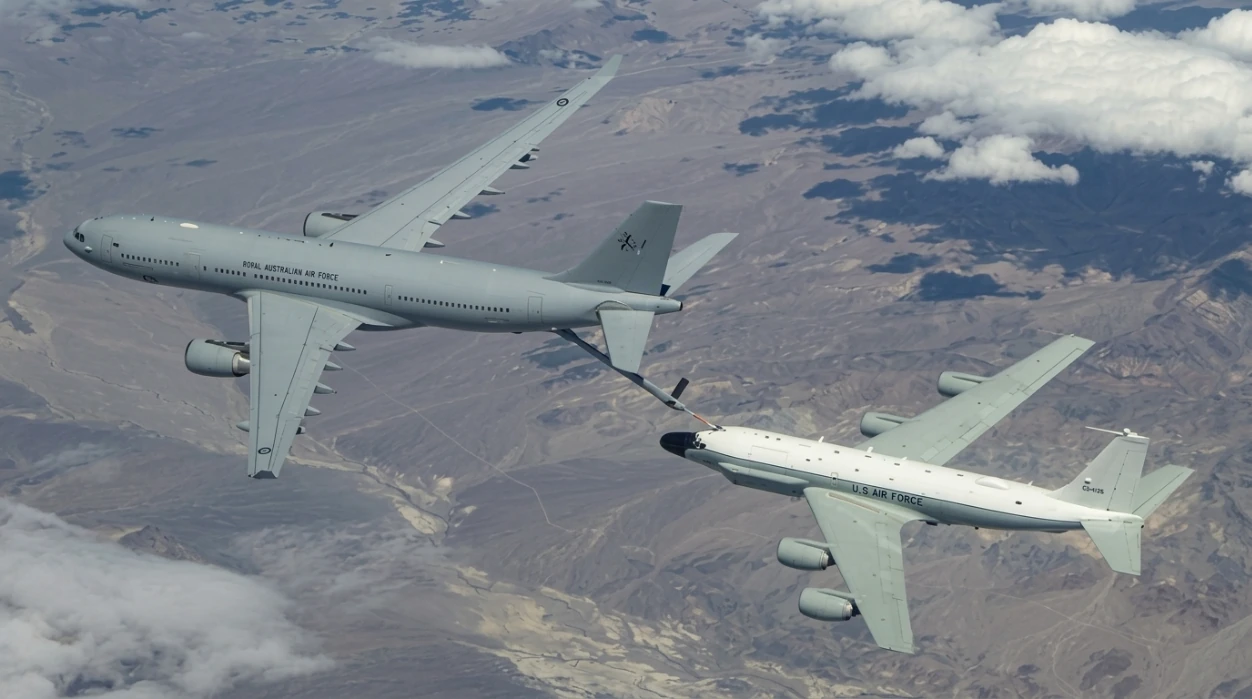
Defense Feeds, Paris – French A330 MRTT refuels U.S. and UK RC-135 aircraft, marking a significant step in NATO airpower interoperability and creating a new tanker option for some of the alliance’s most important airborne intelligence missions.
The milestone was demonstrated during Exercise Ravitaillement en Vol over central France, where French, British and U.S. aircrews worked together on aerial refueling operations.
The development is more important than a single successful refueling contact. It shows how allied tanker fleets can increasingly be treated as a shared support network, potentially allowing RC-135 Rivet Joint aircraft to remain airborne longer without relying exclusively on U.S. KC-135 or KC-46 tankers.
French A330 MRTT Refuels U.S. and UK RC-135 Aircraft
The milestone in which the French A330 MRTT refuels U.S. and UK RC-135 aircraft involved a French Air and Space Force A330 MRTT Phénix supporting a U.S. Air Force TC-135 training aircraft and a Royal Air Force RC-135W Rivet Joint. Personnel from the U.S. 55th Wing, Nebraska Air National Guard, RAF 51 and 56 Squadrons and France’s 31st Air Refueling and Strategic Transport Wing participated in the exercise.
For the RC-135 community, this provides a practical new option for extending mission endurance. The Rivet Joint is primarily designed to collect and analyze electromagnetic activity, including radar and communications emissions, meaning the aircraft’s effectiveness depends heavily on its ability to remain within useful collection areas for extended periods.
The addition of a compatible French tanker therefore gives planners another way to extend those collection windows while reducing pressure on U.S. tanker assets.

Why Tanker Interoperability Matters
Aerial refueling is often treated as a supporting function, but tanker availability can directly influence how many long-range intelligence missions an air force can sustain. U.S. KC-135 and KC-46 aircraft are already required to support fighters, bombers, transports and other specialized aircraft, creating competition for tanker capacity during major operations.
Allowing French A330 MRTTs to support RC-135 missions introduces another layer of flexibility. The U.S. Air Force has indicated that the integration could eventually provide U.S. and British RC-135 fleets access to more than 30 allied A330 MRTT aircraft worldwide.
That figure matters because it transforms the concept from a bilateral capability into a potential multinational support architecture. Instead of planning every intelligence sortie around the availability of nationally assigned tankers, commanders could increasingly draw on compatible aircraft operated by partner nations.
Extending RC-135 Intelligence Missions
The operational value becomes particularly clear when considering what the RC-135 actually does. The Rivet Joint is designed to detect, identify and analyze electromagnetic emissions, giving commanders insight into radar activity, communications patterns and other signals associated with military operations.
For this type of aircraft, additional time airborne can translate into a more complete intelligence picture. A longer collection period allows crews to observe changes rather than simply capturing a snapshot of activity, potentially making it easier to identify unusual patterns or shifts in military behavior.
This is especially relevant for NATO surveillance missions around areas where Russian military activity is closely monitored. Additional tanker support gives planners more flexibility to sustain airborne intelligence coverage without placing all of the burden on U.S. refueling aircraft.
Indo-Pacific Could Benefit From the Same Capability
The significance of the integration extends beyond Europe. The same tanker interoperability could become valuable in the Indo-Pacific, where geography creates some of the most demanding air-refueling requirements in the world.
RC-135 missions conducted across the region can involve long distances between operating bases, tanker tracks and intelligence collection areas. A limited tanker pool can therefore become a constraint on how frequently and how long specialized aircraft can operate.
A distributed network of allied A330 MRTTs could give commanders additional choices when planning those missions. The ability to combine different launch locations, tanker tracks and collection areas could improve flexibility in a theater where distance is itself a major operational challenge.
The A330 MRTT Gives NATO More Flexibility
The French Phénix is particularly well suited to this role because the A330 MRTT family combines strategic transport functions with aerial refueling. Its boom-equipped configuration also makes it compatible with large U.S. military aircraft such as the RC-135. (
However, technical compatibility is only one part of the equation. The Exercise Ravitaillement en Vol demonstrated that true interoperability requires common planning, simulator preparation, communications procedures, emergency protocols, command arrangements and the necessary national approvals.
That preparation is what turns a theoretically compatible tanker into an aircraft that can actually be assigned to an allied mission.
