

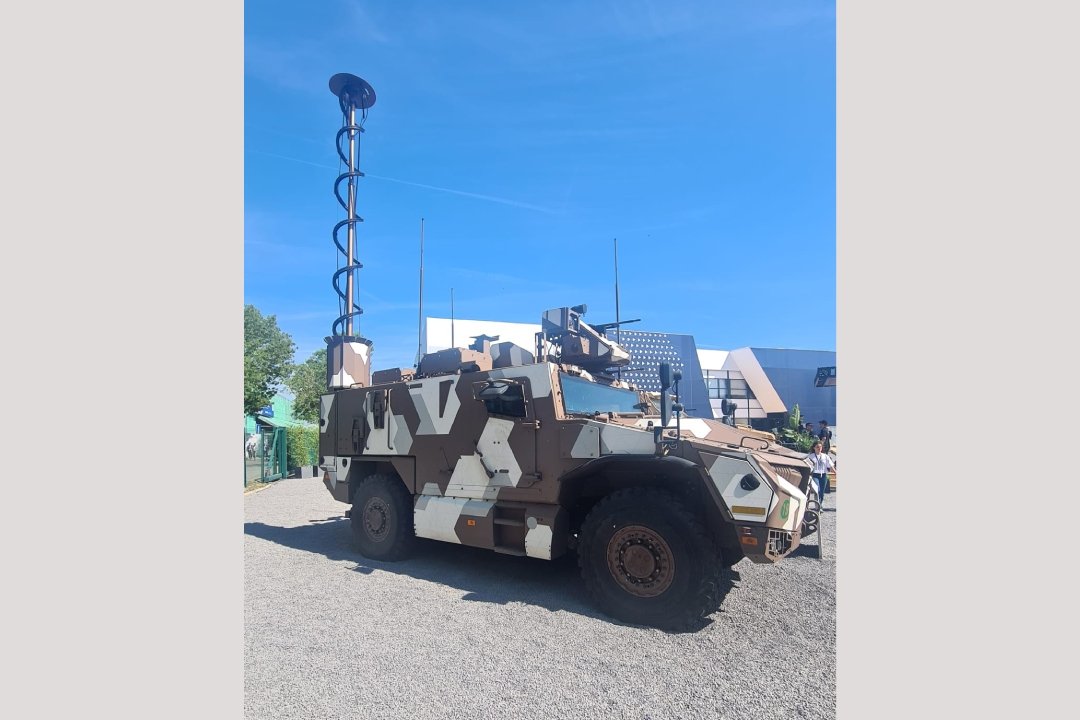

The French Army is expected to restructure its electronic warfare forces and capabilities in light of lessons learnt from ongoing conflicts, Armada understands.
Sources close to the Armée de Terre’s (ADT/French Army’s) Electronic Warfare (EW) units have shared that a major change is planned for the force’s EW order-of-battle. The change focuses on the possible activation of non-specialist EW platoons to support the manoeuvre force. Although the exact configuration and number of these platoons is yet to be determined, Armada has been informed that they would be primarily dismounted units. The platoons will be configured to detect, identify, locate and share (henceforth known as process) electromagnetic targets across a waveband of circa 500 megahertz/MHz to six gigahertz/GHz.
Targets could include radio links connecting Uninhabited Aerial Vehicles (UAVs) with their ground control stations and datalinks used by the UAV to share its video and still imagery, and other intelligence, surveillance and reconnaissance data. Additional targets include conventional tactical radios and their networks, civilian communications like cellphones and their associated networks, radio-controlled improvised explosive devices and global navigation satellite system position, navigation and timing signal reception. The non-specialist EW platoons are expected to use a variety of systems provided by Thales including the company’s Eagle Tracker Communications Intelligence (COMINT) system which will be mounted on a UAV to give the platoon a comparatively long line-of-sight range to process communications targets. The company’s Vortex-XS apparatus will be used to collect COMINT from WiFi and cellular networks. The platoons will also be equipped with a light electronic intelligence system to process ground-based radar threats within range. These threats could include ground-based air surveillance, fire control/ground-controlled interception, weapons-locating and ground surveillance radars. Jamming will be performed using Thales’ Eclipse system which generates 1000 watts/W (60 decibels-per-milliwatt/dBm) of output power, which can be increased to 2000W (dBm) with a directional antenna.

Activating the platoons
Armada understands that the exact number of non-specialist EW platoons to be deployed throughout the ADT manoeuvre force has yet to be determined. Likewise, the size of each platoon and whether they will be organic to specific manoeuvre formations remains undecided. The brigade is the Armée de Terre’s principal tactical unit of manoeuvre. Sources disclosed that these questions may be decided prior to the next French defence budget expected to be revealed in early 2027. The future budget could see the allocation of funding to the ADT to raise these units.
The EW manoeuvre force concept of operations for the French Army would see the non-specialist EW platoons fighting the spectrum battle in a dismounted capacity. They will be delivered as close as possible to their area of operations by vehicle where they will dismount with their equipment. The rationale for the ADT is to have the non-specialist EW platoons performing tactical electromagnetic manoeuvre to win and secure local Electromagnetic Superiority and Supremacy (E2S). Specialised, heavier EW units will be kept further back from the zero line to concentrate on spectrum battle management and/or operational-level E2S tasks outside the purview of the former.
The mainstay of the army’s operational electronic warfare force is the KNDS VBMR-L Serval-GE electronic warfare vehicle for which Thales is providing the mission fit. Deliveries of these specialist Servals commenced in August 2025 and are ongoing, according to the company. Thales declined to reveal how many vehicles are being delivered, and when deliveries may conclude, citing classification issues.
Doctrinal realignment
The expected activation of the French Army’s non-specialist EW platoons reflects lessons learnt from the ongoing war in Ukraine. Large, vehicle-mounted EW platforms have proven vulnerable when deployed near the zero line, or in direct support of the manoeuvre force. Such platforms are typically at risk of detection, on account of their characteristic appearance with accompanying antenna arrays potentially betraying their purpose. Upon detection these vehicles maybe vulnerable to attack by UAV-delivered ordnance, or by suicide uninhabited aerial vehicles. Ukraine has shown, on the other hand, that dismounted EW teams can have significant effect while remaining highly mobile and hence survivable. The pre-eminence and proliferation of the UAV above the battlefield is likely to remain de rigueur for the foreseeable future. Meanwhile conventional EW platforms like the Serval-GE have acquired new roles as spectrum battle management centres, and for the processing of exquisite or unknown signals of interest shared by dismounted EW units. The Armée de Terre’s reorientation of its EW forces to reflect this reality puts the force in good stead concerning the potential shape of any future spectrum battle with Russia. It will be imperative that funds for the activation of these non-specialist EW formations are included in the future French defence budget if this vision is to become a reality.
by Dr. Thomas Withington
