

Abstract
A strong 2026-2027 El Niño is arriving as conflict, economic stress, displacement, and international humanitarian funding constraints already pressure food systems in vulnerable states. This article argues that food insecurity should be treated not as a deterministic cause of conflict, but as a security-relevant, early-warning indicator when climate, market, household, state, and humanitarian pressures converge. It offers a practical framework for combining climate and food-security data with observations from Civil Affairs and interagency partners to recognize when communities are losing their ability to absorb a shock and act before conditions become a crisis.
Introduction
During U.S. Army Civil Affairs engagements in Niger in 2022–2023, a security concern emerged that was neither new nor technologically sophisticated: food insecurity.
During engagements with Nigerien citizens, food insecurity, agricultural production, livelihoods, and the ability to provide for families repeatedly emerged as concerns. Most strikingly, some individuals indicated that if joining a terrorist or other armed organization provided the means to feed their families, they could consider doing so. Those conversations did not mean that food-insecure Nigeriens were predisposed to violent extremism, nor did they prove that hunger causes terrorism. They illustrated a narrower point: severe livelihood insecurity can constrain choices and create vulnerabilities that armed organizations may exploit.
That interpretation is consistent with United Nations Development Programme (UNDP) research on pathways into violent extremism in Africa, which emphasizes that recruitment is shaped by interacting economic, political, social, security, and individual factors rather than a single condition.
The food security pressures were also measurable. In early 2023, the World Food Programme (WFP) warned that as many as 2.9 million Nigeriens—about 11 percent of the population—could face food insecurity during the lean season without urgent intervention. Niger then experienced a military coup on July 26, 2023. Food insecurity should not be presented as the cause of that coup. The more useful lesson is what followed: sanctions, border restrictions, suspended assistance, and financing disruptions added pressure to an already fragile economic and food-security environment, illustrating how political instability can feed back into food-system stress.
The consequences of the coup eventually extended directly to U.S. security interests in the region. Following the deterioration of U.S.-Niger security relations, the United States withdrew its military forces and assets from Niger, including Air Base 201 near Agadez, which had supported regional counterterrorism operations. U.S. Africa Command announced that the withdrawal was completed in September 2024. The loss of that military presence underscores how changes within the political and civil environment can ultimately carry significant consequences for the United States.
The experience in Niger raises a question that extends beyond one country: Are national security organizations paying sufficient attention to the conditions that can make populations vulnerable to the threats those organizations are trying to defeat?
El Niño Is a Test of the Early-Warning System
The current El Niño makes that question timely. As of mid-August 2026, the World Meteorological Organization (WMO) reported that El Niño was firmly established and had a nearly 100 percent probability of persisting through February 2027. A very strong event can shift rainfall and temperature patterns worldwide, increasing the risk of drought, flooding, heat, and agricultural disruption.
The concern is not El Niño in isolation; it is the condition of the systems it will stress. The WFP’s 2026 analysis of 45 already food-insecure countries estimates that El Niño-related effects could increase the acutely food-insecure population in those countries from about 225 million to 274 million by the end of 2027—at least 49 million additional people.
The Food and Agriculture Organization (FAO) and the WFP are already treating the forecast as actionable. Their joint anticipatory action appeal seeks to protect nearly 9 million people across 22 high-risk countries through measures such as cash assistance, resilient seed, livestock protection, water storage, flood protection, agricultural advisories, and early-warning dissemination. WFP also reports that experience from previous El Niño events suggests that one dollar invested in anticipatory programs can avoid roughly three to seven dollars in later losses and response costs.
If climate and food security forecasts are credible enough to trigger anticipatory humanitarian action, they should also inform broader assessments of political and security risk.
Hunger Does Not Cause War
Any security argument about food must avoid a deterministic claim. Most food-insecure populations do not rebel, and most farmers who experience drought do not join armed groups. Political instability emerges from combinations of governance, exclusion, repression, corruption, ideology, economic conditions, social networks, existing conflict, and individual decisions.
Food insecurity is better understood as a potential threat multiplier. Arezki and Bruckner’s cross-national analysis of more than 120 countries found that increases in international food prices in low-income countries were associated with increases in anti-government demonstrations, riots, and civil conflict. A later International Monetary Fund (IMF) study of 101 low- and middle-income countries found that imported food-price shocks increased the likelihood of sociopolitical instability, with vulnerability shaped by factors such as income, credit, remittances, and fiscal capacity.
The relevant question is therefore not simply whether food prices rose. It is whether households, governments, and international partners retain the capacity to absorb the shock.
Sequential Buffer Failure
Food crises rarely move directly from a failed harvest to political instability. Between those outcomes are layers of resilience. At the household level, savings, stored food, livestock, remittances, credit, and alternative income can absorb losses. At the state level, strategic reserves, subsidies, social protection, foreign exchange, import financing, and agricultural support can shield consumers. When those systems are insufficient, international actors can provide food, cash, financing, logistics, agricultural inputs, and livelihood protection.
The security concern is not merely the original shock; it is the sequential buffer failure. A drought or flood becomes more consequential after households have sold productive assets. A global price spike becomes more dangerous when a government lacks foreign exchange or fiscal space. A humanitarian emergency becomes harder to contain when funding or access is simultaneously deteriorating. Figure 1 illustrates how these layers of resilience can erode in sequence, increasing vulnerability while also showing how political or security instability can feed back into the food system and further weaken the remaining buffers.
Sequential Buffer Failure and the Food-Security Instability Feedback Loop
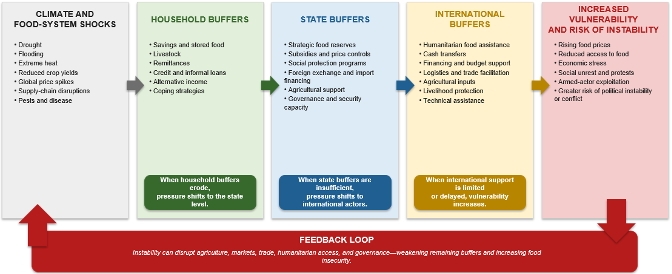
Figure 1. Sequential Buffer and the Food-Security Instability Feedback Loop. The framework does not assume that food security causes violence; it shows how vulnerability can intensify as successive coping mechanisms deteriorate and how instability can further weaken food systems.
Three Pathways to Watch
North Africa: Price and State Capacity
Egypt illustrates why agricultural production alone is an incomplete measure of food-system resilience. FAO’s June 2026 country brief forecasts an above-average wheat harvest of about 10 million tonnes, yet cereal import requirements for 2026/2027 are projected at 29 million tonnes, including 13.5 million tonnes of wheat. A country can therefore have a strong domestic harvest and remain exposed to international prices, currency movements, import financing, and disruptions to global food markets.
This exposure matters because the state plays a significant role in buffering households from food costs. Egypt’s subsidized bread program serves roughly 70 million people, making the government’s ability to maintain affordable food an important component of household resilience. At the same time, food inflation resumed an upward trend in early 2026, reaching 7.6 percent in May, which FAO attributed largely to depreciation of the Egyptian pound. Egypt also continues to face elevated public debt and large financing needs, which could make it harder for the government to absorb the costs of another major shock.
This is why Egypt is important to watch as El Niño develops. A climate-related production shock elsewhere, disruption to a major exporting region, or another increase in international food prices does not have to cause a poor Egyptian harvest to create pressure inside Egypt. The shock can instead arrive through the price of imports and the cost of maintaining the state buffers that protect consumers. The point is not that these pressures will produce political instability, but that Egypt demonstrates why food-security early warning must look beyond crop production to import dependence, household purchasing power, currency conditions, fiscal capacity, and the state’s ability to sustain social protections.
Horn of Africa: Compound Shocks and Access
Somalia illustrates a different pathway: the danger of a new climate shock arriving before households have recovered from the last one. According to the Famine Early Warning Systems Networks (FEWS NET) June 2026 Food Security Outlook, consecutive poor harvests, low livestock productivity, worsening insecurity, historically high food prices, and declining humanitarian assistance have already weakened the ability of many households to cope. The immediate climate concern is now shifting from drought in the April-June gu season to the possibility of excessive rainfall and flooding during the October-December deyr season. A strengthening El Niño, combined with a positive Indian Ocean Dipole, is expected to increase the risk of heavy rainfall and flooding in late 2026.
This matters because additional rainfall is not necessarily good news for a population still recovering from drought. Severe flooding could destroy crops and livestock, displace households, interrupt markets and transportation, and make it more difficult for humanitarian assistance to reach communities already experiencing severe food insecurity. FEWS NET assesses that extreme, widespread flooding could create a credible risk of Famine (Integrated Food Security Phase Classification Phase 5) in several southern agropastoral and riverine areas and major settlements for internally displaced people.
Somalia therefore provides a clear example of sequential buffer failure. The concern is not El Niño alone, but El Niño arriving after household assets have already been depleted, food prices are high, insecurity has disrupted livelihoods and markets, and humanitarian assistance is constrained. The indicators to watch are therefore not simply rainfall totals, but household coping capacity, livestock conditions, food prices, displacement, market access, humanitarian funding, and whether assistance can physically reach affected communities.
South Asia: Global Market Transition
South Asia presents another pathway to watch because climate shocks in major agricultural producers can affect food security far beyond the countries where those shocks occur. India is especially important because of its role in global grain markets. According to FAO’s India country analysis, India’s rice exports are forecast at a record 23.6 million tonnes in 2026, supported by strong domestic production. At the same time, India’s wheat export restrictions, introduced in May 2022 to help control domestic prices and protect supplies, demonstrate how quickly domestic food-security concerns in a major producer can become an international market issue.
The lesson is not that El Niño will necessarily reduce Indian production or lead to new export restrictions. Rather, India’s experience demonstrates how governments may prioritize domestic food security when production concerns or food-price pressures emerge. When a major agricultural exporter restricts trade, the effects can extend well beyond its borders through reduced export availability and higher costs for countries dependent on imported food.
This is why South Asia matters to a food-security early-warning system. Analysts should watch not only rainfall and crop forecasts, but also domestic food prices, government stocks, trade policies, and signs that major exporters are becoming more concerned about protecting their own consumers. A climate shock in one country can become a market shock somewhere else, where governments and households may have far fewer resources to absorb higher food costs.
A Food Security-Instability Early-Warning Framework
The United States and international community do not need another isolated warning system. Much of the necessary information already exists across WMO, FAO, FEWS NET, WFP, the World Bank, the IMF, host-nation institutions, diplomatic reporting, development organizations, and Civil Affairs. The gap is often fusion. As the examples of Egypt, Somalia, and India demonstrate, vulnerability can emerge through different pathways—import and fiscal pressure, compound climate and humanitarian shocks, or the transmission of food-price pressures through international markets.
The framework below is designed to identify convergence across these domains rather than assign an unsupported numerical “instability score.” A poor harvest alone does not predict political unrest. Neither does currency depreciation or a humanitarian funding gap. But simultaneous deterioration across several domains should command greater attention. Table 1 organizes these indicators across six domains and shows how conditions may progress from routine monitoring to escalating concern and, ultimately, potential critical signals that warrant greater attention and earlier action.
Food Security–Instability Early-Warning Matrix
| Domain | Monitor | Escalating Concern | Potential Critical Signal |
| Climate & Production | Rainfall, soil moisture, planting, crop forecasts, pasture, livestock, water | Production losses; consecutive shocks | Widespread crop/livestock losses or compound hazards |
| Markets & Trade | Staple prices, international prices, imports, transport, fuel, fertilizer, export restrictions | Rapid inflation; disrupted trade/transport | Major market failure, import interruption, or extreme price spike |
| State Capacity | Currency, foreign exchange, debt, subsidies, reserves, safety nets | Currency depreciation; rising import and subsidy costs; declining fiscal capacity | State unable to finance imports, subsidies, or safety nets |
| Households & Governance | Food consumption, asset sales, debt, migration, displacement, services | Meals reduced; productive assets sold; disputes increase | Coping options exhausted; sustained unrest or displacement |
| Humanitarian Capacity | Funding, access, logistics, ration size, NGO presence | Assistance reduced or delayed | Aid inaccessible or unable to meet critical need |
| Armed-Actor Exploitation | Recruitment, resources, taxation, market control, aid interference | Livelihood grievances used for recruitment | Armed actors systematically substitute for or obstruct state/humanitarian functions |
Table 1. Food Security–Instability Early-Warning Matrix. Indicators are intended to reveal cross-domain convergence, not to generate a deterministic prediction of conflict.
From Warning to Action
The framework becomes useful only if warning changes decisions. A practical process is Forecast → Fuse → Assess → Trigger → Act. Forecast the hazard, fuse climate, agricultural, market, economic, governance, security, and humanitarian information, assess which buffers remain, trigger additional attention when multiple indicators deteriorate, and match action to the mechanism producing vulnerability.
The regional examples demonstrate why the last step matters. A climate shock may reduce production directly, compound an existing humanitarian crisis, or reach another country indirectly through higher import prices and trade disruptions. The response should address the pathway through which vulnerability is increasing.
For example, consider an import-dependent country entering a poor growing season. A climate forecast alone may not warrant monitoring, but when it is combined with declining crop forecasts, rising international grain prices, currency depreciation, shrinking government capacity to subsidize food, and reports that households are reducing meals or selling productive assets, the picture changes. Individually, these indicators may not signal a crisis; together they suggest that multiple buffers are weakening at the same time. That convergence should trigger closer attention and, where appropriate, earlier measures to protect food access and livelihoods before conditions deteriorate further.
Figure 2 illustrates how this process moves from early warning to action, emphasizing the fusion of information and intervention before deteriorating conditions become a humanitarian or security crisis.
From Early Warning to Early Action
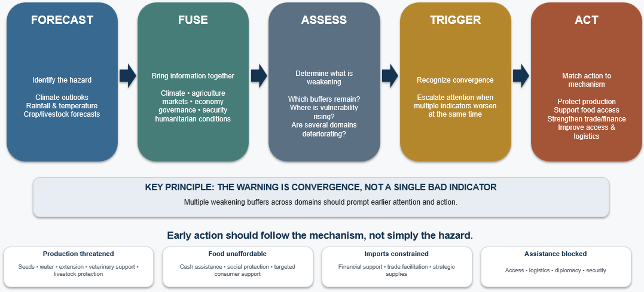
Figure 2. From Early Warning to Early Action. The process emphasizes information fusion and mechanism-specific intervention rather than waiting for a humanitarian or security crisis to confirm the warning.
If production is threatened, appropriate measures may include seed, veterinary support, water, agricultural extension, or livestock protection. If food exists but households cannot afford it, cash or social protection may be more appropriate. If imports become unaffordable, financial or trade support may matter. If assistance exists but cannot reach people, access logistics, diplomacy, and security may become central. Early action should follow the mechanism, not simply the hazard.
What Civil Affairs Should Ask
Civil Affairs can contribute without becoming a humanitarian agency or agricultural ministry. The value lies in recognizing food-security indicators as part of the civil environment, contextualizing them, and connecting observations to organizations already responsible for response. In some operating environments, Civil Affairs personnel may also have physical access to communities or areas where humanitarian and developmental organizations have limited or no presence, providing an opportunity to observe conditions that may not otherwise be visible and share relevant information with appropriate military, interagency, host-nation, and humanitarian partners. During civil engagement, a small set of questions can help identify which buffers are weakening, how communities are coping, and who is filling the gaps:
- Are staple foods more expensive than three or six months ago, and why?
- Are farmers planting the same amount of land as last season?
- Are seed, fertilizer, fuel, water, and other agricultural inputs available and affordable?
- Are households selling livestock, equipment, seed, land, or other productive assets to purchase food?
- Are households reducing meals or changing what they eat?
- Are people leaving the community because livelihoods have become unsustainable?
- Has government or humanitarian assistance increased, decreased, or stopped?
- Are markets operating normally, and can food move into the community?
- Who provides food, money, employment, credit, transportation, or protection when formal systems fail?
- Are armed actors exploiting food, livelihood, land, water, or market grievances?
The ninth question may be the most important: Who is filling the gap? When government services, markets, humanitarian assistance, or traditional livelihood systems can no longer meet basic needs, another actor may step in. If that actor is increasingly an armed group, militia, criminal network, extremist organization, or other non-state actor, that is security-relevant information even before violence increases. It may indicate deteriorating food and livelihood conditions are creating opportunities for those actors to build influence, provide resources, or exploit existing grievances.
The Civil Affairs contribution can remain deliberately limited: Recognize. Collect. Contextualize. Report. Connect. Civil Affairs personnel can recognize relevant indicators during routine engagements, collect and contextualize what communities are experiencing, report those observations through appropriate channels, and connect information with organizations positioned to respond. Where Civil Affairs has access that other organizations do not, this reporting function becomes particularly important because observations from the civil environment can help fill gaps in the broader early-warning picture.
The goal is not to militarize food security. It is to prevent national-security institutions from overlooking a consequential part of the operational environment simply because the indicators initially look agricultural, economic, or humanitarian.
Conclusion: Earlier Warning Must Mean Earlier Action
The experience in Niger illustrates why food security should be understood as more than an abstract development indicator. The people encountered during Civil Affairs engagements were describing whether they could provide for their families and what choices remained when livelihoods failed. The subsequent coup did not prove that hunger caused political instability. It did demonstrate how food systems, markets, governance, humanitarian access, and political disruption can interact in both directions.
The 2026–2027 El Niño should likewise not be treated as a prediction of conflict. It should be treated as a test of whether existing warning systems can identify where resilience is disappearing before another shock becomes a humanitarian and security crisis.
Existing systems already forecast climate hazards and monitor crops, markets, food prices, currencies, displacement, and humanitarian need. Civil Affairs and civilian partners also observe how those pressures are experienced at the community level. In some places, Civil Affairs may provide visibility into communities where other organizations have limited physical access, adding another piece to the early-warning picture. What matters is recognizing that the next crisis may not begin with an empty market or failed harvest. It may begin with a household selling its remaining livestock, a government struggling to finance food imports, humanitarian assistance being reduced, or a major exporter restricting trade.
The challenge is to fuse these information streams, look for convergence, recognize sequential buffer failure, and act while meaningful options still exist. The information often already exists. The greater challenge is connecting it early enough to inform decisions.
Early warning has little strategic value if it produces only earlier observation. It must produce earlier action.
Disclaimer: The views expressed are those of the author and do not necessarily reflect the positions of the U.S. Army, the Department of War, or Collin College.
