

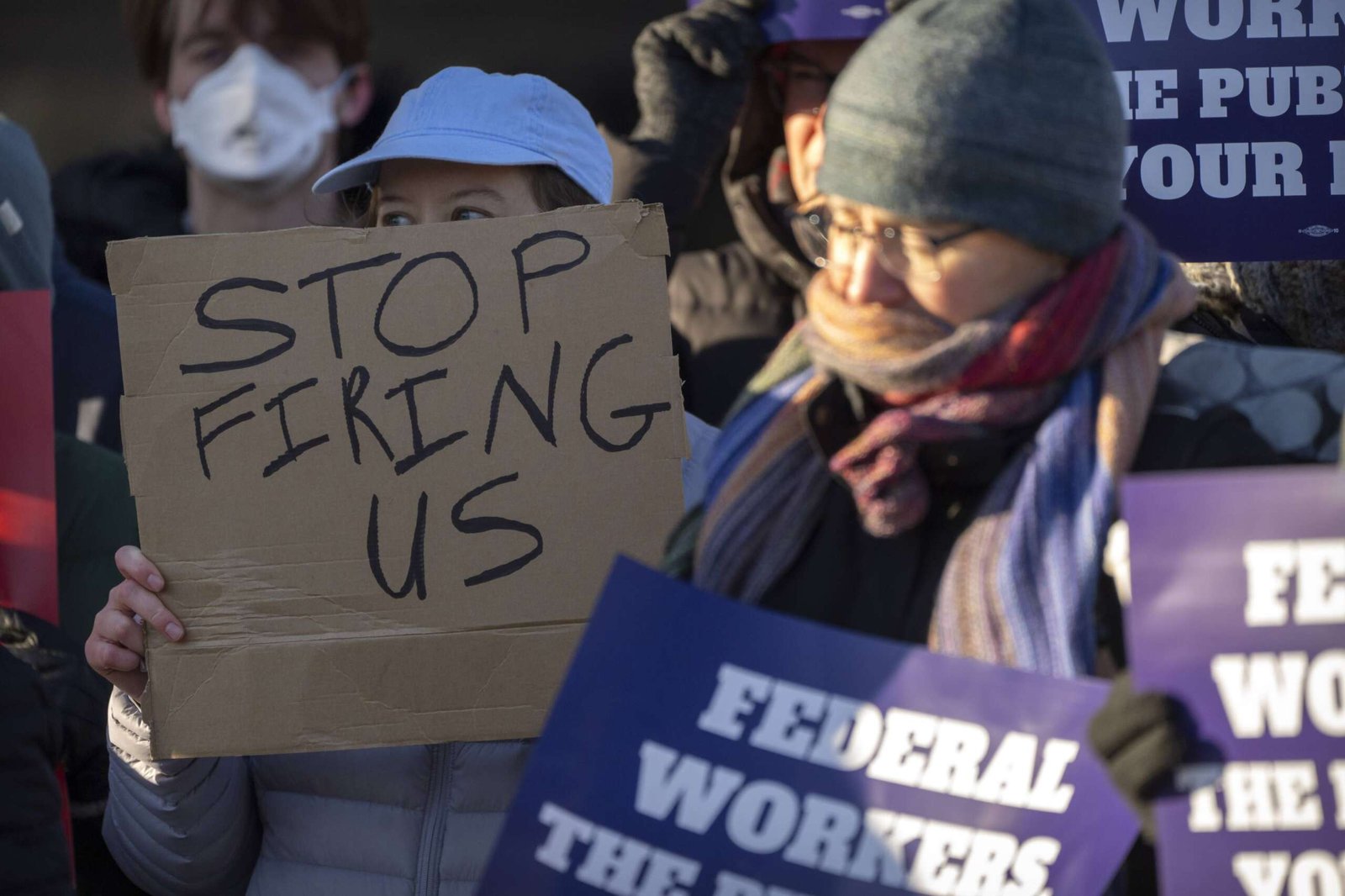
As part of last year’s sweeping federal workforce reductions, probationary employees separated from their jobs at a higher rate than federal employees overall, according to new findings from the Government Accountability Office.
Out of the agencies it analyzed, GAO reported that during 2025, probationary employees separated at an average rate of 19%, compared with about 15% of all federal employees.
The employee separation trends raise some questions about federal hiring prospects going forward. After the workforce reductions, many agencies have started to expand recruitment efforts in recent months, including efforts from the Office of Personnel Management seeking early-career employees.
“What’s interesting about this is that just three months ago OPM launched an initiative to strengthen the pipeline of early-career talent who are entering the federal workforce,” Dawn Locke, GAO’s director of strategic issues, said in an interview with Federal News Network. “But leading up to that, executive orders and OPM guidance resulted in the separation of more than 50,000 early-career individuals. So it’s a bit difficult to understand the reasoning behind these actions.”
In 2025, the Trump administration directed agencies to reduce their workforces and broadly restrict hiring, leading to staffing declines at virtually all major federal agencies.
As part of the reduction efforts, thousands of probationary federal employees were also fired across government. A federal judge later ruled that OPM had unlawfully directed agencies to fire probationary federal employees en masse.
GAO’s report showed that the staffing reductions did not impact all agencies equally. Within agencies that have a mission related to health and safety, the largest employee separations occurred at the departments of Agriculture and Interior, both of which saw about 30% staffing declines. In contrast, the departments of Homeland Security and Veterans Affairs had some of the lowest levels of workforce separations, with about 11% of employees leaving at each agency.
Most but not all agencies included in GAO’s report had steeper staffing declines within their probationary workforces. For instance, nearly 42% of USDA’s probationary employees separated during 2025, compared with about 30% of other employees. And 34% of the Energy Department’s probationary employees separated, versus 19% of all employees.
Conversely, the Interior Department had about 22% of probationary employees separate, compared with 31% of the department’s overall workforce. And at the Nuclear Regulatory Commission, about 11% of probationary employees separated, along with about 17% of all employees.
GAO’s study also found that close to 41,500, or 78.6%, of probationary separations were “voluntary” while about 9,400, or 17.8%, were due to a reduction-in-force (RIF) or other termination action. The remaining 3.6% of probationary separations, just under 1,900, were due to employees transferring to another agency. The percentages were on par with separation trends for all federal employees, GAO said.
A probationary period in government is a “trial period,” usually lasting 1–2 years, to determine whether new hires will meet performance expectations. Probationary periods occur not only for many early-career workers, but also for employees who get promoted into managerial or supervisory positions.
Historically, a probationary period termination could only take place due to poor performance or conduct. But the Trump administration has taken steps to overhaul regulations for the federal probationary period.
In a final rule issued earlier this year, OPM said agencies can decide whether to keep probationary employees also based on the needs and interests of the agency, the organizational goals of an agency, and whether it would advance the “efficiency of the service,” on top of performance and conduct. And probationary employees can now only appeal their termination if they believe it was due to partisan political reasons, marital status or a failure by their agency to follow proper procedures.
“It really reshaped the probationary landscape,” Locke said.
By geographic region, the picture of 2025 employee separations looks different as well. States including Montana, Idaho and Utah saw between 31–40% of federal employees separate from their jobs in 2025, across select agencies. But many southern states, such as Texas and Florida, had lower federal employee separation rates of about 15–20%, GAO found.
“We fully expected to see that there would be a number of probationary employees separated in Maryland and in D.C., where a good chunk of federal agencies are,” Locke said. “What we didn’t expect to see was the number of employees who were separated, for example, in Maine or Alaska.”

For decades, agencies have struggled with mission-critical skills gaps, which occur when agencies don’t have enough people or the right types of skills in their workforce to effectively meet their missions. Challenges relating to federal skills gaps have remained on GAO’s High Risk List since 2001.
Following the significant federal workforce reductions, Locke said the impact on agencies’ skills and ability to meet mission remains “an open question.”
“It’s hard to imagine that these reductions have not exacerbated the skills gap problem,” Locke said. “However, without the reduction-in-force or reorganization plans that these agencies are supposed to have by now, it has not been possible for us to truly determine impacts or what this all means for meeting mission needs, which are ultimately the needs of the American people.”
If you would like to contact this reporter about recent changes in the federal government, please email drew.friedman@federalnewsnetwork.com or reach out on Signal at drewfriedman.11
Copyright
© 2026 Federal News Network. All rights reserved. This website is not intended for users located within the European Economic Area.
