

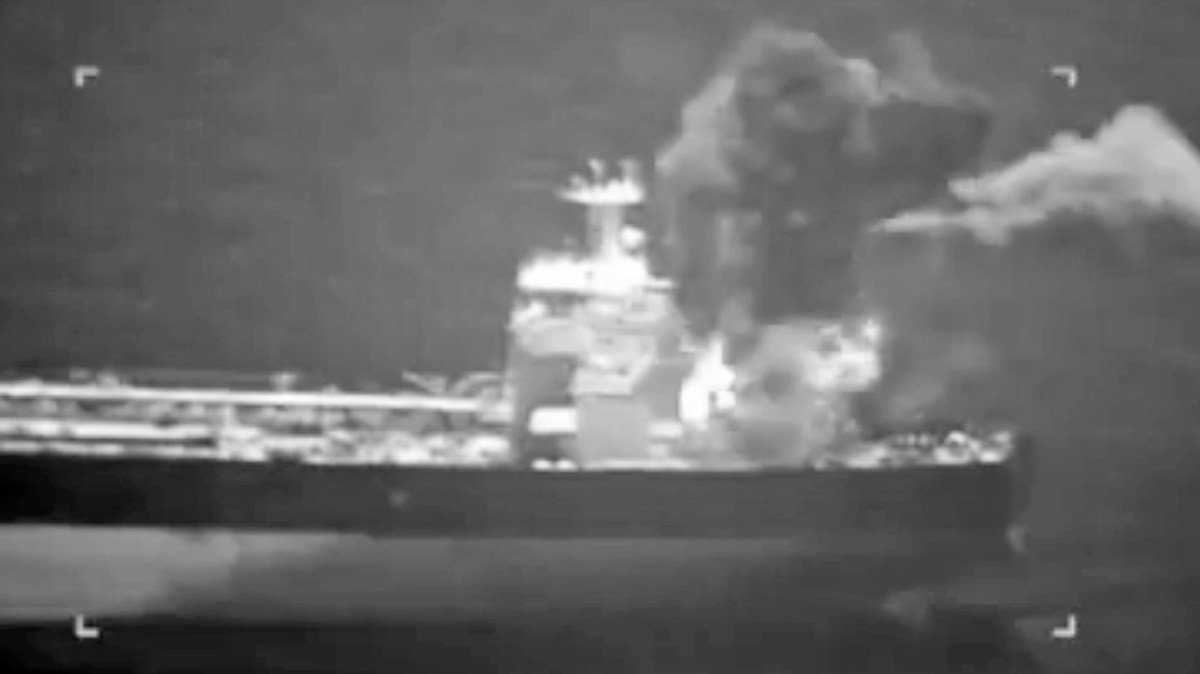
The U.S. carried out new attacks on Iranian targets today, striking several empty oil tankers trying to break the blockade, according to a post on X by U.S. Central Command (CENTCOM). This latest incident comes as the UAE says it was attacked again by Iran today and hours after the U.S. and Iran exchanged blows in and around the Strait of Hormuz.
U.S. forces “disabled M/T Sea Star III and M/T Sevda, May 8, prior to both vessels entering an Iranian port on the Gulf of Oman in violation of the ongoing U.S. blockade, CENTCOM stated. “A U.S. Navy F/A-18 Super Hornet from USS George H.W. Bush (CVN 77) disabled both tankers after firing precision munitions into their smokestacks, preventing the non-compliant ships from entering Iran.”
This was the third time that the U.S. has fired on Iranian ships running the blockade. The Navy has used a destroyer’s five-inch gun firing inert rounds to blast the engineering section of one ship to disable it and a Super Hornet’s 20mm Vulcan cannon to disable the rudder on another. So, the use of bombs dropped down a ship’s smokestack to disable but not destroy a ship is new. You can read about these prior instances here.
The weapons used in this latest wave of attacks on blockade runners wasn’t disclosed. 500lb laser-guided bombs are likely what was employed here based on the Super Hornet’s stores options, precision required, and the effects seen. These can utilize high-explosive bomb bodies or inert ones for desired effects, with the latter being most probable in this case.
Fox News reporter Jennifer Griffin was the first to report this news.
The blockade on Iranian ports was enforced April 13 to strangle Iran’s economy as part of U.S. President Donald Trump’s efforts to prevent Iran from obtaining nuclear weapons. On Friday, CENTCOM reported that U.S. forces have prevented more than 70 tankers from entering or leaving Iranian ports.
“These commercial ships have the capacity to transport over 166 million barrels of Iranian oil worth an estimated $13 billion-plus,” the command stated on X.
However, “a confidential CIA analysis delivered to administration policymakers this week concludes that Iran can survive the U.S. naval blockade for at least three to four months before facing more severe economic hardship,” The Washington Post reported on Thursday, citing four people familiar with the document.
Meanwhile, the United Arab Emirates claims it was once again attacked by Iranian ballistic missiles and drones on Friday.
“The Ministry of Defense announced that on May 8, 2026, the UAE air defense systems engaged 2 ballistic missiles and 3 UAV’s launched from Iran, resulting in 3 moderate injuries,” the UAE Defense Ministry (MoD) announced on X Friday morning EDT. “Since the beginning of the blatant Iranian attacks on the United Arab Emirates, the air defenses have engaged a total of 551 ballistic missiles, 29 cruise missiles, and 2,263 UAV’s.”
The UAE, located about 60 miles south of Iran across the Strait, claims these attacks have killed 13 and injured 230.
The MoD “affirmed that it remains fully prepared and ready to deal with any threats and will firmly confront anything that aims to undermine the security of the country, in a manner that ensures the protection of its sovereignty, security and stability and safeguards its interests and national capabilities.”
Tehran did not immediately respond to the claim, which TWZ cannot independently verify.
These incidents follow an exchange of fire last night between the U.S. and Iran. As we reported yesterday, U.S. Central Command said it attacked several locations in Iran after “Iranian forces launched multiple missiles, drones and small boats as USS Truxtun (DDG 103), USS Rafael Peralta (DDG 115), and USS Mason (DDG 87) transited the international sea passage. No U.S. assets were struck.”
Iran said it launched the attacks in retaliation for “violation of the ceasefire and the aggression by the terrorist US military against an Iranian oil tanker near the port of Jask.”
The extent of the damage to Bandar Abbas, Qeshm Island and the Bandar Kargan naval checkpoint in Minab, targets struck by the U.S. on Thursday in response to the attacks on U.S. Navy ships, remains unclear. No images have emerged and neither Iran nor the U.S. have commented.
Last night, Trump called the exchange a “love tap” and said the ceasefire still held.
This is a developing story.
UPDATE: 11:40 AM EDT –
Amid the kinetic activity, diplomacy continues as Trump insists that Iran never develop a nuclear weapon. The status of its ballistic missile arsenal, control of the Strait of Hormuz and support for proxies like Hezbollah and the Houthis are also major sticking points.
The U.S. is awaiting to hear back from Iran about its peace proposal, U.S. Secretary of State Marco Rubio said.
“We’re expecting a response from them today at some point. We have not received that yet,” he said.
The secretary added that he remained concerned that Iran is still trying to maintain control over the Strait.
“We’ve seen the reporting overnight that Iran is trying to establish some agency that’s going to control traffic in the Strait,” Rubio explained. “That would actually be unacceptable.”
Iran, meanwhile, is accusing the U.S. of moving the goal posts in the negotiating process by using force.
“Every time a diplomatic solution is on the table, the U.S. opts for a reckless military adventure,” Iranian Foreign Minister Abbas Araghchi stated on X. “Is it a crude pressure tactic? Or the result of a spoiler once again duping POTUS into another quagmire? Whatever the causes, [the] outcome is the same: Iranians never bow to pressure.”
UPDATE: 11:55 AM EDT –
Iran claims that its “naval commandos carried out a special operation to detain” an oil tanker, “which was attempting to disrupt Iran’s oil exports and national interests.”
“Implementing the decision of the Supreme National Security Council and with a judicial ruling, the Army Navy seized the oil tanker Ocean Koi, which was carrying Iranian oil and tried to take advantage of the situation in the region to harm and disrupt the oil exports and the interests of the Iranian nation,” said Iran’s Army Public Relations Office in a statement on Friday.
“The commandos of the Army Navy “directed the violating oil tanker to the southern coast of Iran and handed it over to the judicial authorities,” according to the statement. “The Navy of the Islamic Republic of Iran will “vigorously defend the interests and assets of the Iranian nation in the territorial waters of the country and will not tolerate any violator or aggressor.”
Though Iranian officials identified this ship as the Ocean Koi, it is also known as the Jin Li. It is part of Iran’s so-called dark fleet and was sanctioned by the U.S. in February for transporting millions of barrels of Iranian oil. It is unclear why Iran made a show of this event, though it could have been for domestic consumption in the wake of yesterday’s attacks on several targets.
You can see video of the claimed boarding below.
UPDATE: 12:16 PM EDT –
The CIA recruited sources inside Iran, but flawed covert communications reportedly helped Iranian counterintelligence identify and arrest informants, a new report from Reuters stated.
“In interviews with six Iranian former CIA informants, Reuters found that the agency was careless…amid its intense drive to gather intelligence in Iran, putting in peril those risking their lives to help the United States,” the outlet explained.
“Such aggressive steps by the CIA sometimes put average Iranians in danger with little prospect of gaining critical intelligence,” Reuters added. “When these men were caught, the agency provided no assistance to the informants or their families, even years later, the six Iranians said.”
UPDATE: 12:25 PM EDT –
Iranian officials continue to dismiss the notion that the country will cede control of the Strait.
Mohammad Mokhber, an adviser to Iran’s Supreme Leader, said on Friday Iran’s control over the Strait of Hormuz is an asset “on the scale of an atomic bomb”, adding that Tehran would not give up the capability it gained through war.”
12:43 PM EDT –
Hours after launching another attack on the UAE, an Iranian official says that country will remain a target for supporting the U.S. and Israel.
Iran will not leave the Emirates alone, and they are well aware of that, which is why they are trying to maintain tension between Iran, America, and the Zionist entity,” Ali Khodarian, a member of the Iranian Parliament’s National Security Commission, stated on X. “The Americans have realized that their naval blockade parade will henceforth face a military response from the Islamic Republic. No one can now carry out a military operation against our ships without a response.”
UPDATE: 1:37 PM EDT –
The United States will facilitate two days of intensive talks between the governments of Israel and Lebanon on May 14 and 15, State Department spokesman Tommy Piggott announced on Friday.
UPDATE: 1:48 PM EDT-
CENTCOM released imagery of the Arleigh Burke class guided missile destroyers USS Truxtun (DDG 103), USS Rafael Peralta (DDG 115), and USS Mason (DDG 87) operating in the Middle East. “The three destroyers are currently sailing in the Arabian Sea supporting the blockade against Iran,” the command stated on X. “As of today, CENTCOM forces have redirected 57 commercial vessels and disabled 4 to prevent the ships from entering or leaving Iranian ports.”
The three destroyers were in last night’s exchange of fire with Iran.
UPDATE: 3:32 PM EDT –
The U.S. is denying the latest Iranian claim that it successfully carried out an attack on U.S. military assets.
On Friday, the Iranian Army claimed “while the US Navy was attempting to remove three of its destroyers from the Strait of Hormuz towards the Sea of Oman with air support, we carried out a combined missile and drone operation, during which we targeted this naval group with 8 cruise missiles and 24 suicide drones. As a result of this operation, and despite the extensive attempts by the US Navy to repel the attack, one cruise missile and three suicide drones successfully hit the American destroyers, causing fires to break out on them.”
Asked if any U.S. ships were struck today, a U.S. official offered a one-word response.
“No,” the official stated.
UPDATE: 7:36 PM EDT –
During a press gaggle with reporters outside the White House, Trump was asked if he would resume the now-paused Project Freedom.
“We’ll go a different route if everything doesn’t get signed up, buttoned up,” he answered… We may go back to Project Freedom if things don’t happen — but it’ll be Project Freedom Plus, meaning Project Freedom plus other things.”
Trump also said the U.S. expects to get a response from Iran on the American proposal aimed at ending the war “supposedly tonight.”
Asked if Iran is slow rolling the process, Trump says: “we’ll find out soon enough.”
UPDATE: 8:13 PM EDT –
Open source investigator @MT_Anderson says satellite imagery shows the Ocean Trader, a shadowy special operations mothership, appears to be off the coast of Diego Garcia. That’s America’s sprawling island base deep in the Indian Ocean. It includes an airfield, port and large lagoon. It has served as a host for strategic bomber during a number of crisis over the years.
“Sentinel 2 from May 7 reveals a highly significant arrival at NSF Diego Garcia,” he wrote on X. “Likely spot of Spec Ops Command (SOC) mothership, MV Ocean Trader, safely anchored inside the atoll.”
In addition, Anderson says the Military Sealift Command’s (MSC) large, medium-speed, roll-on/roll-off ship USNS Pililaau and an unidentified Arleigh Burke class guided missile destroyer were “also in the lagoon. My last definitive spot [for Ocean Trader] was way back in Nov 2025 off the coast of Puerto Rico.”
As we reported in October 2025, Ocean Trader was seen “prowling the waters of the Caribbean.” It was seen as the U.S. was building up forces for potential raids against cartels in a mission that morphed into one aimed at Venezuelan dictator Nicolas Maduro. Able to launch special operations helicopters, drones and fast boats, and carry troops and supplies, we noted that the ship “could play a central role as a staging point and command and control node for direct action against cartels should the orders come.”
In January 2026, the U.S. captured Maduro in a raid that relied heavily on special operations forces. It is likely the Ocean Trader played a role in the mission. Likewise, this highly-specialized vessel could provide its services in a wide range of contingencies for the ongoing crisis with Iran. This includes helping to enforce the blockade, rescuing downed aircrew, or even participating in direct action missions against Iranian interests. Beyond that, Ocean Trader has spent a lot of time in the Middle East over the years. With all this in mind, it’s presence in the region at this pivotal time should come as no surprise.
Contact the author: howard@twz.com
