

Its character-driven storytelling and environmental combat already show promise, even if the experience still needs refinement.
Expeditions: Samurai is the latest game in a series that began all the way back in 2013 with Expeditions: Conquistador. If you have played either of the last two installments, then you are probably keeping a pretty close eye on this one. With good reason too. Both Expeditions: Viking and Expeditions: Rome have very positive reviews on Steam.
If you are not familiar with any of the Expeditions games, they are a mix of RPG, real-time exploration, and turn-based, tactical combat. Each game is set in a historical setting, where your party of characters is in a foreign land, trying to conquer, navigate, and survive.
Expeditions: Samurai comes to Steam Early Access on August 7th. I was given an early copy of the game to take a look at its present state. Let’s dive in and see where this one is at. Is it worth checking out in early access or should you wait until the full release?
As the name suggests, Expeditions: Samurai takes place in Japan. It is 1600, and your crew of Dutch privateers sails to Japan on orders of the English Queen.
She wants to build trade routes with the people there and has assigned you the task. Of course, nothing goes your way along the journey. All your crew is tired and angry from having to ration the food and the water.
On top of that, your ship was attacked before arriving at your destination. Once you finally do land in Japan, you are clearly not welcome. What you do with the situation is now completely up to you.
You must navigate this foreign land with its unknown problems and politics. You must also manage your motley crew of eight companions with different personalities and stories. Every decision you make affects not only you but also them. It can affect their relationship, their trust, and their lives. Even the smallest decision can have far-reaching consequences.
Each character in your crew will level up and get skill points. These skill points can be used to boost four different skill types: Power, Finesse, Perception, and Wits.
Each type has its own focused skills that you can put points into. For example, Finesse is focused on improving critical chance and movement in combat. The three skills under Finesse are Surprise Attack, Skullduggery, and Manipulation.
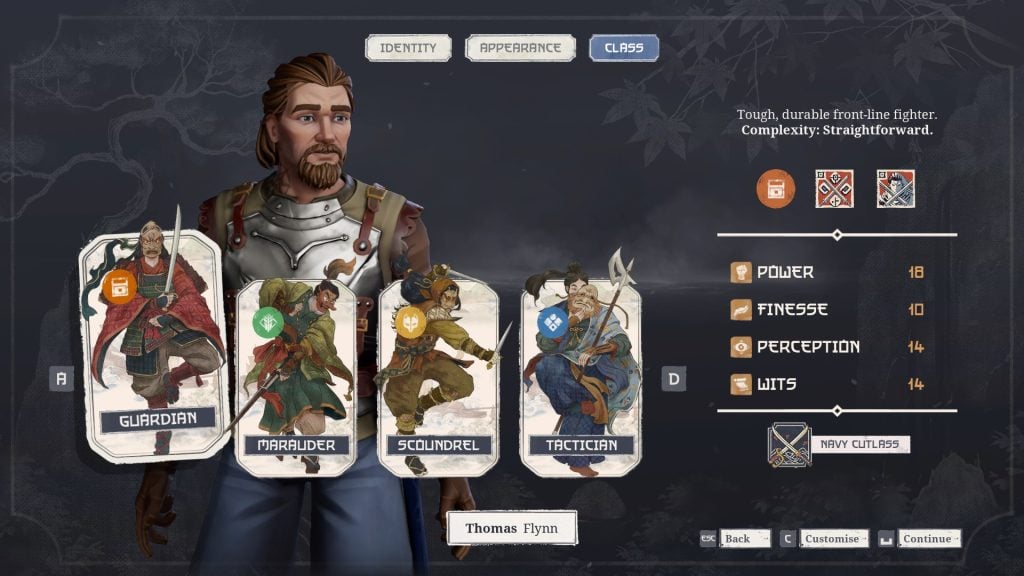
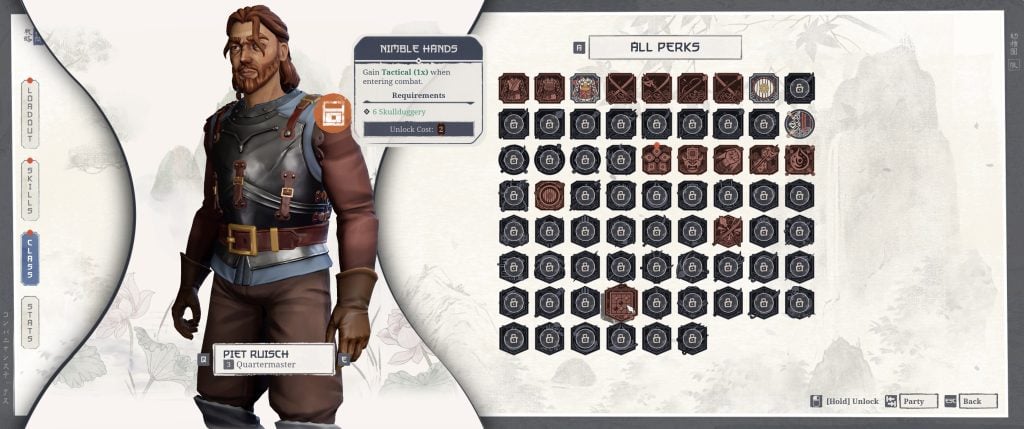
Characters also have a list of abilities that they can unlock. They get access to different abilities based on their class and skills that they have a lot of points in.
There are also universal abilities that can be unlocked for each character, such as armor type proficiencies and weapon type proficiencies. You have the freedom to build out each character in your party to play in a way that best matches your playstyle.
The game is split between real-time exploration and turn-based combat. While you are exploring, you can interact with different people, go to shops, and even sneak into places you probably shouldn’t.
Normally, your party members will just follow the character that you are controlling, but you do have the option to split the party up. When you do this, each character will remain where they are until you reposition them.
This feature can allow you to just focus on your character with the best Surprise Attack skill to sneak in and take out all the unsuspecting guards. Don’t forget to move the rest of your party up from time to time, though. If you don’t and they are too far away, then they won’t be activated into combat if your stealthy unit is spotted and combat begins. This can be a very fatal mistake.
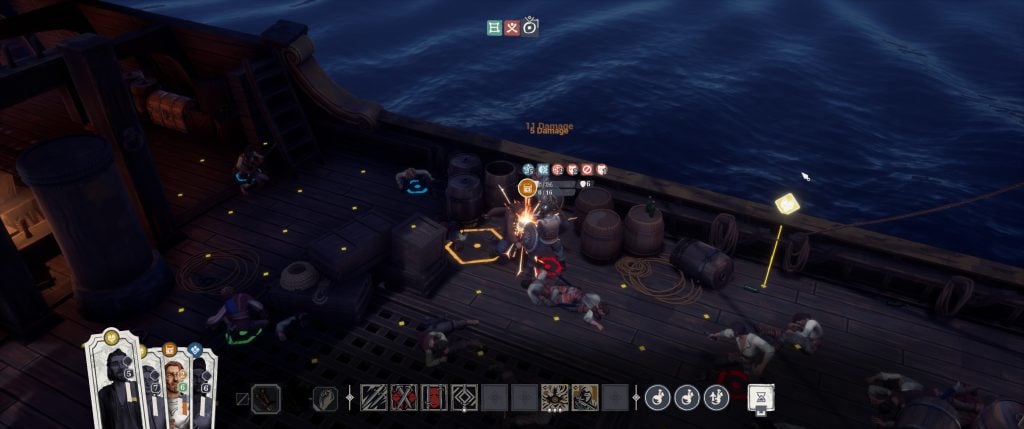
Once combat does start, you will switch over to turn-based combat, and a grid will appear on the ground.
Each of your characters will get to go first before it is the enemy’s turn. Your characters all have separate movement and action points. Positioning does matter in combat. Hiding a unit behind cover will prevent them from being shot by ranged attacks. Flanking a unit with at least two characters will increase your crit chance.
There is also an attack of opportunity to keep track of. This means that disengaging with an enemy unit will result in an automatic attack from them. The same goes if they try to run away from you, though.
Combat felt pretty fast. There were usually not a lot of enemy units to engage with. Movement and action points were so few that you simply moved, used an ability, maybe two, and then moved on to the next character. That’s not to say that combat was not interesting, though.
The different abilities of your characters added to the tactical depth of your options. There were also plenty of environmental things to interact with. You could knock an enemy through a wall or even set the ground on fire by shooting down a lantern. The fire can even last longer depending on what type of ground it is burning on. Having these environmental options helped to add an additional layer of depth to each combat encounter.
So far the game has been a lot of fun, but I am still pretty early in the game, and the fact that this was an early preview build definitely showed.
The game crashed on me several times. There were also a few voices for characters that didn’t make it into the game yet. I am sure these will be fixed before Early Access. At least I hope they will be. When the game was running, though, it was a lot of fun to play.
If the developers fix the bugs and add some finishing touches to the game, then it might be worth checking out during Early Access.
Personally, I prefer to wait until the game has been fully released. I really enjoyed the last two Expeditions games in the series, and it looks like I am really going to enjoy Expeditions: Samurai as well. It just needs a bit longer to be a full experience that I can recommend as a must-play.
Please head over to its Steam page to check the game out. Especially if you are a fan of the other games in the series. Make sure you add the game to your wishlist and keep an eye on it going forward.
A preview copy of the game was provided by the developer.
