

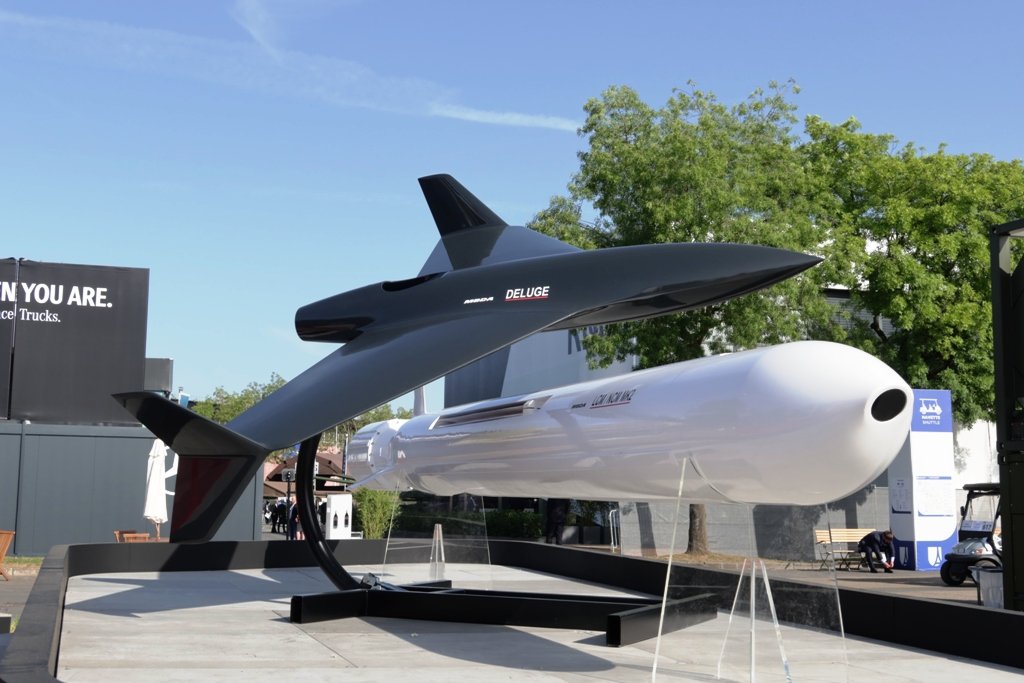
The MBDA stand at Eurosatory showcased the real size mock-up of the new version of the MdCN/NCM Naval Cruise Missile, the Mk II, as well as the real size mock-up of the Ground Launch System for the same missile, which will become the Land Cruise Missile system
On May 19th, 2015, over 11 years ago, the French Navy FREMM Aquitaine launched for the first time an MdCN (Missile de Croisière Naval, naval cruise missile), a first for as surface ship in Europe. Then known also as SCALP Naval, the acronym for Système de Croisière Autonome à Longue Portée, long range autonomous cruise system, in October 2020 the first launch from a submarine was performed.
At Eurosatory MBDA unveiled the upgraded version of the combat-proven MdCN, known as NCM Mk II, the acronym standing for Naval Cruise Missile, together with the LCM, the Land Cruise Missile. “Same missile, just two different launchers,” Paul Houot, Product Line Executive Tactical Strike at MBDA told media, in front of the mock-up of the four-canister Ground-Launch System, GLS in short.
The GLS employs several building blocks of the naval launch system, such as the firing unit electronics. It hosts four canisters capable to launch the LCM, the first demonstration firing being scheduled for 2028. The mock-up featured a frame structure supporting the launcher, which is raised at an approximately 35° angle before firing. Digitally produced images show the system installed on a three-axle trailer towed by a 6×6 tractor; the actual launcher is fitted at the back of the trailer, while at the front we find a container hosting electronics, the generator, and other ancillaries.

The LCM system thus becomes a highly mobile system, capable to fire within 15 minutes from reaching an unprepared position, and leaving it within the same time, reducing time to target, a key issue when dealing with volatile targets, as well as limiting the exposure to enemy counter-battery fire. It is to note that a cruise missile is inherently less vulnerable to counter-battery fire as it can manoeuvre attacking the target from a direction that does not betray the launch point. Having four missiles ready, a multiple launch can be considered to saturate the target defences. MBDA will make available the first GLS in 2029, the launcher being developed on company funds.
As mentioned, the missile is being modernised, which will allow improving range, survivability and lethality, modification being based on lessons learned and requests by customers. The main visual difference between the NCM and the NCM Mk II is in the nose cone, which shape is no more symmetric ogive and features a large transparent aperture clearly indicating the presence of a new, improved seeker. Most of the electronics is located at the front of the missile, followed by the warhead, the liquid fuel tank, the turbojet engine, and the add-on booster.

“The changing took place in the front part of the missile,” Ingénieur Principal Guillaume, the programme manager at the DGA, told EDR On-Line. Although not much was revealed, a new generation GNSS receiver with improved jamming resistance has been installed. Not be seen is the key survivability feature; according to MBDA the new front section ensures an increased stealthness, while enhanced flight performances allow the Mk II missile to fly at a lower altitude, further reducing its visibility to radars. The range issue remains undisclosed, apart the fact that the NCM/LCM Mk II will fly at over 1,000 km or 600 NM. Not even a vague indication was provided on how range increase was obtained; should it be considerable, a potential increase in the amount of available fuel, made possible by electronics miniaturisation, or the adoption of a more energetic fuel, might be the reason. The new front section shape might generate some extra lift while reducing drag. What is sure is that wings remaining the same, this being confirmed by the DGA programme manager confirmed. The MCI (Mass, Center of mass, and Inertia) remains unchanged, the DGA officer confirmed, which will ease adapting existing flight control laws to the new missile. Another element that was not detailed is the new warhead; apart from the fact that it ensures “increased lethality” and is capable to cope with hardened targets, such as buildings, reinforced command posts, as well as surface targets with airburst mode, no more comments were available. The angle of impact as well as the direction are established in the planning phase, ensuring maximum damage to the target according to the type of objective.
As the original MdCN/NCM, the NCM Mk II missile can be launched from surface ships as well as from submarines, the latter propriety being rare in cruise missiles. Two years ago France tested an attack mission having two missiles coming into a target at the same time while launched from a surface and a submerged platform. The LCM is obviously being launched from the GLS. The land LCM battery is made of a Firing Control Unit (FCU), the command and control vehicle which receives inputs from higher echelon, prepares the mission, and assigns it to the launchers, known with the acronym GBLU, for Ground-Based Launching Unit; each FCU can be linked to the upper echelon HQ and to four GBLUs. The NCM Mk II and the LCM Mk II will be almost identical. In fact while hardware will be exactly the same, Ingénieur Principal Guillaume explained that the guidance software is different: the ground missile optical guidance system will be active along the whole trajectory, while in the naval missile this will be activated only when the missile will overfly the coastline, the low level flight over the sea being regulated by a radar altimeter.
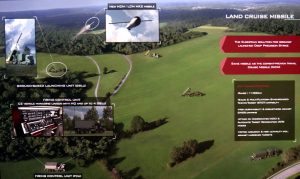
To fully exploit the missile, an efficient planning tool is needed. MBDA developed the FastTrack, an AI-based system that allows to reduce from hours to minutes planning time of a complex mission that involves NCM/LCM cruise missiles.
The system generates several trajectories, considering enemy defensive systems types and lethality and their locations provided by intelligence, terrain, weather conditions, the type of target, the number of missiles involved, the aim being of course to have them hitting the target in close sequence, usually less than 30 seconds. EDR On-Line could witness two different simulated missions, one against a time-sensitive target, a train stopped in a station, where time-on-target was the critical factor, and one against a hardened command post, considerations on the angle and direction of attack and the simultaneous arrival on target being here the priority. Mission planning was performed in real time by FastTrack.
Once the command post receives the target information, battery assets leave their cover positions and deploy, and in less than 15 minutes are ready to launch. In the meantime FastTrack generates its trajectories, compare them, and proposes the best solutions to the operator; on the screen we could see the percentage of the trajectory during which the missile was screened from enemy sensors, exploiting terrain features and low altitude flight, which is an indicator of stealthness by itself, the higher the better. AI-based algorithms taking into account all parameters provided solutions within a few minutes, average percent of stealthness oscillating between 75 and 85%.
A third mission was considered at nearly the maximum distance, from north-west to south-eastern France, close to 1,000 km range. Here the percent was way under 50% half way through the mission, due to a forward located enemy air defence asset. Neutralising that battery was key to considerably increase the mission success probability. Thus the HQ decided to add to the mission a swarm of Deluge, what before Eurosatory 2026 was known as One Way Effector, a long range loitering munition unveiled by MBDA at the Paris Air Show 2025.

While NCM/LCM Mk II are high value effectors, the Deluge was designed to be low cost and easy to produce; MBDA has partnered with drone manufacturers and the civilian industry, and is capable to produce over 1,000 such effectors a month. The mission conducted with this high-low mix of effectors proved effective, the 34% stealthness rate jumping over 80% as soon as the enemy battery was neutralised, which does not necessary means destroyed, as if it emptied its magazines it does not represent a threat anymore. Around 30 Deluge were used to obtain that effect. At the bottom of the screen it was possible to see the missiles flight altitude, which was always pretty low, a key data in ensuring maximum stealthness.
According to Sophie Bourdais, Commercial Director for Strike at MBDA, the company is awaiting a contract from the DGA, which will cover the Mk II development costs and will also include a first production batch of the new missile. The contract should be signed once France Programming Military Law will be finalised. The new missile will be available in 2030.
Photos by P. Valpolini
