

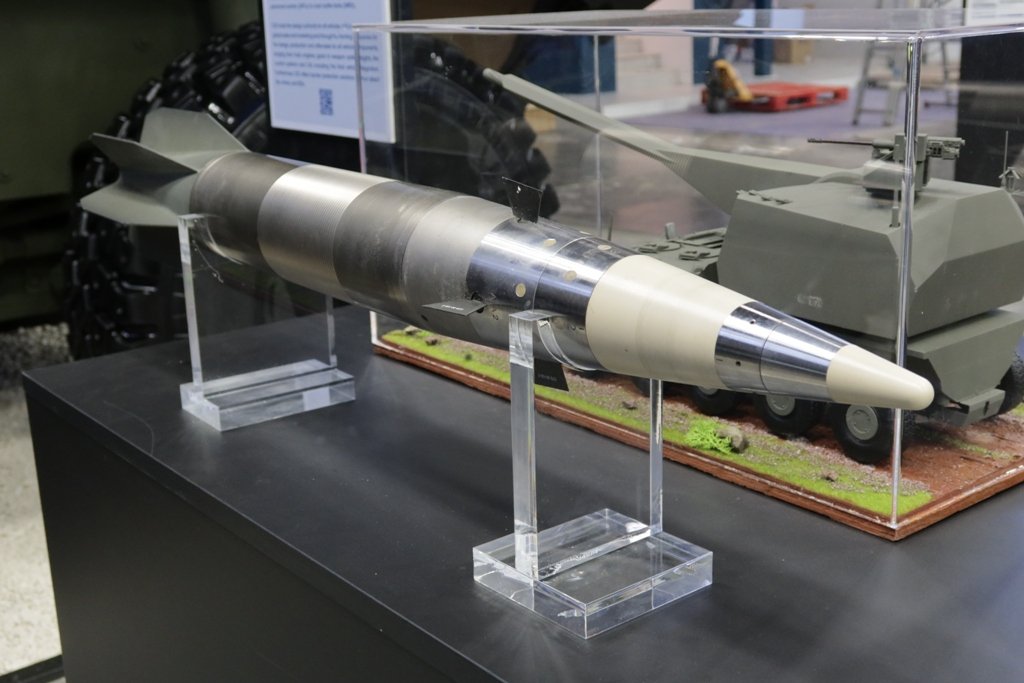
In the early 2000 Leonardo launched a development programme for a family of long range unguided and guided ammunition for naval and land applications. Named Vulcano, some family members are already available while some are being developed. At Eurosatory 2026 the Italian defence group exhibited the 155 mm and 120 mm rounds, the former together with the model of a wheeled SP howitzer, the VBM 155, which prototype will be ready in autumn, the latter beside the IMBT, the Italian MBT under development by LRMV, the joint venture between Leonardo and Rheinmetall
Vulcano 155
On June 5th, 2026, General Dynamics Ordnance and Tactical Systems (GDOTS) as prime for an industrial team including Leonardo and Diehl Defence, has been awarded a $ 37.86 million developmental contract for the U.S. Army’s next-generation extended range artillery projectile, a derivative of the Vulcano 155 Guided Long Range (GLR) ammunition, as part of the ERAP (Extended Range Artillery Projectile) programme. The Vulcano is in competition with two other US solutions to meet the ERAP requirements.
Being selected by the US Army was definitely a major success for the Vulcano, which is a joint programme with Diehl Defence, the German company providing the seekers for the guided versions of the rounds.
In the 155 mm calibre the simplest version is the BER, for Ballistic Extended Range; a subcalibre round, its low drag compared to full bore ammunition allows the round to reach a target at 50 km distance when fired from a 52 calibre barrel, nearly 30 km more than conventional 155 mm rounds. The BER is in production. The same is true for the GLR versions, however some development is still ongoing to adapt them to the needs that emerged from recent conflicts, mostly that in Ukraine.

The GLR is available in various versions. The basic GLR is guided by an inertial measuring unit (IMU)-global navigation satellite system (GNSS), the round being fired on coordinates; currently the round is available with military encoded GPS or commercial GNSS receiver, which exploits the Galileo unencrypted signals. For the time being no miniaturised, hardened and encrypted Galileo receivers are available, although some work is underway to develop them. All GLR rounds are fitted with four canard wings used to guide the round in flight; these provide some lift, which further extends the range compared to the BER, up to 70 km, and allow to shape the trajectory, adapting the impact angle to the type of target.
Another version available is the Vulcano GLR-SAL (Semi-Automatic Laser), in which the seeker guides the round following the laser beam reflected by the target, the beam being generated from a laser illuminator, either land or air based, the second being equipped with an Imaging InfraRed (IIR) seeker. This obviously provide metric accuracy, which together with the reduced amount of explosive, the round being undercalibre, considerably limits potential collateral damages. Not only, the SAL guidance allows to hit mobile targets, as the illuminator can track them; illumination is usually limited to usually around 10 seconds, an active system being easily detected by enemy countermeasures.
The second version fitted with a seeker is the GLR-IIR, for imaging infrared, which picks up the thermal signature of the target in the last phase of the trajectory, guiding the round as close as possible. The seeker used in today rounds is the same used on the Vulcano 127 naval round; its resolution is not sufficient to discriminate a land target on the background terrain, however several customers acquired it as they intend using their artillery assets in the coastal battery role, hence against naval targets, for which the current seeker works properly.

However a higher resolution IIR seeker is in development, to give the 155 GLR-IIR a capacity against land targets. No information was released about the developing company and when the new round will be available. EDR On-Line understands that this might leverage the work which is being done for an IIR seeker for the Vulcano 120 round.
One of the outcome of the Ukrainian conflict is that in many areas satellite navigation systems are jammed or spoofed, hence we the GPS fix can exploited only when and where possible. To bypass the risk of jamming Leonardo developed a mode in which the guided munition is fired on coordinates, adopting for most of the flight a ballistic trajectory, the seeker being activated as usual in the final part of the flight. Of course this reduces the range, as the lift provided by the canard wings cannot be exploited to increase it, ensuring however accuracy within the 50 km range typical of BER ammunition.
Another lesson learned from the Ukrainian conflict is the enormous number of artillery rounds fired daily. As many other defence groups, also Leonardo is dealing with this issue, and is currently doubling its production capacity.
Vulcano 120 mm
The other land member of the Vulcano family is the 120 mm round, which is being developed to provide a secondary indirect firing capability to main battle tanks (MBTs). Typically the maximum elevation of an MBT gun is around 20°, much less than that of an artillery howitzer, which is born for indirect fire missions, but sufficient to deal with targets at over 10 km distance, allowing a tank formation to hit a beyond-line-of-sight (BLOS) target without the need to require the intervention of support units. The Vulcano 120 programme was made public in July 2025 and is still in the early development phase, a first product being foreseen in three-year time.
Hitting a BLOS objective is not only a matter of range and of overcoming obstacles between the firing platform and the objective, it also needs to guide the projectile on the target. The first iteration of the Vulcano 120 will be fitted with a SAL seeker, hence it needs an illuminator that tracks the target, and at Eurosatory the round mock-up was showcased together with a nominal ISR VTOL drone, a quadcopter, which payload is compatible with that of a miniaturised laser illuminator. The drone would fly well ahead of the tank, acquire the target, and loiter at a range of 2-4 km from the target, which dictates the illuminator range. As Leonardo is considering targets at ranges between 10 and 30 km, this means a flight time of around 20 to 60 seconds if we considering a flat trajectory, the average velocity of the Vulcano 120 being between 500 and 600 m/s. As said obstacles between the firing platform and the target might impede reaching the objective, due to the limited elevation of MBT guns; Leonardo engineers are therefore working on “uphill” trajectories, exploiting the projectile manoeuvrability since the beginning of the flight. Some 2 to 3 km after launch the manoeuvring capacity of the round comes into play, pulling up the projectile to allow it overcoming vertical obstacles. Trajectory shaping is also used in the final phase of the engagement, to hit the target at the most effective angle or to reach it even if it is hidden close to an obstacle.
Here too Leonardo engineers consider a 10 seconds target illuminating session, a time based on considerations about time of impact uncertainties, energy consumption, cooling and becoming easily detectable.
Tests with the Vulcano 120 have not yet been carried out, however Leonardo considers the activities done with the Vulcano GLD-SAL a risk-reduction factor. The company is currently defining system requirements without linking it to any specific drone or designator. Should line-of-sight engagements at long range (5-10 km) be required, Leonardo considers the Vulcano 120 could cope with this mission, with the aim of neutralising the threat disabling for example its optics rather than destroying it.
A Vulcano 120 with an IIR seeker is also part of the development programme. Work on the IIR seeker is ongoing, EDR On-Line understood, which might also be adapted to the Vulcano 155 GLD-IIR to be used against land targets, however no more details were provided.
Photos by P. Valpolini
