

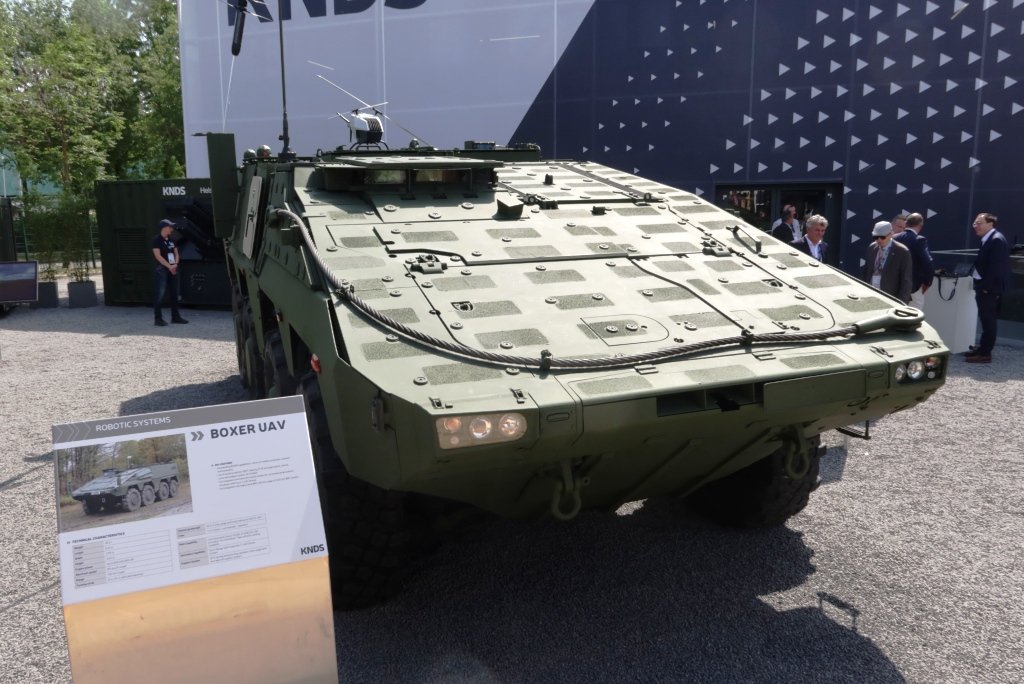
The presence of UAVs on the battlefield is increasing exponentially, thus KNDS Deutschland is looking at new ways for integrating them into mobility platforms, to provide them with ISR as well as kinetic effects capabilities. At Eurosatory KNDS Deutschland displayed several solutions in cooperation with UAV partners, however the company intent is to propose its solutions as drone-agnostic systems
Three solutions were exhibited by the German branch of KNDS at the Paris exhibition, one based on the Boxer 8×8 platform, providing heavily protected UISR and C-UAS capabilities to frontline formations, one based on a container, which can be left unattended, allowing to create a mesh of C-UAS and loitering munitions distributed system, and the final one based on a light armoured vehicle, giving protection against incoming UAV threats to lighter formations
Boxer UAV
Leveraging the Boxer modularity KNDS developed a new module to provide armoured formations with a dedicated UAV-carrier platform, the 8×8 chassis ensuring maximum mobility on the battlefield. The Boxer UAV prototype seen at Eurosatory was carrying three different types of drones. Inside, on the right, we could find an undisclosed helicopter-type ISR UAV with intermeshing rotors; according to information gathered at the show EDR On-Line understood this might be a prototype from Anavia from Switzerland, part of EDGE, or from Vectacore from Austria. The bigger UAV was hosted on a platform which could slide on the left at the centre of the vehicle, to be then raised once the roof grid had been opened, bringing the UAV on the top of the Boxer before spreading its rotors for take-off. On the left side we could find interceptor drones five Interceptor EOS drones provided by Tytan. As the name indicates, the mission of these electrically powered small drones, mass is 3.5 kg, is to kill enemy incoming drones up to Class II. The deployment follows the same pattern; the tray is moved to the right, elevated, and the killer-drone is ready for take-off. It has a 20 km range, can reach a 3,000 metres ceiling, and reach a maximum speed of 200 km/h.
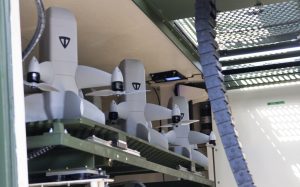
The Interceptor EOS is initially guided by a ground radar but is fitted with an autonomous navigation system, target detection being ensured by an AI-powered thermal camera fitted in the nose. No explosive warhead is installed, target neutralisation being done only exploiting the drone kinetic energy.
Mounted on the side of the Boxer we could see a smaller ISR drone, the MX10 by KNDS France, a tube-launched system with counter-rotating rotors, which provides shorter range surveillance. The Boxer UAV has a crew of three, driver, commander, and operator, and is equipped with an iC2D command and control system, by KNDS, which allows controlling up to three ISR UAVs. Drones can take-off even with the mothership vehicle on the move, and recoverable ones can also land while the Boxer UAV is moving. The take-off and landing system is protected against jamming and can operate also in GNSS-denied conditions. The Boxer UAV main task is to control up to three medium-range ISR rotary wing platforms, while providing as secondary mission a short-range self protection against drones.
Drone Launcher Container
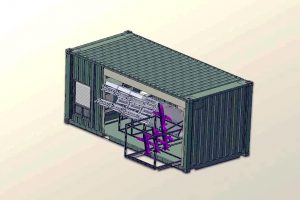
KNDS Deutschland acted as integrator developing a container-based concept in cooperation with three German partners, steep, Tytan Technologies, and Helsing. The mock-up of this container was visible on the company static display, the customised 20-foot container being provided by steep GmbH. Looking at the system from the front, on the left we find the section reserved to ancillaries, which is the power system and communications, the latter ensuring the link with the overall network. The container can be transported by a high-mobility truck and deployed on the battlefield, remaining active for days waiting for activation from higher echelon. Several containers distributed on a wide area according to a precise planning ensure two main roles; one is protection against incoming threats from the air, the second being a strike capability. The area C-UAS role is provided by the Interceptor Metis long-endurance interceptor provided by Tytan GmbH, which has a 60 km range, a 5,000 metres ceiling, and a maximum speed of 375 km/h. Its layout is that of a classic mid-wing airframe, each semi-wing hosting an electric motor activating a pulling two-blade propeller. The system takes-off from a high-angle ramp, a single module hosted on the right side of the container accepting three Metis; when operating, the module is moved forward, to free the space over the drones to be launched. The Metis has a take-off mass of 6 kg and hosts a 1.2 kg fragmentation warhead.
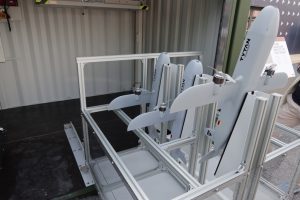
Tytan is also providing it a self defence C-UAS capability n the form of two Interceptor EOS killer drones, the same used on the Boxer UAV previously described. Here the drones are hosted each one on a mobile tray located at the back over the Metis module; a window at the rear opens to let the tray exit the container, to allow space for the EOS take-off.
Between the service module and the Tytan module we find the modules developed by Helsing GmbH for launching its HX-2 AI X-wing electrically powered strike drone. Three of them were hosted in the container, each one accommodating two munitions, for a total of six. The HX-2 has a 100 km range, a maximum speed of 220 km/h, and mass at launch of 12 kg. Each surface of the X-shaped rear empennage hosts an electric motor which activates a two-blade pulling propeller. The Helsing loitering munitions can carry different types of warheads, multipurpose, antitank, or anti-structure. During Eurosatory Helsing and Eurenco, the French energetic materiel specialist, signed an MoU for the development of a sovereign European warhead for the HX-2. Presented as a concept project, the Drone Launcher Container can be combined also with other effectors, KNDS and its partners looking at the reactions from potential customers before developing a final configuration.
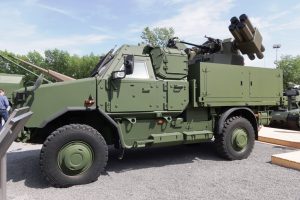
Last but not least comes the Dingo 4×4 RIWp, which sees two proven systems, the KNDS Dingo 4×4 platform and the Moog Reconfigurable Integrated-weapons Platform (RIWp) generate a light armoured C-UAS solution. The vehicle used is the pick-up variant with a two-man armoured cabin, the turret armed with a 30×113 mm gun and two four-missile pods, one per side, being installed at the rear. Fully modular, the RIWp can accept several types of effectors, adapting it to customers’ needs.
Graphic courtesy KNDS, photos by P. Valpolini
