


Showcasing its new FP-7 and FP-9 ballistic missiles at Eurosatory, Fire Point, the Ukrainian drone and missile company attracted extra interest on Day 4 following the successful night attack against Moscow
FP-1 drones, produced by Fire Point, are becoming a common sight in the sky over Moscow. In the night between June 17th and 18th a major strike hit the Moscow Oil Refinery. Videos show the attack drone being hit by last ditch defences in the very last phase of the attack, however the warhead detonated, and causing mayhem. The images show the lid of one of the fuel tanks flying into the sky and falling back. According to unverified sources, it would have a diameter of around 14 metres.
Before noon this video could be seen on the mega screen behind the new FP-5 Flamengo, FP-7 and FP-9, at the Fire Point booth in Eurosatory. A coincidence that generated an even greater interest in the exhibitor booth.
The FP-1 and FP-2 share the same airframe; a square section fuselage, fitted with a 6 metres span straight wing, an inverted-V tail plane linked by two spars to the wing, and an internal combustion engine at the rear activating a two-blade propeller. A classic configuration, typical of ISR tactical drones, with the main difference being that the FP-1 carried a 60 kg warhead at 2,700 km distance while the FP-2 has a 200 kg warhead, the 140 kg difference in fuel bringing range down to 700 km, flight time being respectively 18 and 4 hours. The maximum take-off mass is the same for both, 330 kg, as well as speed, maximum being 205 km/h while cruise varies between 140 and 180 km/h. To reach minimum lift speed the FP-1/2 are launched from a ramp with the help of a booster, or from a truck on the move on a paved road.
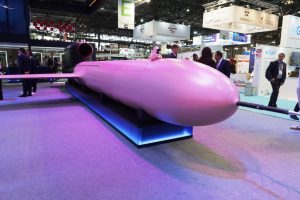
While the Fire Point stand was dominated by the huge pink FP-5 Flamingo, a 6,000 kg cruise missile capable to carry a 1,150 warhead at 3,000 km distance with a cruise speed of 650-700 km/h cruise speed, maximum being 950 km/h, two new systems were visible, the FP-7 and FP-9.

The FP-7 is based on the Russian S-400 missile and its first iteration will generate a ballistic weapon capable to carry a 200 kg payload at 250 km, maximum time to target being 250 seconds. It reaches an apogee of 50 km, declared accuracy being 14 metres. It is launched from a ground-based platform and is considered an alternative to the US-made ATACMS. It is powered by a solid rocket motor, and reaches a maximum speed of 1,500 m/s (5,400 km/h).
The ballistic version is in the very final stage of development, according to FP sources, however the real aim of the FP-7 development is to become an interceptor missile, capable to intercept incoming air threats at range. It will become the munition of the Freyja system, the aim of Fire Point being to develop a system with the capabilities of the Patriot but at one third of the cost. To shorten development time the Ukrainian company, which was formed in 2022, is talking to European companies, the main topics being seekers and radars. For Ukrainian companies the time-to-market expression is translated into time-to-frontline, Fire Point aiming at a first launch by the end of 2027. EDR On-Line understood that the ground-based air defence version of the FP-7 might feature a form of thrust-vectoring system to allow it a higher manoeuvrability in the very first phase of the flight, as air targets are definitely less predictable than static land targets. It also seems that the warhead mass might be reduced to 150 kg, allowing greater acceleration and manoeuvrability,
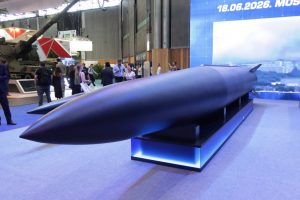
A similar system could be seen on the FP-9, the much bigger ballistic missile, currently in active development at Fire Point. It will carry a maximum payload of 800 kg at 850 km distance, maximum speed being 2,100 m/s (7,560 km/h). Maximum flight time will be 520 seconds, the apogee remaining 50 km, while accuracy is 20 metres.
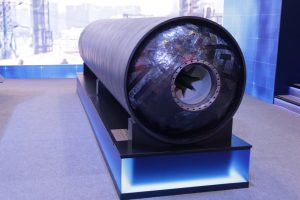
At Eurosatory Fire Point also exhibited the huge solid rocket motor under development for the FP-9, which generates a 37,000 kgf of thrust, the critical nozzle throat diameter being 190 mm. Manufactured using continuous filament winding of carbon fibre and epoxy resin, the casing is 4,392 mm long while the overall motor length is 5,102 mm, diameter being 1,000 mm. Without propellant the engine mass is 570 kg, to which 4,700 kg of propellant must be added, for a total mass of 5,270 kg. EDR On-Line understood that the motor thrust will last around 10 seconds, sufficient to reach the required velocity.
Ukraine will be soon capable to hit targets at tactical distances with the FP-7, the FP-9 moving this capacity up to the operational level, no timeline for this programme being available.
Photos courtesy Internet and P. Valpolini
