

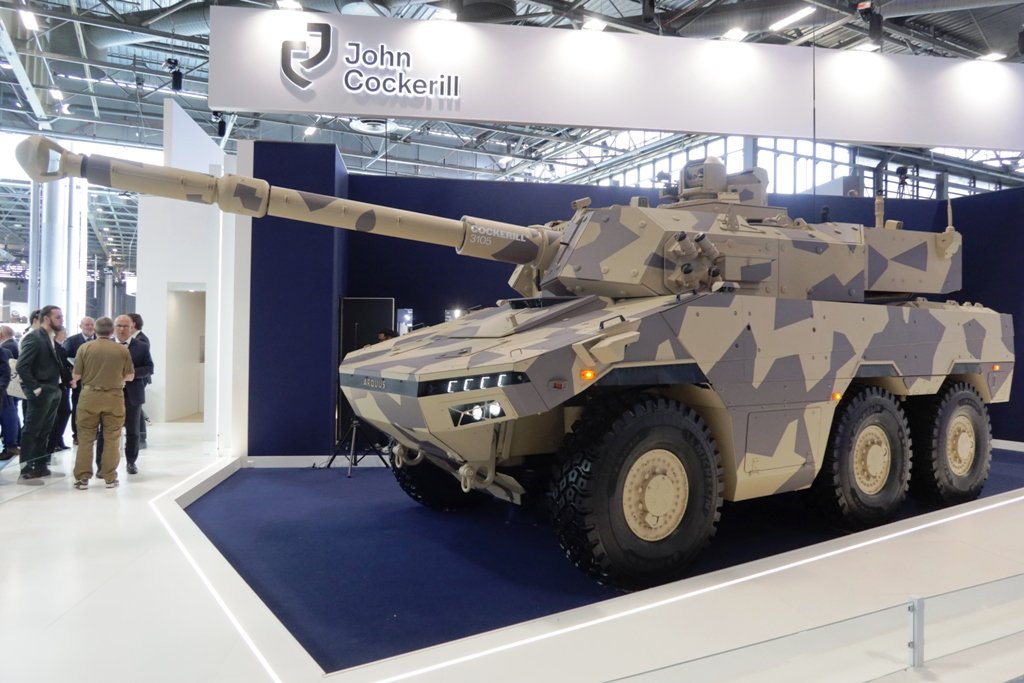
The star of Day 1 at Eurosatory 2026 was the Fenris, the reconnaissance vehicle unveiled by John Cockerill, which puts together the skills of the Belgian company, a specialist in turrets and armaments, and the mobility knowledge of Arquus, which has now become fully part of the Belgian group.
The Fenris, this is the name given to the new 6×6 armoured car, was developed in a super short time; as company responsible explained, the idea was launched in Q1/25, the real design work starting in July that same year. Ten months later, in May 2026, a fully working prototype was put together, in time to be unveiled at the exhibition taking place at the Parc des Expositions de Villepinte, close to the main Paris airport.
Such a short development time was made possible by the fact that the Fenris couples two well proven systems, which underwent some modification but mostly leveraged the experience acquired in recent years, the chassis of the 6×6 Jaguar, the reconnaissance vehicle used by the French and Belgian armies, and the Cockerill 3105 turret, in use by several customers, including Ukraine.
As said, some modification were needed; the Jaguar was designed for a smaller turret, armed with a 40 mm CTAI cannon, while the Cockerill 3105 turret was designed for MBT chassis or 8×8 IFVs, which tend to be higher than a 6×6 armoured car of the Jaguar class. This led to some modification; one is that the maximum elevation of the 105 mm rifled gun is limited to 36°, on MBTs it can go up to 42°, well sufficient to allow hitting target in high positions, as well as reaching targets at 10-11 km range when firing in indirect mode. As for the chassis, the wheelbase is now 4,360 mm, with 2,670 mm between the first and second axle, and 1,690 mm between the second and the third, while total length without gun is 7,393 mm versus the 7,100 mm of the Jaguar 6×6, a small increase to allow hosting the bigger turret. Overall length increase is obviously much higher due to the bigger gun, the Fenris being 9,715 mm long while the Jaguar is 7,800 mm. Mass increase is marginal, 26 versus 25 tonnes, therefore the engine remains the same, the Volvo HDE 11 diesel engine, which provides 500 hp and a 2,475 maximum, coupled to a ZF automatic transmission with seven gears. The Fenris can run in 6×4 mode when on paved roads, thus reducing fuel consumption, switching to full 6×6 mode when going cross-country. Standard ground clearance is 462 mm, however this can vary thanks to the variable height suspensions adopted. These allow reducing the vehicle height when hiding behind a natural obstacle, or increase the ground clearance when operating on difficult terrain. They also allow the vehicle to vary its pitch, should this be needed for example to “virtually” increase gun elevation. Angles of attack and departure are both 45°. The Fenris can be equipped either 14.00 R20 or 16.00 R20 tires and is fitted with a centralized tire inflation system, which allows adapting the tires footprint to the ground conditions.
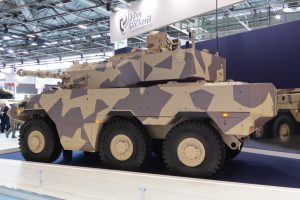
The Fenris chassis is 2,994 mm wide and 2,197 mm high; considering the Cockerill 3105 turret height becomes 3,095 mm, which raises to 3,717 mm when considering the Hornet remotely controlled weapon station, a height which however remains compatible with the 3,850 mm height of the A400M cargo compartment, the other dimensions as well as the mass being well within limits.
The driver is located in the front part of hull, at the centre, commander and gunner being hosted in the Cockerill 3105 turret, which represents the lethality key element of the Fenris, packing the punch of a medium MBT in a 26 tonnes vehicle. Produced in welded ballistic aluminium, protection can be upgraded up to Level 5, although EDR On-Line understood that the Fenris overall protection is Level 4 according to STANAG 4569. The high pressure 105 mm rifled gun allows using all NATO standard ammunition in that calibre, the turret being stabilised on two axis. The Cockerill 3105 is fitted with an automatic ammunition loading system that hosts 12 rounds, two more sets of 12 rounds each being hosted in the hull. For target acquisition and aiming the commander can use a panoramic periscope which pan and tilt allow for 360° observation located on the right side, on top of the turret, while the gunner has an optronic sight, located on the right side of the gun. Their optronic suite is identical, and provides detection/reconnaissance/identification ranges respectively of 18, 9 and 5 km in daytime and 15, 7 and 3.5 km at night. This allows using the turret in the hunter-killer mode. An auto-tracking system employing artificial intelligence-based algorithms ensures high accuracy, the company claiming a 95% success at 2 km range on the move against mobile targets.
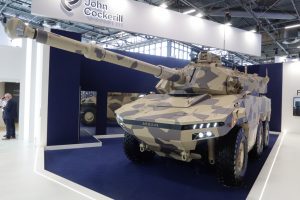
To counter the drone threat, the Fenris is fitted with a Hornet C-UAS remotely controlled weapon station armed with an FN MAG 58 7.62 mm machine gun.
The Fenris is developed to provide reconnaissance units with a highly mobile vehicle with heavy firepower, capable to move stealthy, thanks to the wheeled solution and the reduced size, and eventually to react shaping enemy formations through fire. It can also add punch to infantry formations, which today seldom have the luxury of being accompanied by large calibre mobile systems. That said, discussions between supporters of medium and heavy calibres in the reconnaissance role will continue. The Fenris adds a modern big calibre option, following the path of the well known AMX-10 RC.
John Cockerill Defence is ready to deliver the first vehicle within 16 months from the order.
Photos by P. Valpolini
