

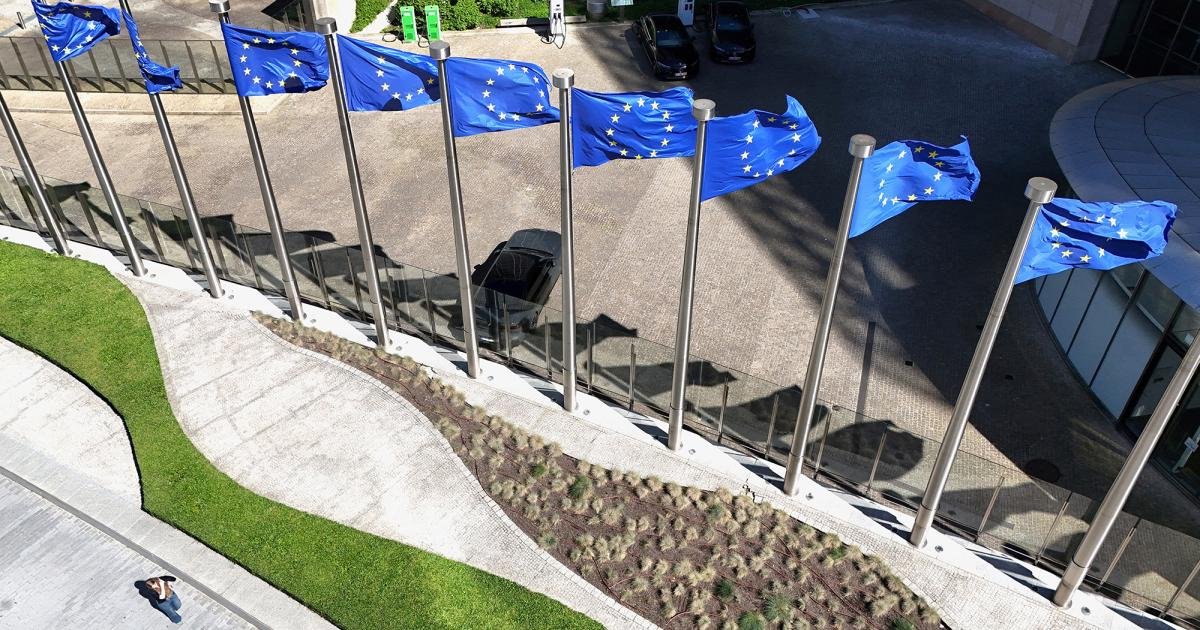
The irony has not been lost on European policymakers. As U.S. President Donald Trump desperately casts about for a 51st state—Canada, Greenland, and Panama all said no this past year—the European Union’s membership queue is the longest it has been in decades. Despite the Trump administration’s accusations of civilizational decline in Europe, EU accession negotiations are advancing with an urgency not seen since the bloc’s last major expansion in 2004. Nine countries hold official EU candidate status, including Moldova, Montenegro, and Ukraine. Others are considering it, too. In a referendum in August, Iceland, which is already in the European Economic Area and enjoys many of the benefits of EU membership, narrowly voted not to reopen negotiations to join the bloc, 52.8 percent to 47.2 percent. Meanwhile, the United Kingdom, which left the European Union in 2020, is spending considerable political capital trying to rebuild the economic relationship it forfeited when it left.
Scores of other countries, meanwhile, are seeking closer economic ties with Brussels. The EU concluded trade negotiations with India and the South American trading bloc Mercosur in January, with Australia in March, and with Indonesia last September. This pace of new economic deals is unprecedented and partly a response to U.S. volatility. But it also reveals a rising global recognition that although the EU is relatively slow moving, the agreements it signs are dependable. Its bureaucratic process and institutional lethargy are proving, unexpectedly, to be an asset in an age of instability.
AFTER THE FLOOD
Trump came to office in January 2025 with a new theory of U.S. economic leverage. The United States is the world’s largest import market. Trading partners, he reasoned, needed access to U.S. consumers more than the United States needed access to their goods. That imbalance, if exploited with sufficient force, would produce concessions on trade flows, investment, and the rules governing global competition. His means of applying this force was tariffs, which were deployed at a speed and scale that rattled global markets.
Initially, it seemed that U.S. economic leverage had been judged correctly, since numerous framework agreements followed. But these were the product of executive actions—unratified by Congress and built on legal authorities that the courts were already contesting. When the Supreme Court ruled the tariffs unlawful in February, the administration replaced them with those empowered under a different statutory authority. Countries such as the United Kingdom, which had offered concessions to secure a deal, found themselves no more certain of the terms than before. It was becoming clear that U.S. trade policy could and would change overnight. The volatility that was supposed to generate leverage became instead a permanent condition, undermining the U.S. position.
Indeed, a year on, the results are not what the president predicted. The U.S. goods trade deficit reached a record $1.24 trillion in 2025, despite the highest effective tariff rate in generations. The deficit narrowed somewhat in the early months of 2026 but widened in July to $119.60 billion, 31 percent above the 12-month average. The tariffs did shift where Americans buy goods, and the deficit with China has fallen. But much of that trade was simply diverted rather than reduced—the three largest U.S. goods deficits are now with Mexico, Taiwan, and Vietnam.
The promised reshoring, meanwhile, has not arrived. Manufacturing shed tens of thousands of jobs through much of 2025, and although the sector has begun a modest recovery in 2026, total employment remains only marginally above where it stood when the tariffs took effect. Companies, it is now apparent, do not build factories on the basis of a 90-day tariff pause or a framework whose terms may not survive the next executive order. Again, the uncertainty that was supposed to generate leverage backfired. More than three-quarters of manufacturers surveyed through 2025 by the National Association of Manufacturers cited trade policy uncertainty as their top concern.
Trading partners have drawn their own conclusions. Canada, the United States’ largest trading partner, suspended trade negotiations in August after the administration introduced last-minute demands, which Prime Minister Mark Carney described as uneconomic and unfair. In explaining his decision to walk away, Carney said that the U.S. approach had “called into question the reliability of any deal.” Governments and investors must now permanently price in the risk of U.S. executive discretion. Regardless of who wins the presidency in 2028, formal trade agreements with the United States no longer offer any certainty that the specifics will remain unchanged over the medium term.
SLOW AND STEADY
A growing number of countries, confronted by the uncertainty that this strategy has produced, have begun to look elsewhere. Their gaze is increasingly alighting on Europe, the world’s second-largest consumer market. For decades, the standard critique of the EU as an economic partner was that it was too slow, too rule-bound, and too hampered by the necessity of finding consensus among its 27 member states. That critique is not wrong. But the rules that complicate EU decision-making were designed to solve a specific and difficult problem: how to make economic integration possible across a continent of vastly unequal economies. The rules that slow the process also ensure that France and Germany cannot simply override the Netherlands or dictate terms to Portugal. That was the price the large economies paid to bring the small ones in. The rules of the single market—the level playing field, the shared external trade policy, and the jurisdiction of the European Court of Justice—were designed to make membership attractive to less powerful countries by guaranteeing that the more powerful ones could not call the shots. Nobody anticipated that these same rules would turn out to be an asset in a world shaped by volatility and executive authority.
The rules of the single market bind every member state equally. France cannot unilaterally grant its industries preferential treatment. Germany cannot override a common external trade policy because a new government finds it inconvenient. The constraints that frustrate European governments when they want to act quickly are the same constraints that make European commitments durable. No election can reverse them. No executive order can impose new terms overnight. An agreement concluded under Brussels’s rules, therefore, carries a different kind of assurance from one concluded under Washington’s. In the EU, trade agreements require negotiation by the European Commission, approval by a qualified majority of member states in the European Council, and, ultimately, the European Parliament’s consent before they fully enter into force. New defensive tariffs can be imposed only after the commission conducts a formal investigation, which is bound by statutory deadlines and triggered by evidence of injury to European industry. There is no equivalent in Brussels to such executive authorities as Section 301 or Section 232, which allow a U.S. president to impose or remove tariffs at will. The same logic that binds France and Germany internally also shapes how the EU engages externally: as a partner bound by rules rather than one that sets terms by power.
The United Kingdom tried a different approach. With leaders including then Prime Minister Boris Johnson arguing that a country of its size and trading relationships could do better outside European rules, the country voted to leave the EU in 2016. British business has since discovered that the rules that felt constraining turned out to be load bearing. The British government’s Office for Budget Responsibility has estimated that Brexit has reduced trade with Europe by 15 percent and made the economy four percent less productive—a loss of roughly $135 billion a year. A comprehensive U.S. free-trade deal, which leading advocates of Brexit argued was a certainty, never arrived. What came instead, in May 2025, was a four-page, nonbinding framework that reduced tariffs on a quota of British car exports and offered some relief on aerospace, subject to the same volatility that has defined U.S. trade policy. London is now going in a different direction, negotiating closer regulatory alignment with Brussels on agriculture, energy, and defense. These are modest steps toward rebuilding the economic relationship the United Kingdom walked away from.
BUILT TO LAST
When countries sign agreements with the EU, they are buying into a system whose core purpose is the preservation of rules and stability, one designed to outlast the political cycles of any member state. Access to the EU single market of 450 million consumers is valuable on its own terms. Less considered is the value of the institutional framework that comes with it. This economic power is not of a type that the EU set out to build, and as a consequence, it seems not to recognize what it has. This lack of awareness was on show in 2025, when, fearful of a trade war, Brussels squandered its own leverage and signed off on a lopsided framework with Washington. Under this agreement, the EU accepted 15 percent tariffs on most of its exports and pledged to make hundreds of billions of dollars in energy purchases and investment.
Attitudes may be changing. In February 2026, António Costa, president of the European Council, declared the single market to be Europe’s “superpower” and the EU “a trusted partner for those who want a reliable, predictable, and rules-based partnership in an increasingly challenging geopolitical environment.” Countries are drawing closer to the EU not only because of its market size but also because it offers terms that are durable. Indian Foreign Minister Subrahmanyam Jaishankar put it plainly after signing the EU-Indian trade deal: “In a multipolar and uncertain world, the India-EU partnership will act as a factor of stability and resilience.”
Further proof is in the agreements themselves. The EU’s agreement with Mercosur, for instance, which took effect provisionally in May, was finally signed after more than 25 years of negotiations. It is the largest trade agreement Brussels has ever concluded, creating a trading zone of more than 700 million people across Europe and the four Mercosur economies of Argentina, Brazil, Paraguay, and Uruguay. The EU was already the region’s largest foreign investor, with $453 billion invested across the four economies as of 2023. But annual trade between the two blocs—currently more than $125 billion—is projected to increase by 40 percent by 2040. The deal still requires the European Parliament’s consent and a Court of Justice review to enter into force. Unlike executive agreements that can be reversed overnight, EU trade commitments must run a gauntlet of institutional review before they become permanent. When Brazil ratified the agreement, President Luiz Inácio Lula da Silva described it not as a trade policy achievement but as a reaffirmation of multilateralism in an era of unilateral tariffs. “At a time when unilateralism isolates markets and protectionism inhibits global growth,” he declared, “two regions that share democratic values and a commitment to multilateralism choose a different path.”
The EU possesses precisely the kind of stability that this volatile moment demands.
Brussels also concluded an agreement with Indonesia, in September 2025, after nearly a decade of negotiations. This deal, covering Southeast Asia’s largest economy and 280 million people, eliminates tariffs on 98 percent of goods traded between the two. Crucially, Indonesia agreed to lift local content requirements in electric vehicle and renewable energy supply chains—a major concession from a country that had been using those requirements to attract manufacturing investment. EU Trade Commissioner Maros Sefcovic, when signing the agreement, described it as “a clear signal that the EU and Indonesia are choosing openness and partnership . . . in a world of rising protectionism.”
Brussels, perhaps realizing it has something of value to offer, has increased its ambitions since then. Its negotiations with Australia, which began in 2018 and concluded in March, paired a trade agreement with a security and defense partnership. The combination gives the EU preferential access to Australian lithium, manganese, and other critical minerals essential for electric vehicle batteries and renewable energy supply chains. Australian Prime Minister Anthony Albanese described it as building resilience “in an increasingly uncertain global trade environment.”
The most ambitious of the recent agreements was finalized with New Delhi in January, concluding talks that began nearly two decades ago. This deal opens a market of nearly 1.5 billion people, growing at around seven percent annually, to Brussels’s exports. Indian tariffs on EU motor vehicles, previously over 100 percent, will fall to as low as ten percent. Duties on machinery, chemicals, and pharmaceuticals—currently as high as 44 percent—will largely disappear. Wine tariffs of 150 percent will be cut to between 20 and 30 percent. The agreement is projected to double EU exports to India by 2032. On services, the EU made its best-ever offer to any trading partner, opening 144 subsectors to Indian firms, and India reciprocated by opening 102 to European companies. A security and defense partnership was also signed alongside this economic package. India’s motivation was transparent: as U.S. tariffs on Indian goods reached 50 percent, New Delhi was looking to open new markets and reduce its vulnerability to Washington’s trade policy. Indian Prime Minister Narendra Modi said that the deal “promises to create unprecedented opportunities and open new avenues of growth as well as cooperation.” Meanwhile, the EU, in the words of European Commission President Ursula von der Leyen, sought to “reduce strategic dependency at a time when global trade is being weaponized.” Both parties got what they were looking for.
NOTHING’S PERFECT
Problems, of course, remain, and many European economies are struggling. Foreign direct investment in Europe fell seven percent in 2025, part of a broader global contraction driven by geopolitical uncertainty. Manufacturing’s share of EU GDP has fallen from 17 percent in 2000 to 14 percent today. The Industrial Accelerator Act, proposed in March, sets an ambition of raising that figure to 20 percent by 2035. But this target will require sustained political will across multiple election cycles, as well as institutional capacities that do not yet fully exist.
European economies are also threatened by a surge of Chinese exports, redirected to Europe partly by U.S. tariffs. French President Emmanuel Macron has described this flood of high-quality but affordable Chinese goods as a matter of life and death for European manufacturing. The EU finds itself simultaneously positioned as an attractive trading partner for countries reorganizing their economic relationships and as the destination for the overcapacity that the Chinese economic system generates and cannot absorb at home. Managing that tension—remaining open enough to be credible and protectionist enough to maintain the domestic political support for that openness—is the defining challenge of European industrial policy.
There is also a rising political risk inside Europe. The EU’s credibility as a trading partner depends on the durability of its institutional architecture—the single market rules, the jurisdiction of the European Court of Justice, and the common external trade policy. These are more resilient to a single election cycle than U.S. trade policy has proved to be. Changing the EU’s institutional architecture would require sustained political majorities across many member states over an extended period. Although that is a major challenge, the rise of parties skeptical of the integration project is not reassuring. The Alternative for Germany, or AfD, received more than 20 percent of the German vote in 2025, and France’s National Rally, although it has abandoned calls to leave the EU, now openly campaigns to assert national constitutional primacy over EU law and challenge Brussels’s regulatory authority from within. These parties’ platforms vary, but both point toward repatriating competences to national governments, weakening European Court of Justice jurisdiction, and loosening the common rules that make EU commitments credible to outside partners. Sustained across multiple member states over time, these attitudes could erode the institutional architecture that makes the EU such a valuable partner.
Finally, the European Union suffers from serious geopolitical vulnerabilities. A system requiring consensus among 27 member states is not built for rapid crisis response, and the bloc remains challenged by the lingering effects of the energy crisis, the shadow of Russian aggression, and internal divisions over wars in the Middle East. When events demand geopolitical agility, the EU’s institutional slowness is a liability, not an asset.
THE THIRD WAY
The conventional assumption has been that the fracturing of the U.S.-led order would produce a choice between two blocs—one organized around Washington, the other around Beijing. That may yet prove to be correct. But there is another possibility. Rather than seeing the emergence of a bloc, this would see the development of a network of overlapping bilateral, plurilateral, and interregional agreements that structure trade into long-term arrangements designed to bring down tariffs, embed supply chain relationships in legally binding frameworks, and extend the reach of common rules through market access rather than coercion. Brussels did not set out to build such a network. It has pursued agreements—with Australia, India, Indonesia, and Mercosur—for reasons specific to each relationship. But taken together, these agreements are beginning to amount to something larger. Washington is not excluded from this architecture. But a future U.S. administration that chooses to engage would be doing so on terms it did not write. That is not a position Washington is accustomed to.
If such a network proves durable, it would demonstrate that there is still a way of organizing the global economy that generates its own forms of reliability and trust, operating on different principles from those on offer in Beijing or Washington. The EU, long mocked for its institutional caution and complexity, turns out to possess precisely the kind of stability that this volatile moment demands. Brussels must recognize this strength and treat the durability of its institutional framework as a deliberate asset rather than an accidental feature. The implications extend beyond Brussels. Countries watching the current moment might conclude that executive agility and the willingness to weaponize economic relationships are the currencies of power in a volatile world. The EU’s experience suggests otherwise.
Loading…
