

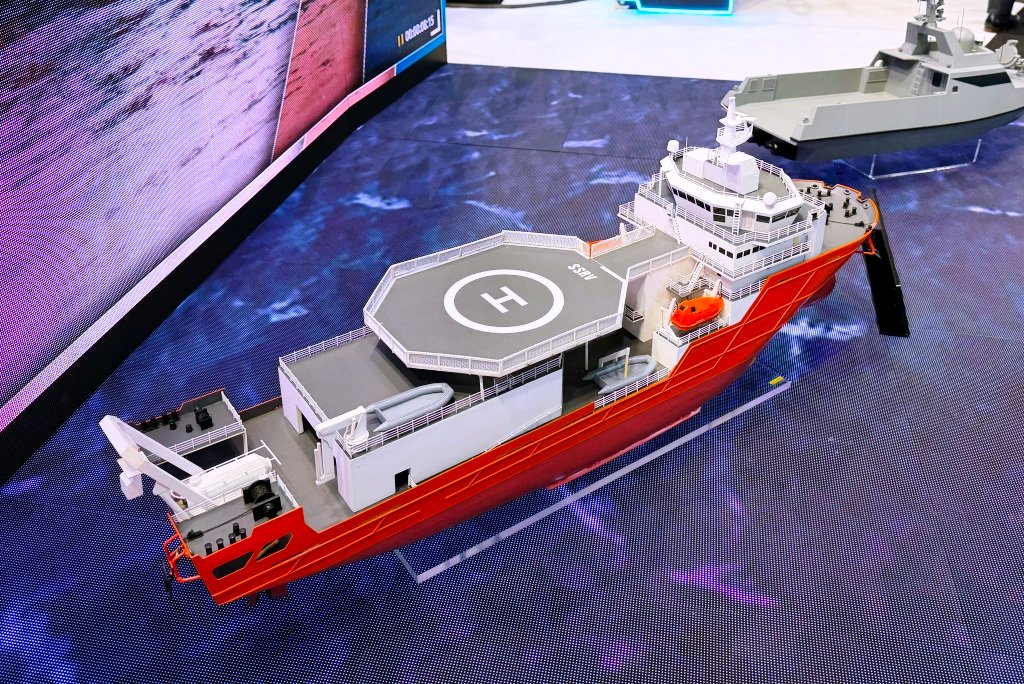
At Euronaval 2026 in Paris, a scale model of ST Engineering’s Singapore-built Submarine Support & Rescue Vessel (SSRV) is set to offer European naval audiences a closer look at an integrated approach to one of the most demanding missions at sea: rescuing the crew of a distressed submarine. Beyond the platform itself, the concept raises a broader question for submarine-operating navies: how can a rescue capability be made available quickly enough, and sustained reliably enough, when a submarine emergency occurs far from home?
When a submarine becomes disabled on the seabed, the margin for action can be unforgiving. The survival of its crew depends not only on the ability to locate the submarine and establish a connection, but also on the timely coordination of rescue systems, surface support, medical facilities and onward evacuation. A technically capable rescue vehicle is only one part of the equation; the effectiveness of the entire chain depends on how quickly its different elements can be brought together and operated as a single system.
This is the challenge that ST Engineering’s SSRV is designed to address. Rather than relying on a collection of separately mobilised assets, the vessel brings the principal components of a submarine rescue mission together on a dedicated platform. Its integrated architecture is intended to reduce logistical complexity and provide a more coherent response from the initial search through to the recovery and treatment of survivors.
The distinction matters. In a submarine emergency, the time required to mobilise a rescue capability can be as consequential as the performance of the equipment once it reaches the scene. An integrated vessel can reduce the need to assemble several platforms and coordinate their arrival, although its actual response time will still depend on its location, readiness, transit distance, sea conditions and the availability of specialist personnel.
An integrated rescue capability on a single hull
The SSRV’s defining feature is its combination of a Submarine Rescue Vehicle (SRV), a remotely operated vehicle (ROV), a Launch and Recovery System (LARS) and a Transfer Under Pressure (TUP) system. These capabilities are housed and operated from the same vessel, supported by onboard medical facilities and a helideck.
Each element has a distinct role. The ROV provides the means to inspect the seabed and the distressed submarine, assess the condition of the site and, where feasible, clear obstructions that could prevent rescue operations. The SRV is designed to establish a connection with the submarine’s escape trunk and transfer survivors to the surface. The TUP system then enables rescued personnel to move into a pressurised environment for further treatment, reducing the risks associated with an abrupt change in pressure. Helicopter evacuation can provide a further link to shore-based medical facilities when circumstances permit.
The value of this arrangement lies in the interfaces between its components. Search, inspection, mating, recovery, pressurised transfer and medical care are not independent tasks: a delay or failure at one stage can affect the entire operation. Bringing the equipment together on a purpose-built platform is therefore an important design choice, but it does not eliminate the need for rigorous procedures, trained crews, maintenance, rehearsals and coordination with the distressed submarine’s operating navy.
Platform dimensions and operational performance
The SSRV measures 85 metres in length, with a beam of 18.3 metres, a draught of 4.3 metres and a gross displacement of 4,290 tonnes. Its stated service speed is 12.5 knots. The vessel is also equipped with a Dynamic Positioning System meeting DPS-2 requirements, intended to maintain its position above the rescue site during demanding operations.
Station-keeping is particularly important during the launch and recovery of a rescue submersible, when the relative movement of the support vessel can complicate an already delicate procedure. The vessel’s stated operating capability up to Sea State 5 provides an indication of its intended operating envelope, although the precise limits will depend on the activity being conducted. The conditions in which a vessel can maintain its position are not necessarily identical to those in which every stage of a rescue can be completed safely.
These distinctions are operationally significant. A submarine rescue platform must be assessed not simply by its maximum speed, dimensions or headline sea-state rating, but by the conditions under which its rescue systems can be deployed, recovered and used reliably. Readiness, equipment availability, crew proficiency and the time needed to reach a casualty are equally important measures of capability.
From seabed search to medical care
In the configuration described for the Swift Rescue class, the 9.6-metre Deep Search and Rescue 6 submersible is designed to operate at depths of up to 500 metres and rescue as many as 17 personnel per sortie. It is crewed by two operators. These figures provide a useful indication of the system’s reach and capacity, but they also underline the need for a coordinated rescue plan when the number of survivors exceeds the capacity of a single sortie.
The mission begins with locating and assessing the distressed submarine. The ROV can help operators examine the site and identify potential obstacles around the escape trunk. Once conditions permit, the SRV is deployed to mate with the submarine and recover survivors. The vehicle then returns to the support vessel, where the TUP system enables personnel to be transferred under pressure into the appropriate onboard facilities.
The stated TUP capacity of up to 40 personnel provides scope for managing rescued survivors within a controlled pressurised environment. It should not, however, be interpreted as a guarantee that every casualty can be treated or transferred simultaneously: the practical sequence depends on the pressure conditions, medical requirements, system configuration and the number of rescue sorties needed.
The vessel’s onboard hospital and helideck extend the mission beyond the physical recovery of survivors. They form part of a wider chain of care in which stabilisation, medical assessment and evacuation must be planned alongside the underwater operation itself. The objective is not merely to bring personnel to the surface, but to preserve their chances of survival throughout the transfer to definitive medical treatment.
Why the concept matters to European navies
For European submarine-operating nations, the SSRV arrives at a time when the resilience of specialised support capabilities deserves close attention. Submarine rescue is a relatively rare requirement, but the consequences of being unable to respond quickly can be severe. Maintaining a dedicated national capability requires investment in specialised equipment, personnel, training, maintenance and periodic exercises. Relying on external or multinational support can offer an alternative, but it introduces questions about availability, access, mobilisation and competing demands during a crisis.
The SSRV’s integrated design offers one potential answer: concentrate the principal rescue assets on a dedicated platform intended to deploy as a coherent unit. For navies considering their future submarine escape, rescue and abandonment (SMER) arrangements, this approach merits examination not only as a shipbuilding proposition, but also as a possible model for organising rescue capability.
However, a dedicated vessel does not automatically guarantee strategic autonomy. Its value to a European operator would depend on procurement and support arrangements, access to trained personnel, interoperability with national submarine fleets, and the ability to deploy within the necessary timeframe. The financial implications of acquiring and maintaining a specialised vessel would also need to be weighed against existing national capabilities and options for multinational cooperation.
The central question is therefore not simply whether the SSRV can perform the technical tasks required of it. It is whether the overall capability can be made available, sustained and integrated into the operating procedures of the navy that needs it.
What to look for at Euronaval 2026
The scale model on display on ST Engineering’s stand at Euronaval, taking place in Paris from 3 to 6 November 2026, provides an opportunity to examine the vessel’s concept and its integrated architecture. The model itself cannot establish operational performance, but it can serve as a starting point for more substantive questions about the system behind the design.
For naval planners and technical specialists, several issues deserve particular attention: the vessel’s readiness and mobilisation arrangements; the practical operating limits of the SRV and its launch-and-recovery system; the procedures for managing repeated rescue sorties; the integration of medical care with under-pressure transfer; and the arrangements for training, maintenance and interoperability with different submarine designs.
These are not objections to the concept. They are the questions that distinguish an impressive technical platform from a dependable operational capability.
ST Engineering’s SSRV presents an integrated approach to submarine rescue, bringing search, recovery, pressurised transfer and medical support together aboard a single vessel. Its potential significance for Europe will ultimately depend on how that architecture translates into availability, response time and operational readiness. At Euronaval 2026, the model should therefore be viewed not only as a display of naval engineering, but as an opportunity to examine a fundamental question for submarine-operating nations: how to ensure that a rescue capability is ready before the emergency begins.
Photo by J. Roukoz
