

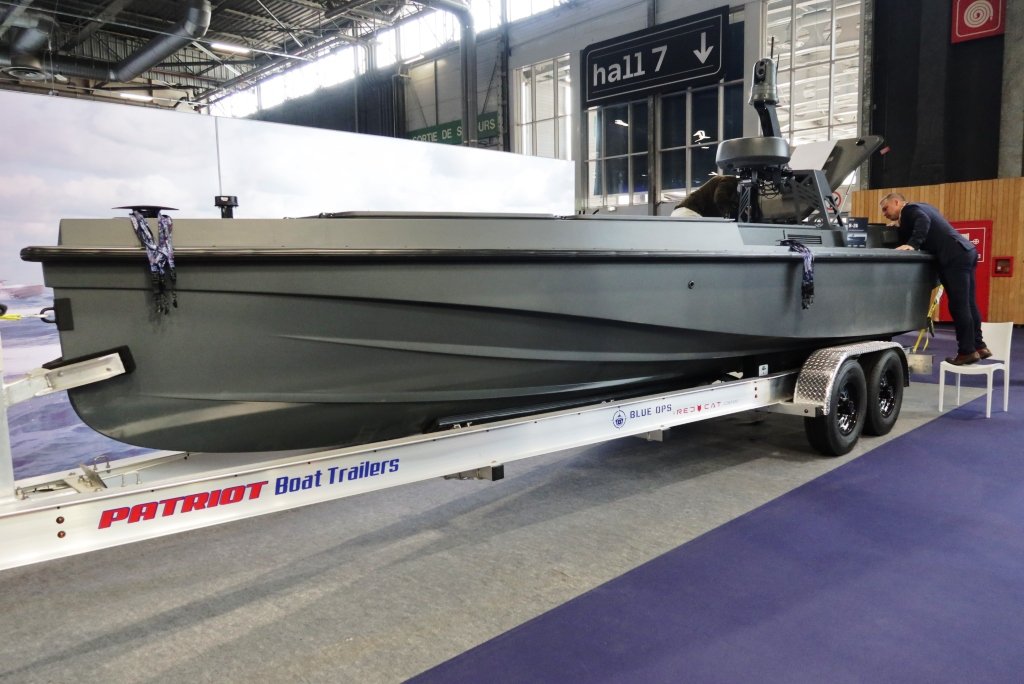
“We went to DSEI two years ago in London, but we were just introducing at that point in time, learning. We didn’t have a boat yet. Now it’s time to push,” Benjamin “Barry” Hinckley, Blue Ops President tells EDR On-Line at Euronaval 2026. The Paris exhibition marks the first presence of a company product in Europe, namely the V7 (Variant 7) USV, now renamed B-26, the number showing the boat length in foot (in fact 25.59), which production start was announced one year before, at the London exhibition. Barry Hinckley is the descendant of a ship making family; in two-year time the Hinckley Company will celebrate its 100th anniversary, the company founded by Henry R. Hinckley having started its activities in 1928 as the Manset Boatyard in Southwest Harbor, Maine. Barry has therefore boat construction in his DNA
The Blue Ops President is travelling throughout the world to directly assess the use and the need of unmanned surface vehicles (USVs) in different scenarios. “I have been to Ukraine four times in the past year, been to the Middle East recently, straight up Hormuz. I have been to Korea, I’ve been to Taiwan, I’m going back to Taiwan. Anywhere where there seems to be water and tension, I tend to be there,” he told us, underlining that he strongly believes in USVs, not only in those areas but also in the United States; “We are in a political season right now, and there is no argument from either side about wanting to put robots in difficult situations versus humans. Everyone agrees.”
Robots do not get tired, they do not get hungry, they do not have to get relief, and they do not have to risk the human life, he underlined adding that as three quarter of the globe is covered by water, nearly all nations have a coastline to protect. And none of them has the manpower to man a sufficient number of military vessels to cope with that mission, while robotised platforms can stay at sea for 15-20 days without relief. “I was talking to people who makes C-UAS systems, and an option might be to send out a sort of C-UAS picket boat,” Barry Hinckley exemplified.

Putting together shipyard skills and autonomy capabilities was relatively simple, as Blue Ops is part of the Red Cat Group, which generated an ecosystem capable to deliver mission-ready solutions across all domains in defence and security. The group controls three companies beside Blue Ops: Red Cat Aerial, which designs and manufactures small, unmanned aircraft; Apium. Which provides its products to transform a single robot into a swarm-ready robot; and Quaze, active in designing and producing wide surface charging areas, which eliminate the need for human interaction and physical connexion.
Leveraging the family company experience, the Hinkley Company builds recreational boats in America and still offers its boats with a hull and deck warranty for life, Barry Hinkley underlines that also Blue Ops builds at that quality standard boats based on the modular open system approach (MOSA), which allows to easily plug in third party’s solutions. His company understands that to succeed in today military market co-manufacturing and co-production are the buzz words, and opening having an open architecture system is key to this. Not only: “Our platform can be built and sold around the world. We are very interested in co-manufacture and co-production. So right now, we are talking to multiple European countries about building our designs there. When politicians are raising tax revenue from their citizens and they want to spend it on defence, the citizens rightfully want that money spent in their country. It makes sense, it creates jobs,” Blue Ops President underlines.

The quality issue raised by Barry Hinckley makes the difference between what is happening in Ukraine and what is needed in the West. “They do not care because the boat is going to go one way and run into a Russian ship and it’s over. We have to build boats in America that will last ten years before their last trip,” he clarified. “We took the understanding of what Ukraine did and then took it to a more refined level of manufacturing and production. So, the primary lesson was you do not necessarily have to spend billions of dollars to find a solution for self-defence or, quite frankly, offense, if you look at what they did to the Russian Navy. As for the MOSA issue, “The lesson learned that we put into our boat is keeping the system open. Our goal is to be the dominant small USV builder in the world and deliver a very durable, reliable, and affordable platform that then can be innovated locally. So, we can share the knowledge of extremely high-quality boat building and lessons learned in other theatres around the world about the best hull shape for different areas of operation and sea conditions, and how to use and build the best platform that can integrate the next round of innovation,” Barry Hinckley stated, adding that “one size does not fit all,” so trying to sell the whole package is probably not the best solution.

Coming to boats and talking construction materiel, the President is definitely a fan of fiberglass. “There is no compromise in fiberglass,” he told us, underlining that other manufacturing systems and materiel are not as good. Rotomolding is not high quality enough, 3D printing is not mature enough, carbon fibre is too expensive, aluminium requires skilled labourers and is not good for mass production, he highlighted, so, at least until something new will not appear, fibre reinforced plastic remains the best choice.
The Blue Ops booth at Euronaval hosted an example of B-26; in May 2026 the company announced it was building then V7 combat USVs for undisclosed customers, this boat having superseded previous USVs produced by the company, such as V2s, which logged over 10,000 hours in live combat missions. In fact, production started in Fall 2025, the idea of that new boat having emerged only five months earlier. According to the press release a V7 (now B-26) has a cost of US$ 625,000, however going over 100 boats price goes down to 600,000 and to 500,000 over 200 platforms ordered.

The B-26 is 7.80 metres long overall, waterline length being 6.86 metres, has a 2.25 metres beam and a draft of 2.25 metres. Full load displacement is 3.5 tons, of which 800 kg are represented by mission payload. The latter can be tailored for different missions such as ISR, counter-UAS/remote weapon station, resupply, mine countermeasures, surface-to-air, or UAV launch and recovery. The B-26 is powered by a Steyrmotors diesel engine, quite probably the SE286E40, which provides 280 hp and drives a Bravo 3 inboard/outboard drive with two counter-rotating propellers. This allows it to reach a 40 knots maximum sustained speed, the 1,200 litres fuel tanks ensuring a 2,500 nautical mines rage at maritime security speed, and a 450 hours (over 18 days) ISR endurance. The B-26 can safely navigate in operational conditions up to Sea State 3 and can afford Sea State 4 with degraded performances. On the boat exhibited at Euronaval we could see the Teledyne FLIR Marine M364C high-resolution marine thermal camera with pan and tilt and 2-axis gyro stabilization on top of the mast structure, and at the lower level Simrad Halo 24 which among others provides collision avoidance capabilities. Communications include 4G/5G LTE and SATCOM, the C2 system being ATAK/WinTAK compatible. Navigation including anti-jam GNSS, inertial, and speed-over ground systems.

At Euronaval Blue Ops launched its B-18, a much smaller USV, no full specifications being provided. The 5.5 metres long boat is also powered by a Steyrmotors diesel engine, reliability being the key issue, probably based on a less powerful engine of the same series, which allow it to reach an over 45 knots maximum speed. Range at maritime security speed is 1,630 nautical miles while ISR endurance is 325 hours (over 13.5 days). “The B-18 is just hitting the market now with; it is Sea State 5 survivable, carries 450 kg of payload, kinetic, ISR, or other, it is a very capable small boat, it fits in a 20-foot container, and has raised a lot of interest, especially in in the Pacific command area,” Barry Hinckley told EDR On-Line. The B-18 has completed sea trials ahead of schedule and is now ready for production.
While both the B-26, under production, and the B-18, ready for production, are based on single planning hulls, a further platform is in the Low-Rate Initial Production phase, the B-39. “We are releasing a new class of vessels; they are multi-hull, so they have very wide decks and carry massive payloads. The first one is the B-39, which is nearly 12 metres long, has a beam of over 3.5 metres and can carry a payload of over 5.4 tonnes,” the company President detailed. The B-39 autonomous platform is not coming from a blank sheet; “the boat was an existing hull shape that we had used commercially already. If you think about resupply in the military, sending over 5 tonnes of supply on cargo is of great interest, especially in the littoral areas,” he added. EDR On-Line understood that the propulsion system will be completely different, and will be based on powerful outboard engines, Blue Ops proposing both gasoline and diesel options by Cox Marine, a company active on the military market with its 300 and 350 hp. Looking at the documentation gathered at Euronaval a smaller autonomous catamaran platform, the B-25, should also be in development by Blue Ops.
Photos courtesy Blue Ops and P. Valpolini
