

American companies have long recruited military veterans for their leadership experience, discipline and ability to perform under pressure.
But the nation’s highest-ranking enlisted service member says businesses may be overlooking the largest, and potentially one of the most talented, segments of the military.
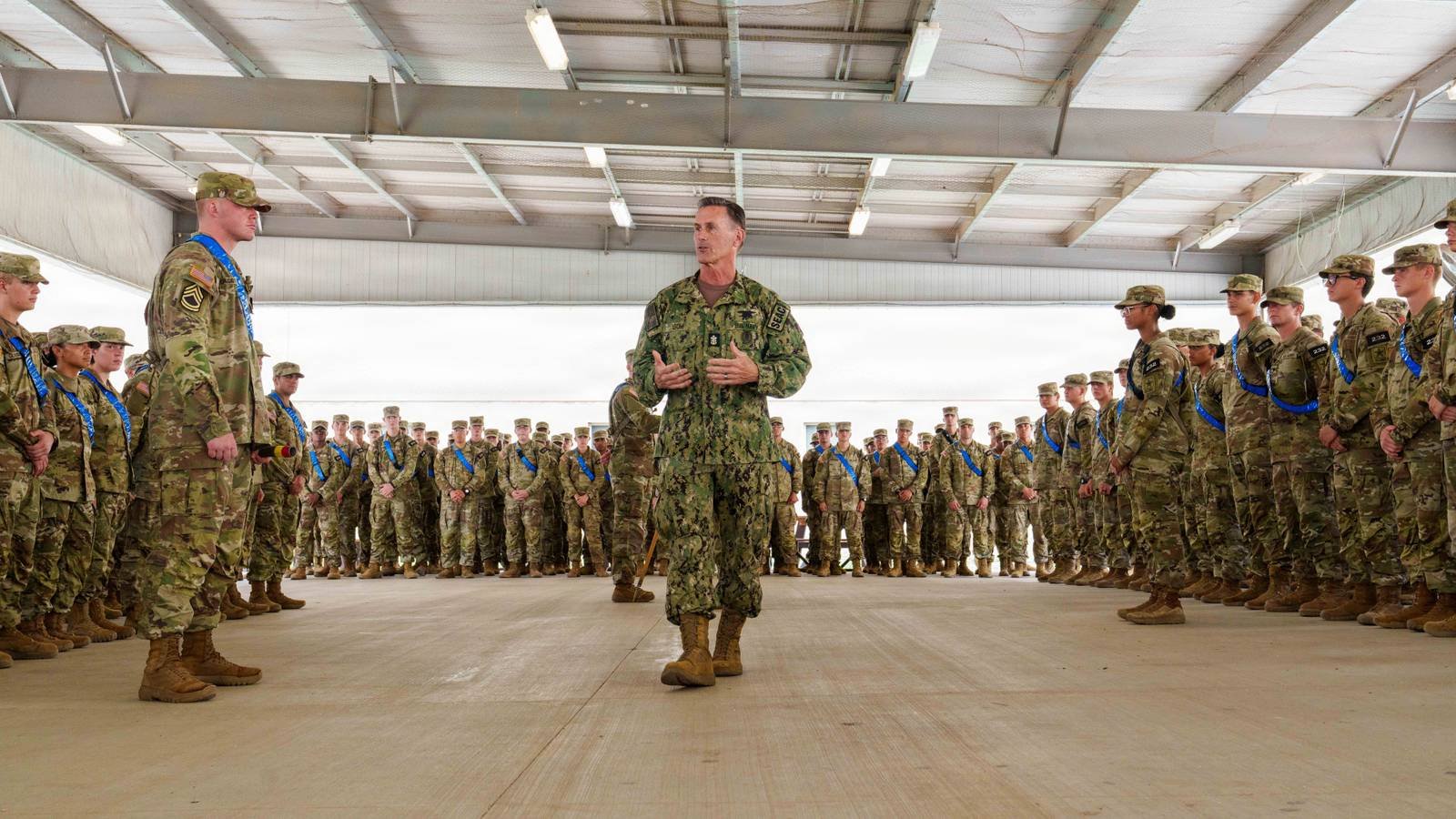
In an exclusive interview with Military.com, Senior Enlisted Advisor to the Chairman (SEAC) David Isom said corporate America recognizes the value of military officers but may not fully appreciate the capabilities of enlisted service members, who account for more than 80% of the joint force.
I think what happens is those business leaders, they miss a real opportunity because they’re missing that 80-plus percent of the joint force, Isom said.
The 80% of the Military Employers May Be Missing
Isom, a career Navy SEAL who became the military’s most senior enlisted leader in 2025, said civilian employers generally understand what officers bring to an organization.
Military officers are recognized for their education, leadership development and experience managing complex operations under difficult circumstances.
“I think most of the business leaders, most of corporate America, sees the value of our incredibly talented officer corps,” Isom said, describing officers as “well-educated, trained leaders, forged under fire, managing stress and pressure at the highest levels.”
Those qualities make officers attractive candidates for management and executive positions.
But Isom believes employers may be missing opportunities to recruit enlisted personnel with comparable leadership abilities, advanced technical skills and substantial operational experience.
And according to Isom, the enlisted force has changed dramatically over the course of his career.
The Enlisted Force Is Not What It Used to Be
Isom enlisted in the Navy in 1987 as a Machinist’s Mate, maintaining engines, generators and other essential shipboard equipment before entering Naval Special Warfare.
His career eventually included 17 years at Naval Special Warfare Development Group and senior enlisted leadership positions at Special Operations Command North, Special Operations Command Pacific and U.S. Indo-Pacific Command.
Nearly four decades after joining the Navy, he sees an enlisted force with capabilities that would have been difficult to imagine when he began his career.
Isom contrasted today’s enlisted service members with those who served during the nation’s earliest conflicts, when formal education was often concentrated among military officers.
That distinction, he said, no longer accurately reflects the modern force.
One example comes from the U.S. Air Force Academy, where enlisted personnel can now serve as instructors.
Isom pointed to enlisted service members with advanced degrees teaching science, technology, engineering and mathematics to future military officers.
He described an enlisted member with a doctorate in physics teaching cadets at the academy as an example of how the military increasingly draws upon expertise throughout its ranks.
He also highlighted a senior Navy enlisted service member who had qualified as a test pilot on 22 different aircraft platforms.
“Those stories used to be one-offs, and now they’re becoming more and more common,” Isom said.
For civilian employers accustomed to associating advanced education and technical expertise primarily with commissioned officers, those examples challenge traditional assumptions about military rank and qualifications.
Some Navy SEAL Candidates Already Have College Degrees
Isom also pointed to the educational backgrounds of service members entering one of the military’s most demanding training pipelines.
At Basic Underwater Demolition/SEAL training, commonly known as BUD/S, he said the number of enlisted candidates arriving with bachelor’s degrees has increased dramatically over time.
“There are classes now where over half of the folks showing up show up with a bachelor’s degree already,” Isom said.
He described that development as part of a broader change in the qualifications of Americans choosing enlisted military service.
Enlisted service is not necessarily an alternative to higher education. For some Americans, it is a choice made after completing a degree.
For others, military service provides access to technical training, professional development and leadership responsibilities that may be difficult to obtain early in a civilian career.
That combination can produce veterans whose qualifications extend well beyond what their military occupational titles might suggest.

Young Troops Are Making Decisions That Matter
Education is only part of the equation. Isom said the military increasingly depends on enlisted service members to exercise independent judgment, solve complex problems and make decisions without constant supervision.
He pointed to the military’s emphasis on mission command, which gives subordinate leaders the authority to act within a commander’s intent. That approach requires more than following instructions.
It demands an understanding of the mission, the ability to evaluate changing circumstances and the judgment to make decisions when senior leaders are not immediately available.
Isom said the system gives enlisted members opportunities “to become tremendous leaders and to exercise that creativity.”
Those experiences can begin relatively early in a military career.
A young noncommissioned officer may be responsible for supervising personnel, maintaining sophisticated equipment, managing resources or making operational decisions with significant consequences.
In civilian employment, those responsibilities may correspond to executive management, technical or operational positions, even when the veteran’s military rank does not immediately communicate that experience.
‘Eye Watering’ Talent Across the Military
As the senior enlisted adviser to Gen. Dan Caine, Chairman of the Joint Chiefs of Staff, Isom has an opportunity to observe service members across the military’s branches and occupational specialties.
He regularly travels with the Chairman and separately visits installations to speak directly with troops. What he sees has reinforced his confidence in the next generation.I love traveling around with the Chairman and separately because we do a lot of troop engagements, Isom told Military.com. He described the abilities of today’s young service members as “eye-watering.”Their familiarity with artificial intelligence and emerging technologies is particularly notable, he said, along with their creativity and willingness to tackle difficult problems.
But Isom also credited the military’s investment in training and developing its enlisted leaders.
He said the services have devoted considerable effort to preparing young personnel to make difficult decisions, including in situations where they may be far from home, operating without immediate supervisors or senior commanders.
Their ability to make those decisions on future battlefields, he said, will be “absolutely critical.”
That preparation may also have significant value when those same service members eventually leave the military.

What a Military Resume May Not Reveal
The challenge Isom identifies raises a larger question about how civilian employers evaluate military experience.
Military rank provides information about a service member’s position within a hierarchical organization, but it does not necessarily capture the full range of responsibilities, technical qualifications or leadership experience that person developed.
A senior enlisted service member might have spent years managing people and equipment, overseeing complicated operations or advising commanders on consequential decisions.
A junior enlisted veteran might have worked with sophisticated technology or developed expertise in fields directly relevant to civilian industry.
For employers, the opportunity is to look beyond the distinction between officer and enlisted service and evaluate what candidates actually accomplished.
That could mean asking about the teams they led, the technology they operated, the decisions they were trusted to make and the problems they solved.
It also means recognizing that leadership does not begin with a commission.
A Message to Corporate America
For Isom, the enlisted force represents a large and increasingly sophisticated pool of potential employees.
He described today’s enlisted personnel as innovative, creative and talented, with the grit and tenacity to succeed in demanding environments.
His assessment comes from his conversations with business leaders and nearly four decades observing the evolution of the military.
But he believes the misconception is important enough to address directly.
When I talk to business leaders, I say, don’t miss the opportunity to recruit from our really, really super talented enlisted force, and you won’t regret it, Isom said.
For companies competing to attract skilled workers and future leaders, his message is straightforward.
Some of the talent they are looking for may already be wearing a military uniform. And much of it does not have an officer’s rank
