

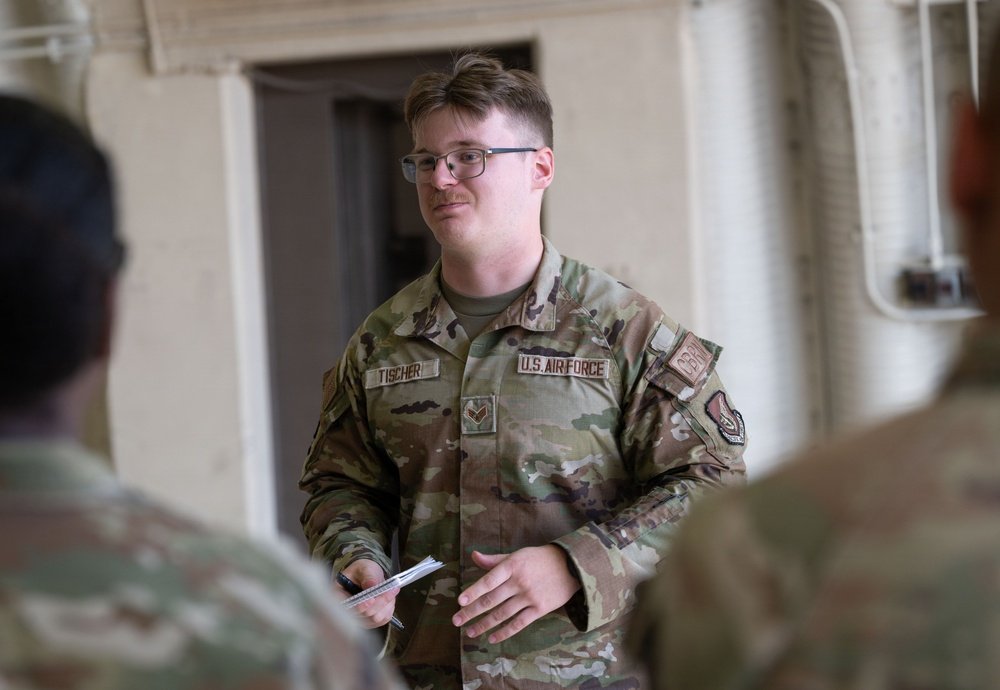
KUNSAN AIR BASE, Republic of Korea – U.S. Air Force Airmen assigned to the 8th Fighter Wing and 51st Medical Group participated in exercise Radiant Falcon at Kunsan Air Base, Republic of Korea, Oct. 5-8, 2026. The four-day exercise strengthened the wing’s ability to recover, process and relaunch potentially exposed aircraft in a radiological environment while protecting personnel from hazardous exposure.
The scenario integrated Airmen assigned to the 8th Operational Medical Readiness Squadron, 51st OMRS from Osan Air Base and 8th Civil Engineer Squadron, simulating fighter aircraft returning to Kunsan Air Base after flying through a radioactive plume. The training focused on establishing contamination control areas, tracking radiation exposure and sustaining airpower operations within safe operational limits.
“The main aspect of the exercise is if we do have a radiation experience, we’re able to get those sorties back, get maintainers processed through, and get ready to go,” said U.S. Air Force Staff Sgt. William Lavender, 8th OMRS bioenvironmental engineering technician. “We’re training and ensuring that members are safe when they deal with those types of environments.”
Airmen established contamination control areas and coordinated with maintenance crews during aircraft turnaround procedures, preparing the aircraft for follow-on missions while logging simulated radiological dose data for health records.
“We’re going to have a brief with them going out to this area and give them threshold limitations,” Lavender said. “That way, they’re able to do what they need to do to get those sorties back in the air and ready for the fight.”
Radiant Falcon highlights Kunsan AB’s role as an airpower generation hub in the Pacific region, where high-tempo operations require rapid hazard monitoring and precise exposure tracking across flying and support units.
“I think one of the most important aspects to keep that mission moving and protecting the force is the translation of information,” said U.S. Air Force Senior Airman John Bryant, 51st OMRS bioenvironmental engineering journeyman. “Making maintainers understand that there’s little to no risk to them really helps get the mission done accurately.”
The exercise enabled emergency management and bioenvironmental engineering technicians to integrate procedures during a simulated contingency operation. Similar radiological response training at installations across Pacific Air Forces and U.S. Air Forces in Europe reinforces cross-functional coordination, manual dose logging and combat airpower sustainment under contested chemical, biological, radiological, and nuclear conditions.
“Emergency management and OMRS are working more closely, and we’re trying to integrate more especially within our contingency operations,” Lavender said. “Having them out here and combining our knowledge from CBRN to radiation has been very great.”
Exercises like Radiant Falcon ensure the 8th Fighter Wing remains prepared to maintain rapid response capabilities, credible deterrence and uninterrupted mission execution in any environment.
