

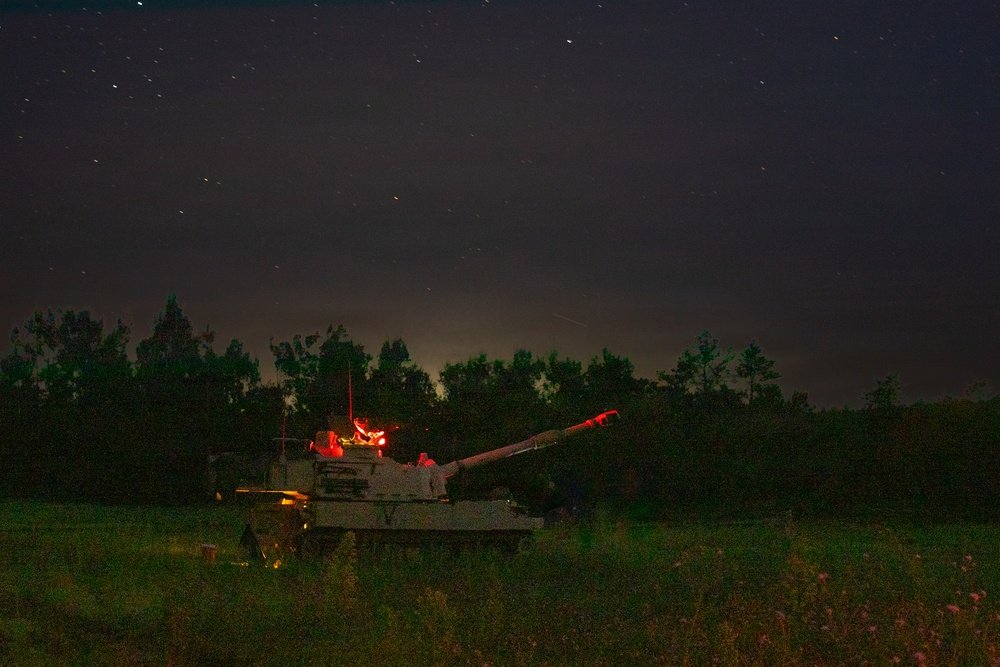
GRAYLING, Mich. — Concealed among the trees of northern Michigan, M109A6 Paladin howitzers waited for their next fire mission as Soldiers monitored communications, maintained their equipment and prepared to move again.
For Alpha Battery, 1st Battalion, 201st Field Artillery Regiment, West Virginia Army National Guard, the cycle of receiving a mission, moving into position, firing and displacing was about more than putting rounds on target. During Exercise Northern Strike 26-2, the battery used Camp Grayling’s expansive training areas and complex exercise environment to rehearse how it could be required to operate during large-scale combat operations.
“We shoot, we move, we communicate, and we try to replicate what we would face in combat,” said Maj. Johnny Kocher, the regiment’s executive officer. “All these things affect our maneuverability and survivability.”
The battery returned to Michigan after completing artillery table certifications at Camp Grayling in April. Northern Strike gave the unit an opportunity to build on those qualifications by integrating its crews, fire direction personnel, communications systems and leadership into a larger, less predictable training environment.
That effort included more than firing the battery’s 155 mm self-propelled howitzers. Soldiers also had to remain mobile, maintain communications and respond to simulated drone threats while continuing to provide artillery support.
“I keep telling my Soldier that you have to move after you shoot,” said Kocher. “Once they see or hear a drone it really drives the point home.”
Evolving battlefield threats mean modern artillery units must be able to fire rapidly and displace before an adversary can identify their position and return fire, a tactic commonly known as “shoot and scoot.” Northern Strike allowed Alpha Battery to repeatedly rehearse that process across distances and terrain difficult to replicate during a typical home-station training period, taking advantage of one of Camp Grayling’s greatest assets: its size.
With nearly 147,000 acres of training space, Camp Grayling is the largest National Guard training facility in the United States and is part of the National All-Domain Warfighting Center. Its maneuver areas and live-fire ranges allow units to train across greater distances than they may encounter at home station.
“We don’t normally have access to all the resources that are available here,” Kocher said. “That’s something you get in an exercise like Northern Strike.”
For Alpha Battery, that space allowed Paladin crews to negotiate wooded routes, establish firing positions, use natural concealment and operate farther apart, placing additional demands on command, control and communications.
“The whole point of Paladins are for us to shoot and move,” Kocher said. “There’s just so much more room for us to flex the capabilities of that platform.”
The larger training environment also allowed Soldiers to practice the complete artillery mission. Fire missions require information to move accurately from observers and higher headquarters to the fire direction center, where Soldiers verify firing data before passing instructions to gun crews. The process must remain fast and accurate even as crews relocate and respond to changing battlefield conditions.
“From there, it’s all about processing our missions and making sure all our mission data is safe and accurate,” said Staff Sgt. Devon Butler, a gun chief for Alpha Battery.
Those demands are increasingly important as unmanned aircraft systems, electronic warfare and counterfire capabilities make stationary artillery vulnerable. Survivability depends on crews capable of completing a mission, maintaining communications and moving before an adversary can respond.
For younger Soldiers, repeated missions offered opportunities to refine their responsibilities while allowing leaders to evaluate the battery under pressure. Crews operated their Paladins over Grayling’s long distances, worked through multiple fire missions and endured challenges as a unit.
For Alpha Battery, the value of that environment was measured at the crew and section level. Everything from receiving a mission, delivering accurate fires, or responding to changing conditions pushed crews to their limits.
“This training area is far superior to any other training area I’ve seen,” said Butler. “It gives you a real feel for what a mission might be like.”
Northern Strike is an Army-sponsored, multi-component, multinational exercise designed to build readiness and enhance interoperability among U.S. forces and international partners. Northern Strike 26-2, Michigan’s largest and longest-running joint readiness exercise, takes place Aug. 1–15, 2026, at the National All-Domain Warfighting Center and includes approximately 9,000 participants.
