

Forged in a fight for survival, the Korean Service Corps Battalion, Materiel Support Command–Korea, 19th Expeditionary Sustainment Command, has provided critical support to the U.S. Army for more than 75 years. Established during the Korean War, the organization embodies generations of Korean contributions to Army readiness and the enduring U.S.-ROK Alliance.
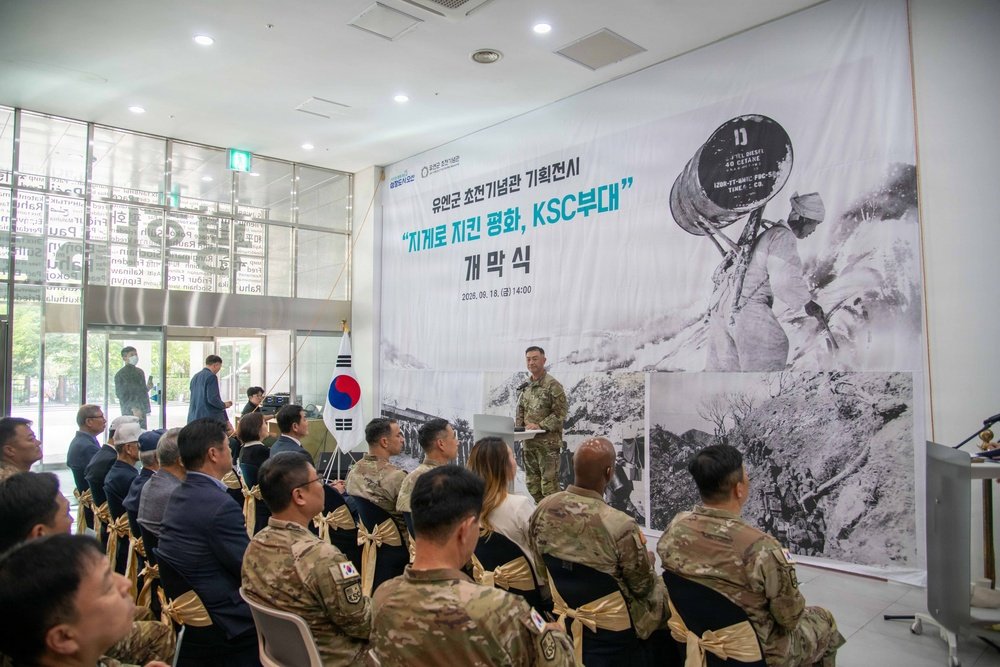
That shared legacy came into focus Sept. 18 as the KSC Battalion was honored during the opening of a yearlong exhibit at the UN Forces First Battle Memorial in Osan, Republic of Korea.
For the exhibit, “The Peace They Carried: The Korean Service Corps,” the battalion provided historical artifacts and materials, including an A-frame, photographs, historical documents, recruitment posters and challenge coins. Together, the items illustrate both the physical demands placed on early corps members and the evolution of the KSC from a wartime labor force into an integral part of the U.S. Army’s modern support structure in Korea.
“The title of this exhibition carries a powerful message,” said Brig. Gen. Jin H. Pak, commanding general of the 19th ESC. “During the Korean War, peace was carried not only by those who fought with weapons, but also by Korean civilians who moved ammunition and supplies, evacuated casualties, repaired defensive positions, and performed other essential duties—often under constant threat in active combat areas.”
The battalion traces its roots to the Civilian Transportation Corps, which was established during the Korean War to provide critical logistical support to United Nations forces. Using traditional Korean wooden pack frames known as jige, corps members carried ammunition, food and other supplies across rugged terrain inaccessible to vehicles.
Because the frames resembled a capital “A” against their backs, the workers became known as the “A-Frame Army.” Their difficult and often dangerous work helped keep front-line forces supplied during some of the war’s most challenging periods.
“Their courage, sacrifice and steadfast determination contributed to establishing the strong foundation of the ROK-U.S. Alliance that continues today,” Pak said.
The exhibition also recognizes the civilians whose contributions can be overshadowed in traditional accounts of the war. By preserving their stories and displaying the tools and records associated with their service, the memorial connects the sacrifices of the wartime generation with the alliance they helped build.
Osan city leadership helped establish the exhibition to honor the KSC’s wartime service, those who fought in the war’s opening battles and the members of the “A-Frame Army,” said Osan Mayor Cho Yong Ho.
“The UN Forces First Battle Memorial seeks to fill a missing page in the history of the Korean War,” Cho said.
Today, the KSC Battalion remains an essential part of the U.S. Army’s support structure on the Korean Peninsula. Its Korean national employees provide transportation, maintenance, supply, engineering and other operational support that strengthens readiness during exercises and contingencies.
The activation of the 75th KSC Truck Company April 8 at Camp Humphreys further enhanced 19th ESC’s supply and transportation capabilities. By addressing a key logistical requirement, the company provides long-haul cargo transportation that helps keep forces mobile and operational throughout the southern Korean Peninsula.
The 75th designation honors more than 75 years of Korean Service Corps members serving alongside U.S. forces. Its mission reflects how the organization has adapted to the changing needs of the Army while preserving the spirit of service on which it was founded.
The ceremony marked more than the opening of a new exhibit. It honored a shared legacy of service, partnership and sacrifice that has helped preserve peace and stability on the Korean Peninsula for generations—and continues to strengthen the alliance today.
