

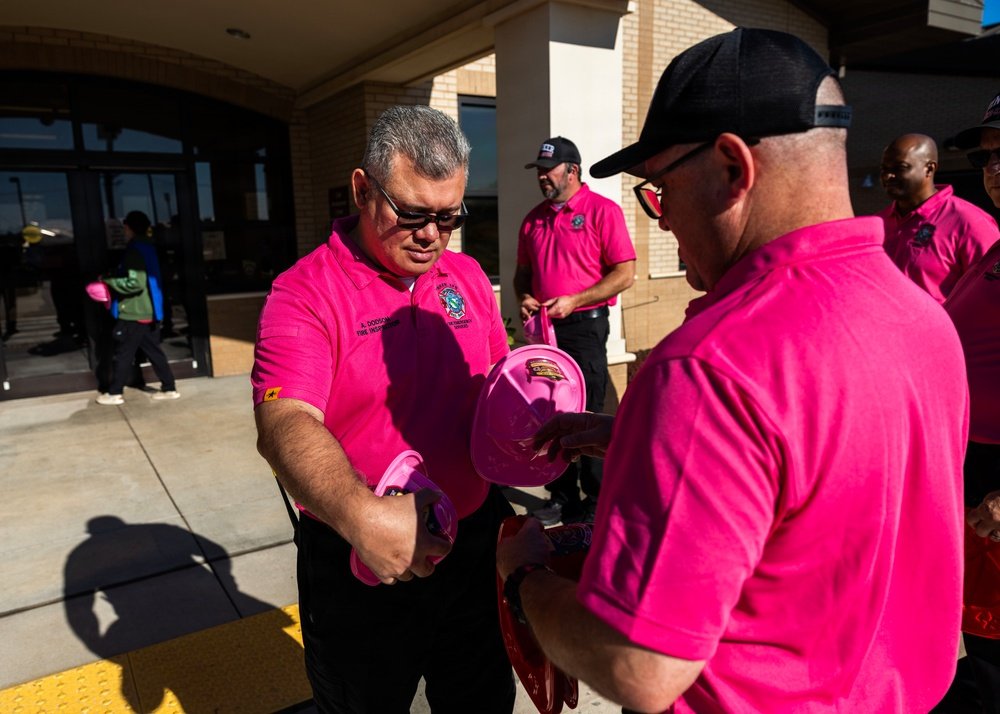
TINKER AIR FORCE BASE, Okla. — Behind every aircraft taking flight, every maintenance hangar supporting depot-level repairs, and every family residing on Tinker Air Force Base is an invisible shield: fire prevention. While firefighters standing watch on the flight line and in the stations are prepared to answer emergency calls around the clock, the 72nd Civil Engineer Fire and Emergency Services Prevention Branch works continuously to ensure those fires never ignite in the first place.
Over the past year, the Fire Prevention Branch has launched a comprehensive push to expand community outreach, tackle modern fire hazards, modernize technical oversight, and bring vital life-safety education directly to Team Tinker personnel and their families.
Tackling Modern Hazards: The Personal Electric Mobility Device (PEMD) Program
As personal transportation evolves, so do the fire hazards present within living, working, and industrial spaces. The rapid proliferation of e-bikes, e-scooters, and hoverboards has introduced a serious and rapidly escalating threat across the nation: lithium-ion battery thermal runaway fires.
Recognizing this growing operational and domestic risk, the Tinker Fire Prevention Branch took proactive leadership by developing the installation’s dedicated Personal Electric Mobility Device (PEMD) Safety Program. Designed to mitigate mishaps across administrative facilities, industrial complexes, dormitories, and privatized housing, the program establishes critical guardrails:
• Safe Charging and Storage Protocols: Mandating that PEMDs be charged exclusively using manufacturer-certified equipment, prohibiting unattended or overnight charging, and establishing safe standoff distances from primary emergency egress routes.
• Workplace and Facility Standards: Providing clear criteria for unit facility managers regarding where lithium-ion powered devices may and may not be stored or recharged across Tinker’s industrial and administrative footprint.
• Hazard Awareness and Early Intervention: Educating the base populace on warning signs of damaged or failing lithium-ion cells—including swelling, overheating, unusual odors, or hissing sounds—and enforcing prompt reporting procedures.
This initiative positions Tinker Air Force Base ahead of the curve, directly anticipating the national focus championed by the 2026 Fire Prevention Week theme, which emphasizes lithium-ion battery safety and responsible modern energy use.
Bringing Safety to Life: Restoring a Community Fixture
Education and early intervention represent the first line of defense against preventable fire emergencies. One of the most visible milestones in this effort is the full operational return of the installation’s dedicated Fire Prevention Mobile Trailer.
After being out of service for more than five years, the branch spearheaded a targeted restoration effort to bring the mobile learning lab back online. Designed to simulate common residential hazards—such as kitchen cooking fires, electrical overloads, and smoke-filled room evacuations—the trailer provides realistic, hands-on emergency egress training. With its return, Tinker residents and base personnel will see the trailer deployed across installation events, squadron safety days, and community gatherings throughout the coming seasons.
Empowering the Next Generation: 2nd Annual Junior Firefighter Camp
Community safety begins with educating youth. Building on that foundation, the Fire Prevention Branch hosted the 2nd Annual Junior Firefighter Camp in partnership with the Tinker Youth Center this past summer.
Participation surged this year, marking a 110% increase over the inaugural event. Twenty-one youth participated in an intensive 20-hour curriculum spanning four days of structured classroom instruction and active, hands-on evolutions. Guided by a team of 11 dedicated fire department instructors, campers gained practical experience in:
• Home escape planning and smoke alarm operation.
• Safe portable fire extinguisher deployment fundamentals.
• Structural fire hose handling and water stream application.
• Emergency team communication and situational awareness.
• The Junior Firefighter obstacle course challenge.
By equipping military-connected children with fundamental fire safety reflexes, the program develops ambassadors for fire prevention who carry these life-safety habits home to their neighborhoods, dorms, and schools.
Behind the Scenes: Technical Excellence and Mission Assurance
While public outreach represents the visible face of fire prevention, rigorous technical oversight forms the foundation of base survivability. The Fire Prevention Branch provides continuous life-safety and code compliance oversight across more than 20 million square feet of inspectable space, spanning massive industrial depot facilities, advanced test cells, sensitive administrative headquarters, and military family housing communities.
To maintain continuous, exacting standards across every facility, the Fire Prevention Branch instituted several internal initiatives:
1. Standardized Inspector Onboarding: Deployed a comprehensive inspector qualification checklist that shortens on-the-job training timelines, eliminates operational ambiguity, and ensures uniform code enforcement across all facilities.
2. Accelerated Deficiency Resolution: Enhanced coordination with unit facility managers, civil engineer shops, and mission partners to streamline the tracking and abatement of life-safety discrepancies.
3. Continuous Professional Education: Branch personnel actively engaged in advanced technical training through the Fire Department Instructors Conference (FDIC), the National Fire Protection Association (NFPA), and the Fire Marshals of Oklahoma Association. Integrating current life-safety codes, cutting-edge suppression systems, and Community Risk Reduction (CRR) methodologies ensures Tinker’s prevention personnel remain at the forefront of national standards.
Protecting the Future: Multi-Million Dollar MILCON Project Oversight
As Tinker Air Force Base modernizes its physical footprint to support next-generation weapons systems and depot maintenance workloads—including major Military Construction (MILCON) projects such as the KC-46A Pegasus Depot Maintenance Complex and Bomber Campus facilities—the Fire Prevention Branch serves as the primary technical guardian of structural survivability.
Multi-million dollar MILCON projects involve intricate fire protection criteria governed by Unified Facilities Criteria (UFC 3-600-01) and specialized Department of Defense directives. The Fire Prevention Branch’s technical specialists dedicate hundreds of hours to critical, multi-phase design plan reviews, pre-construction conferences, and on-site construction inspections. Working side-by-side with the 72nd Civil Engineer Engineering Flight, the U.S. Army Corps of Engineers, and prime contractors, inspectors identify code conflicts, egress challenges, and fire protection deficiencies long before concrete is poured.
This oversight culminates in rigorous final acceptance testing of specialized, large-scale fire detection and high-expansion foam or deluge suppression systems. By resolving complex design anomalies early in the project lifecycle, the Fire Prevention Branch prevents millions of dollars in costly post-construction retrofits and contract modifications—ensuring cutting-edge hangars and test facilities are fully compliant, operationally secure, and ready to support the warfighter on day one.
Looking Ahead: Your Role in Fire Safety
Fire prevention is not just an office inside the fire department—it is a shared responsibility embraced by every Airman, civilian employee, contractor, and resident on Tinker Air Force Base.
Facility managers, supervisors, and personnel are encouraged to maintain vigilance in daily
operations:
• Practice Lithium-Ion Battery Safety: Always use manufacturer-approved chargers for e-bikes, scooters, and cordless tools; never charge devices on soft bedding, furniture, or near primary exit corridors; and immediately take out of service any battery displaying bulging, excessive heat, or physical damage.
• Keep Exits and Panels Clear: Maintain at least 36 inches of unobstructed
clearance around electrical distribution panels, mechanical disconnects, and
primary egress corridors.
• Avoid Overloading Circuits: Ensure surge protectors and power strips are plugged
directly into permanent wall receptacles—never daisy-chained into one another.
• Report Discrepancies Promptly: Submit civil engineer work orders or notify the Fire Prevention Branch immediately for any sticking fire doors, leaking sprinkler heads, or impaired alarm panels.
Tinker Fire Safety Quick Take: 4 Habits That Save Lives
1. Charge Smart: Only use manufacturer-approved chargers for e-scooters, e-bikes, and electronics. Charge on hard, flat surfaces and never block an exit route while charging.
2. Clear the Path: Maintain at least 36 inches of clearance around all electrical panels, emergency shutoffs, and exit doors.
3. Know Two Ways Out: Whether working in a depot maintenance hangar or relaxing in base housing, identify two unobstructed emergency escape routes from your workspace or sleeping area.
4. Report\, Don’t Ignore: If a fire alarm pull station, strobe, or extinguisher shows physical damage or is past its inspection date, notify your facility manager or the Fire Prevention Branch immediately.
Unit & Facility Coordination Contacts
For facility consultations, PEMD program guidance, evacuation drill coordination, public education requests, or to schedule the Fire Prevention Mobile Trailer for an upcoming squadron event:
• Office: (405) 734-3981
• Organization: 72nd Civil Engineer Fire and Emergency Services (72 ABW/CEF), Tinker AFB, OK. mailto:72ABW_CEFWorkflow@us.af.mil
Continuous Improvement
• Feedback Portal: Please take two minutes to provide feedback or improvement ideas regarding support provided by the 72 ABW/CEF team. Responses may be submitted anonymously via the 72 ABW/CEF Customer Feedback Form.
