

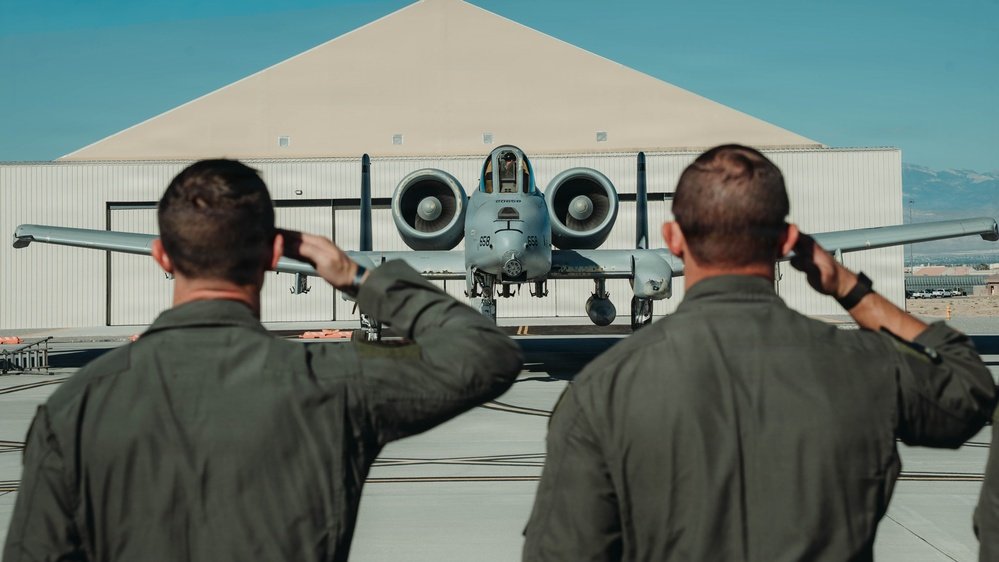
NELLIS AIR FORCE BASE, Nev — The last A-10 Thunderbolt II aircraft assigned to Nellis Air Force Base, Nevada, made its final departure Sept. 22.
Nearly 70 Airmen from Nellis AFB lined up on the flight line to give the A-10, affectionately nicknamed the “Warthog,” one final salute as it took off.
Although the departure signifies the conclusion of nearly 50 years of elite tactical training, operational testing and maintenance sustainability at the installation, the A-10’s impact will not soon be forgotten.
The first attack jet arrived at the base in 1977. Over the past five decades, the installation served as the primary proving ground for the Warthog’s tactical employment. Nellis-based units refined the aircraft’s software, avionics and precision weapons, while the U.S. Air Force Weapons School’s 66th Weapons Squadron trained more than 300 A-10 weapons officers across 100 classes.
“We are maintaining the culture of the A-10 by involving as many other fighter communities involved in the close air support mission,” said Lt. Col. Ridge Flick, the 66th WPS commander. “We are also training F-15 Eagle, F-35 Lightning II and F-16 Fighting Falcon pilots to take on some roles we have had in combat search and rescue.”
While the aircraft itself is departing, Flick emphasized the squadron’s mission of forging elite tactical leaders remains unchanged. The unit will continue training the next generation of ground-based specialists, including combat rescue officers, pararescue, special tactics officers and combat controllers.
As the Air Force retires the A-10 fleet, the military’s close air support capability is not declining. Instead, foundational tactical expertise, operational roles and personnel are transitioning to multirole and advanced fighter platforms across the service.
Airmen from the 757th Aircraft Maintenance Squadron’s Thunder Aircraft Maintenance Unit are being reassigned to other squadrons and airframes, such as the F-35 and the F-16. The discipline that A-10 maintainers developed over 50 years of managing airframe fatigue, wing replacements and depot-level overhauls is being integrated into those newer flight line programs.
At the same time, fifth-generation platforms like the F-35 are absorbing new close air support and combat search-and-rescue command roles into their operational profiles. The platform combines stealth features, advanced sensor suites and secure data-sharing networks to conduct precision ground-support missions in contested environments. For maintainers making the shift, the transition carries both operational and personal significance.
“Working on the A-10 is meaningful to me because that is something that I share with my grandfather,” said Staff Sgt. Eva Kehn, a 757th AMXS weapons load crew chief. “I’m very excited to have that new chapter and bond over that again with my grandfather.”
With her reassignment to an F-35 unit at Nellis, that unique family connection will continue. Her grandfather now serves as a civilian F-35 instructor, meaning their shared professional bond will simply transition to a new airframe.
“It’s a bittersweet moment,” said Master Sgt. Aaron Edmonds, a 757th AMXS aircraft section chief regarding the A-10 final salute. “I enjoyed my time with the A-10, but I’m excited because this departure marks the closing of one chapter and the start of another.”
For Edmonds, the transition is also a homecoming. After maintaining the F-16 earlier in his career, he spent the last five years working on the A-10 flight line and is eager to bring that seasoned experience back to the Fighting Falcon.
“The advice I would give Airmen who are transitioning from one airframe to another is to be open minded, willing to learn, and carry on the great work ethic from your previous aircraft over to your new one,” Edmonds said.
Although the A-10’s engines have gone quiet at Nellis, the tactical DNA forged over five decades of service remains hardwired into the flight line. The transition marks less of a retirement and more of an evolution, ensuring that the Warthog’s legendary commitment to protecting troops on the ground is carried forward by the Airmen and advanced platforms shaping the future fight.
