

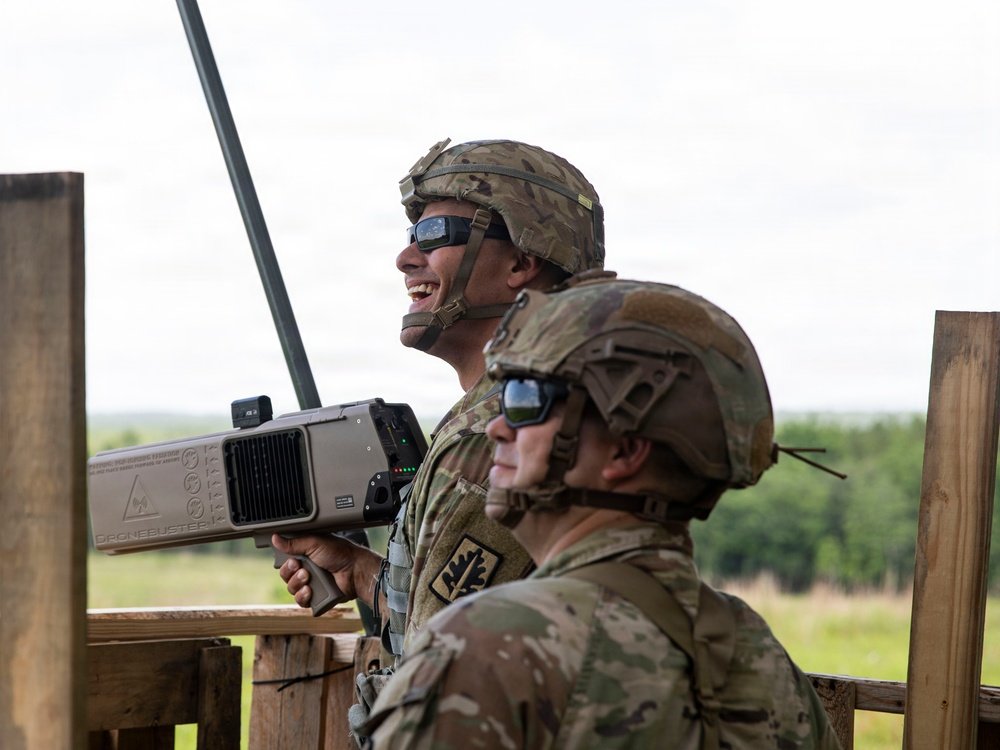
Citizen-Soldiers apply tech-sector expertise to accelerate weapons system evaluations
for Large-Scale Combat Operations
By Sgt. 1st Class Erick Yates, Army Applications Group, 75th U.S. Army Reserve
Innovation Command Public Affairs
CAMP SHELBY, Miss. — Army Reserve Soldiers specializing in emerging technologies
conducted live technical evaluations on advanced Counter-small, Unmanned Aircraft
Systems and counter-drone weapon platforms as part of Operation Sentinel Justice 26, June 7-20, 2026.
The technical assessments, executed by the Army Applications Group from Austin,
Texas—a subordinate element of the 75th U.S. Army Reserve Innovation Command,
focused on integrating commercial off-the-shelf and next-generation military hardware
into tactical formations. Approximately 40 AAG Soldiers from multiple detachments were
selected to conduct technology assessments.
Among the primary technologies under review were the SMASH fire control system and
the Dronebuster 4, a handheld Counter-small, Unmanned Aircraft System directed energy
jammer.
OSJ 26 represents a historic milestone as the largest Army Reserve training exercise
ever conducted, drawing more than 12,000 Soldiers. The event combines a Combat
Support Training Exercise-OSJ 26, Global Medic, and a dedicated 75th USARIC
technology evaluation.
Together, these elements deliver a high-fidelity, multi-echelon, and joint operational
environment specifically designed to sharpen unit readiness for Large-Scale Combat
Operations.
“This year’s OSJ aims to increase both sustainment and force protection modernization
across the Army Reserve, highlighting these modernization lines of effort as a critical
requirement on today’s rapidly evolving battlefield,” said Lt. Col. Blair Tighe, the
innovation officer in charge, Tech Assessment Teams, OSJ 26, 75th USARIC.
“Ultimately, the pattern that is being strived for is increased capability, by improving the
volume of contested logistics capabilities out the door into theater operations,” said
Tighe.
Serving as the Army Reserve Chief Innovation Office, the 75th USARIC occupies a
pivotal role within this exercise framework. By embedding directly into the training
audience, the command steers the multi-faceted technical assessments via integration
of operational injects and a structured innovation lifecycle process to identify capability
gaps. The real-time data gathered on the ground directly, potentially, refines this solution
across the force.
The inclusion of SMASH and Dronebuster 4 technologies addresses the rapid
proliferation of low-cost drone threats observed in modern conflict zones. SMASH
utilizes advanced electro-optics and target-acquisition algorithms to guarantee first-
round hits against moving aerial targets. Concurrently, the Dronebuster 4 provides
individual Soldiers with a lightweight, line-of-sight electronic warfare tool capable of
neutralizing enemy reconnaissance and strike drones instantly.
The unique operational success of these evaluations highlights the Army Reserve’s
strategic emphasis on talent management. The Soldiers driving these assessments are
“Citizen-Soldiers” who work as engineers, developers, data scientists, and project
managers within the United States’ premier civilian technology sectors when not in
uniform.
OSJ 26 Army Applications Group Technology Assessors; SMASH Shooter
“I was selected as a technology assessor due to my strong background in contracting
and program management,” said Master Sgt. Rainy Silva, Detachment 7, AAG, 75th
USARIC, who was selected to assess SMASH.
As a civilian, he serves as a Space Force program manager, frequently working on
source selections, task order evaluations and technical writing.
Upon arriving at the exercise, Silva and Chief Warrant Officer 3 Corey Tyner, another
AAG tech assessor, met with Devon Weiss, the North American regional trainer for
Smart Shooter, to receive an initial briefing on the SMASH equipment.
“Mr. Weiss gave us a complete rundown of the technology,” Silva said. “It was a great
introduction to what we would be evaluating in the field,” explained Silva.
To prepare the SMASH for range training, senior gunners from the 84th Training
Command added the advanced optic to M4 and M240 weapons systems.
“It was definitely a value-added session to have the senior gunners provide the
descriptions and functions of the components for this technology,” Silva said.
One thing Silva mentioned about SMASH is its flexibility. Soldiers can engage ground
targets and then quickly shift to engaging airborne C-sUAS threats.
The system improves accuracy, mitigating error, while still using the fundamentals of
weapons marksmanship so Soldiers have a greater possibility of disabling the target.
The goal of the assessments is to receive Soldier and unit feedback on all technology
used from the familiarization training during OSJ 26.
“[Army] Reserve Soldiers getting familiarization training – That’s the part I’m most
excited about,” Tyner said.
“The more Reserve Soldiers who train with this capability, the greater our force
readiness becomes,” added Tyner.
“An opportunity to train with SMASH is valuable,” said Staff Sgt. Adam Young, 307th MP
Company, 200th MP CMD.
“Using this technology as a Reserve Soldier is important training and helps us better
understand the dynamics of the current battlefield,” Young explained.
SMASH isn’t the only C-sUAS technology under the microscope during OSJ 26; tech
assessors are also tracking how Soldiers adapt to the handheld electronic warfare
capabilities of the Dronebuster 4.
Dronebuster 4
The Dronebuster 4 is a compact, lightweight, handheld electronic warfare weapon
designed for non-kinetic C-sUAS operations. It is built to intercept and neutralize
Commercial Off-The-Shelf and modified consumer drones at the individual Soldier level,
according to internet technology sources.
“As a technology assessor, I enjoy taking part in actions that ensure Soldiers have the
best equipment to perform well,” said Maj. Jason D. Perez, DET 7, AAG, 75th USARIC.
He was selected to assess the Dronebuster 4 technology.
Perez, who has over 20 years in the military, has been an intelligence officer and works
with U.S. Cyber Command as an all-source analyst in his civilian capacity.
Perez said he takes the evaluation process seriously; ensuring the technology works to
the best ability with the updates made.
“I look forward to seeing the results Dronebuster 4 produces when employed with
Soldiers at OSJ during the C-sUAS scenarios,” he said.
Chief Warrant Officer 3 Bethany Groff, AAG, 75th USARIC, also assisted with the
Dronebuster 4 evaluation and emphasized that live demonstrations build vital trust for
the troops.
“This training is vital,” said Groff, a former Colorado National Guard Black Hawk
helicopter pilot and North Carolina NG tactical liaison officer.
“If a soldier doesn’t see this technology in action before they’re on the battlefield, they
are just guessing if it works. If they’ve trained with it, they can reassure their peers being
trained and say, “I visually saw it. I know this works,” she shared.
Army Reserve and Emerging Capabilities
While active-duty units have continuous opportunities to evaluate new equipment, the
Reserve component operates on a much tighter timeline. Maj. Kyle McKemy, TAT
member, AAG, 75th USARIC, emphasized that bringing emerging capabilities to annual
training bridges this critical gap.
“As reservists, we have a lot less time to analyze technologies and integrate them into
our systems,” McKemy said. “We get these two-week blocks in the summer, so if you
can marry up that training with all these new technologies and figure out how to
integrate them in (familiarization training)—and teach a Reserve Soldier how to do it in
that short timeframe—it is incredibly important.”
That deliberate effort to maximize limited training windows has not gone unnoticed by
the AAG’s senior leadership.
For Col. Christopher Christian, commander, AAG, 75th USARIC and OSJ 26
Technology Assessment Team Task Force commander, the collaboration represents a
vital step forward, transforming standard annual training into a high-impact
modernization engine for the entire Reserve component.
“I’m pleased and humbled at the effort the AAG personnel have displayed supporting
OSJ,” remarked Christian.
