

Malaysian company Deftech showed a range of equipment at DSA 2026, held in Kuala Lumpur from 20-23 April, including aerial and ground unmanned systems.
A centrepiece of its booth was an AV8 Gempita 8×8 armoured vehicle in the shape of an antitank guided weapon variant. This is one of 257 vehicles delivered to the Malaysian Army by Deftech. This particular version features twin launchers for Ingwe antitank missiles mounted either side of the turret.
Deftech noted that the AV8 programme achieved 48.7% local content, far exceeding the minimum 30% required under the contract.
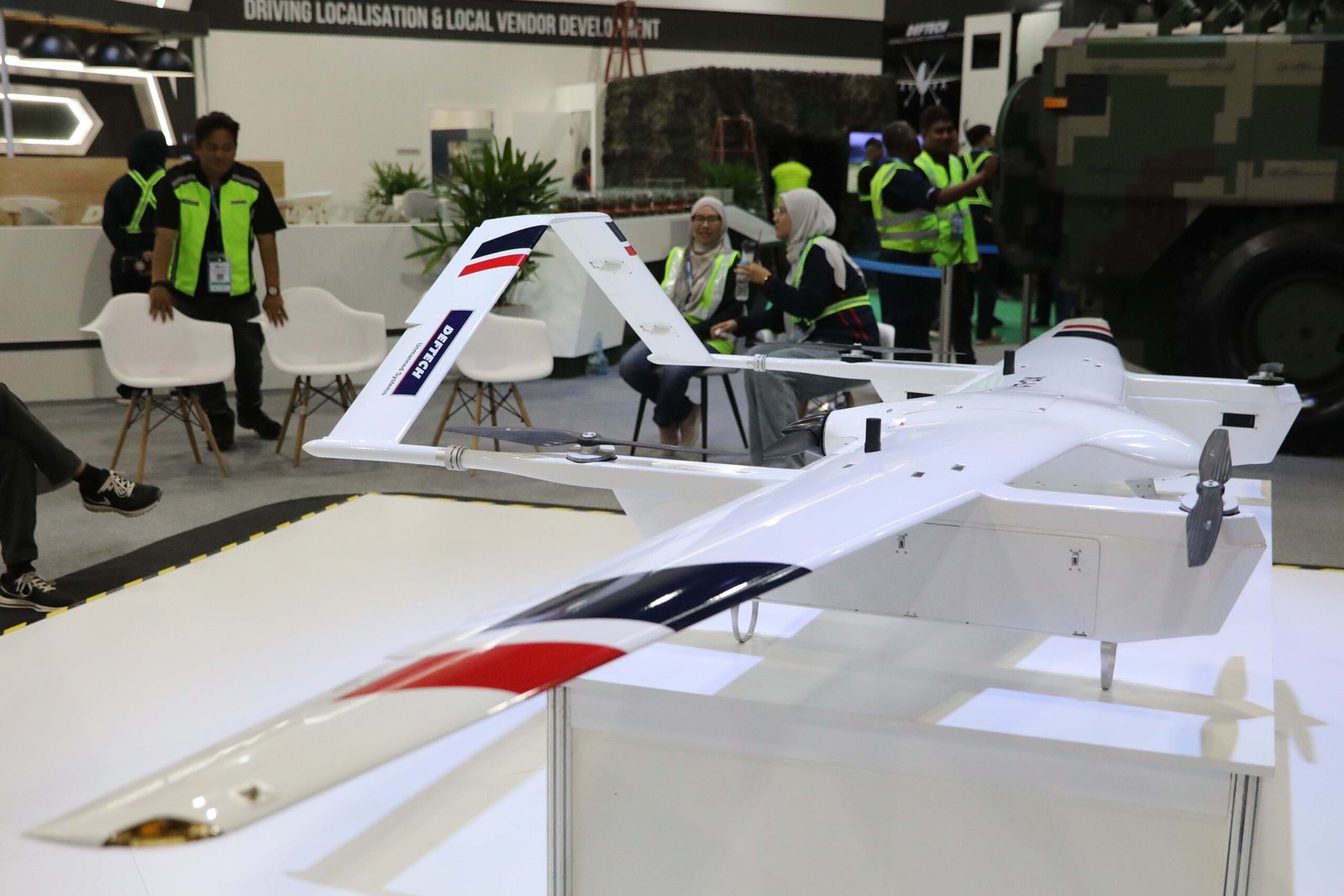
Turning to uncrewed systems, Deftech showed an XC-L1 hybrid unmanned aerial vehicle (UAV). This aircraft is sourced from China, though Mohd Nur Asyraf bin Anuar, Head of Flight Operations at Deftech, declined to reveal which company it originates from.
He emphasised a key point about the XC-L1 – which has a 100km radius and endurance of 5 hours – is that it has received certification from the Malaysian Communications and Multimedia Commission (MCMC) to use radio frequencies allocated to UAVs. This milestone was reached last month, and it is a legal requirement for unmanned flight in Malaysia.
As well as its tailored frequencies, the drone features Automatic Dependent Surveillance-Broadcast (ADS-B).
Deftech will operate the XC-L1 soon on behalf of Petronas for pipeline inspections, but Deftech is also promoting the UAV for military use.
In its catalogue, Deftech also features the indigenously developed Aludra EE, which is a development of the original Aludra once employed by the Malaysian Army until it was retired because it did not meet MCMC requirements. It has a wingspan of 4.86m and a 10-hour endurance.
Deftech is also moving into unmanned ground vehicles (UGV). It is collaborating with Universiti Malaysia Pahang Al-Sultan Abdullah (UMPSA) in a two-year project to develop the TUAH 4×4 UGV.
A prototype TUAH was exhibited at DSA 2026, with the vehicle weighing 780kg and capable of transporting a 500kg payload. Measuring 2.743m long, it has a 70-100km range via lithium-ion batteries.

Work on the project only commenced at the start of this year, and it is also designed to integrate two small UAVs.
As part of the same TUAH project, Deftech and UMPSA are developing an accompanying small UGV called the Drebar. It shares the same ground control station, and is ideal for indoor applications, for example.
The spokesperson said the Malaysian Army is interested in UGVs, and this research is designed to eventually meet this requirement for a locally developed platform.
by Gordon Arthur
