

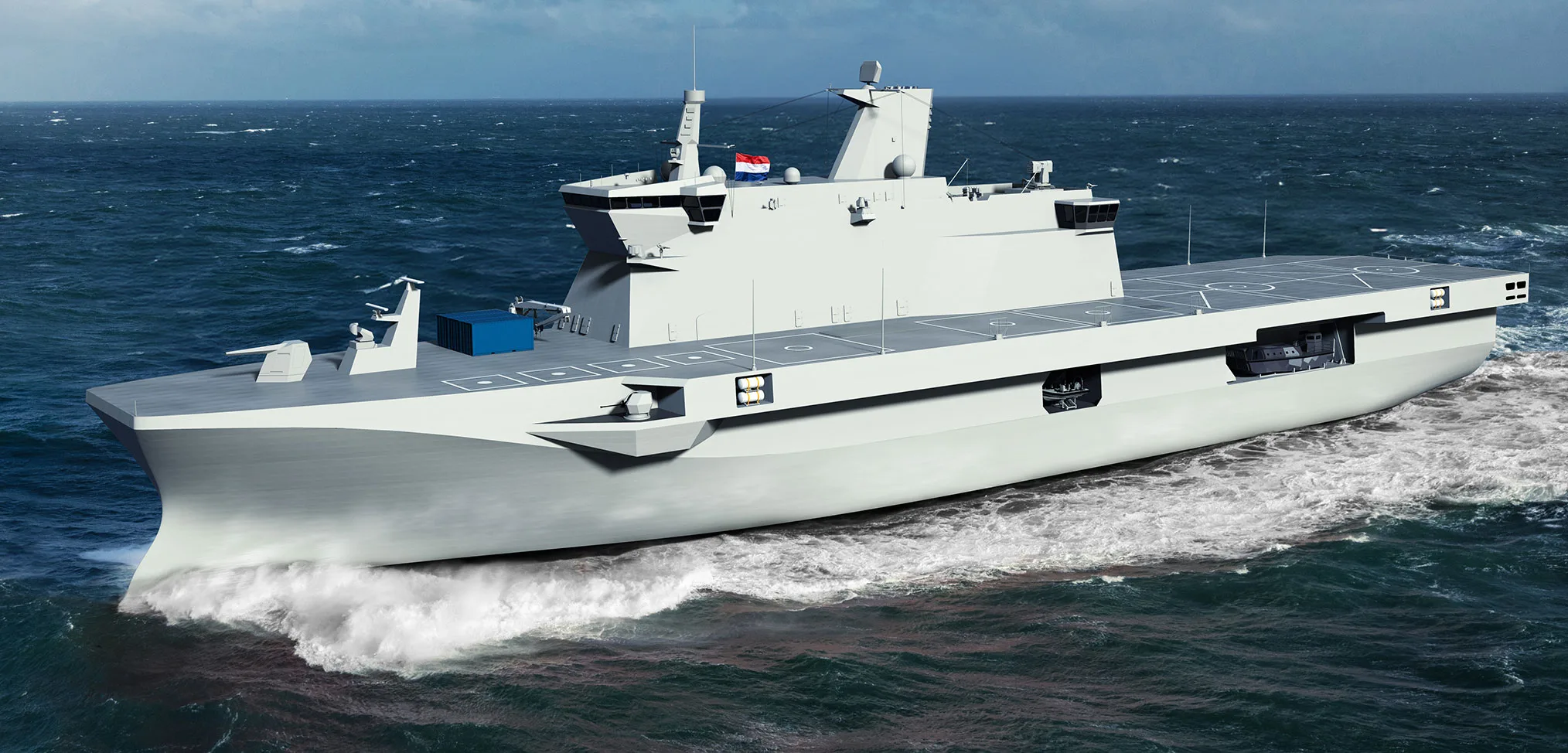
At the NIDV Exhibition Defence and Security (NEDS) event in Rotterdam today, Dutch shipbuilder, Damen presented an image showing their design for the Amphibious Transport Ship (ATS) that is intended to equip the Royal Navy and the Royal Netherlands Navy. Here we take a brief look at the design
The image confirms that a ‘flat-top’ design has been selected, although the relatively large five-deck superstructure makes the ship appear to be smaller than it really is. At 164 metres in length and around 15,000 tonnes, the ATS will be some 43 metres shorter than the RN’s former helicopter carrier HMS Ocean, and substantially shorter than a Bay-class landing ship. The RN originally envisaged up to six much larger Multi-Role Strike Ships to take on the duties of the two Albion-class LPDs, the three Bay-class auxiliaries and RFA Argus. The £2.4 billion Anglo-Dutch agreement announced in July committed the two countries to a common ATS designed in the Netherlands.
Aviation questions
Effectively, ATS is a small helicopter carrier with its two largest landing spots both at the stern for troop-carrying helicopters. The smaller position amidships might accommodate a smaller aircraft such as Wildcat, while the spaces towards the bow look more suited to small UAVs. The through-deck could allow a drone to be prepared forward while a helicopter takes on passengers or stores aft. The illustration alone cannot establish which spots could be used simultaneously.
For an embarked helicopter detachment, the more important question is how many aircraft can be maintained under cover. A widened section of the island might accommodate a hangar, but the rendering suggests a hangar below the flight deck. An internal dock remains part of the requirement, although it is not 100% certain from the single image if this is part of the design. A direct route from the vehicle deck would allow palletised stores or light vehicles to be brought up for onward movement by helicopter.
The choice of ‘transport’ in the ship’s name reflects the breadth of the Dutch requirement. The Netherlands originally sought a common replacement for its Rotterdam-class amphibious ships and Holland-class patrol vessels, with duties ranging from carrying marines and their landing craft to Caribbean patrols and hurricane relief. It also reflects the move away from the ‘assault ship’ concept. The ATS will transport assets into theatre but stay much further from the coast, to keep out of adversary missile envelopes, reliant on helicopters and fast insertion craft to get modest numbers of and equipment ashore.

Where will the eight ships be built?
At Euronaval in Paris earlier this month, Richard Keulen, Damen’s director of corporate strategy and innovation, told Romanian media that the amphibious ships would be the next project for its Galați yard in Romania. The report identifies the Dutch navy’s four ships. Fitting them out in the Netherlands would follow the precedent of the new combat support ship, HMNLS Den Helder, which was constructed in Galați but completed in Vlissingen, although Keulen did not specify the outfitting yard for ATS.
That account is difficult to reconcile with the MoD announcement on 7 July. Introducing the joint programme, it said “the ships will be built in UK shipyards alongside Dutch industry”. Although surprising, the next sentence specified four vessels for each navy, giving British shipbuilders good reason to think a commitment had been made to build all 8 in the UK.

Damen and electrical systems integrator Alewijnse also announced at NEDS that they would extend their collaboration on Dutch naval programmes, including ATS. The companies previously worked together on Rotterdam and HMNLS Den Helder.
Not too much should be inferred from a single image at this stage, other than confirmation that ATS will be a flat-top vessel and Damen will lead the design.
