

We usually write for gamers and casual readers. This article is intended for game developers, publishers, and governments preparing for a new arms race.
Recent news coverage has included a great deal of discussion about asymmetric warfare and new ways of waging war. Despite the interest, relatively few games address the subject. I wanted to explore what it would take to design an asymmetric-warfare game suited to the changing character of conflict.
I interviewed two military veterans who have contributed to the wargaming community for decades. Both are well read in military history and have insight into asymmetric warfare.
Steve Overton served as a combat engineer with the 23rd Combat Engineer Battalion, 3rd Armored Brigade, in the mid-1970s at the height of the Cold War. By 1973, he was creating scenarios for PanzerBlitz. His understanding of wargaming also allowed him to advise military commanders on the conduct of field exercises. He not only created wargames but applied what he learned to real military maneuvers. Over the years, he has worked on such simulations as Panzer Command: Kharkov, Panzer Command: Ostfront, Flashpoint Campaigns Series, and Burden of Command.
He is currently seeking a publisher for an asymmetric-warfare game called Kontact Now while also working on an operational-level game about the Vietnam War.
The second person I consulted was retired U.S. Army Major Donald E. Vandergriff, a decorated veteran, avid wargamer, and author. He served as a tank commander doing mop up operations after the Gulf War and later did contract work in Afghanistan with DynCorp International. He has long urged the Pentagon to make greater use of wargaming, and he has trained officer cadets through wargame-style scenarios at several military academies. His master’s degree is in military history, with a focus on German military history. He has also researched Fourth Generation Warfare and its relationship to asymmetric conflict. Vandergriff has published numerous books and more than 100 articles on military subjects, including an article in ARMOR magazine.

Drawing on these interviews, I developed a blueprint for designers interested in creating a new type of wargame. Such a game might also serve militaries seeking training simulations for the future of combat.
Both interviews touch on current events. I have kept those references general so that the article does not become political commentary, and I have avoided naming current political figures for the same reason. The interviews have been edited for clarity.
Interview With Steve Overton
I had been speaking with Steve for several months, sometimes by phone. He is closer to my father’s age than to mine. I found his mannerism both kind and reflective.
Chris: Steve, there has been considerable media coverage on asymmetric warfare in recent years, but there are not many training programs that teach either armchair generals or real militaries how to prepare for it. I want to understand how someone might design such a game at both the tactical and strategic levels. First, please tell me about your background.
Steve: I grew up in Wyoming and now live in Texas. I served as a combat engineer with the 23rd Combat Engineer Battalion, 3rd Armored Brigade, in the mid-1970s. Our area of operations was the Fulda Gap at the height of the Cold War. I helped advise on the implementation of field exercises in preparation for a possible Soviet invasion.
I started wargaming in 1971, and by 1973 I was creating scenarios for PanzerBlitz. Since then, I have developed a tactical board game series called Kontact Now, which is set to be published, and I have worked on the development teams of several computer wargames.
I am currently working on an operational-level board game about the Vietnam War.
I specialize in systems with random events and asymmetric objectives.

Chris: How would you define asymmetric warfare?
Steve: Asymmetric warfare begins when the two sides do not have the same objectives, or when their objectives overlap only partly. For example, one army may want to destroy the other side’s power plants, while its opponent wants to destroy an allied oil facility. Which objective is more legitimate? That can be difficult to judge, but a wargame designer assigns each objective a value. If both sides want to control a waterway, it might be worth 10 points. If one side controls it, that side receives the points. If one side destroys all the oil facilities, it might receive a point that the other side cannot earn. The opponent might receive a point for destroying the power stations. At the end, you total the points and determine who performed better, even though the two sides pursued different objectives. The available points simply need to balance overall.
Today, one army may have no navy and still be able to sink ships. If the smaller power has no ships of its own, how does the larger side earn comparable points? An important landmass might compensate for the lack of naval targets. We can see conflicts today in which neither side captures its opponent’s principal objective, leaving the result at a stalemate.
Chris: Can you give an example of two historical armies with different characteristics?
Steve: The Russian military has traditionally relied on railways to move troops and supplies in mass. When Americans establish a caliber or size for a gun or cannon, Russia often makes it larger. Much of this is intended to prevent the West from using Russian equipment while allowing Russia to use equipment captured from the West.
Moscow was crucial during World War II because so many rail lines converged there. The Soviet Union was on the brink of disaster more than once. At one point, Stalin reportedly considered negotiating with Hitler but was persuaded against it by other nations.
Interviewer: Have you played Labyrinth: The War on Terror? It depicts asymmetric warfare in the modern era. It is difficult to understand because of the strategic whack-a-mole effect. Have you played Every Single Soldier’s games? They do a good job at the operational level.
Steve: Not yet, because I have been so focused on game design. My grandfather once told me, ‘Don’t turn your hobby into a job.’ What did I do? I turned my hobby into a job.
I recently finished Burden of Command, which was a five-year project, so I did not have much time to explore other games during that period.
Interviewer: In Vietnam ’65, you have almost no visibility into the enemy. In Afghanistan ’11, the Taliban can cross into Pakistan and disappear from view. I think designers need to use constantly shifting victory points and objectives that the opposing side does not know. Officials at the Pentagon may have fixed ideas about what the enemy wants and how the enemy behaves, even when those ideas contradict reality. Political incentives also influence decisions, much as they do in a company where advisers compete for a chief executive’s attention. Leaders may believe they understand the enemy better than they do. The smaller adversary should be able to counter that by being more mobile.
Steve: Limited intelligence is part of the asymmetry. The lower the command level, the more asymmetric the situation becomes. A lieutenant receives less intelligence than a four-star general. Consider the attack on Arnhem during Operation Market Garden. At the tactical level, one commander may want all four bridges while another wants only one. In a different battle, one side may want a hospital and the other a schoolhouse. At the major-general level, however, the commander can see the broader terrain and identify the key strongpoints.
Interviewer: In my reading, much of the technological advantage disappears when infantry fights infantry. Success comes down to how soldiers are trained and maneuvered. I am trying to understand how industrialized countries can win nearly every battle and still lose the war.
Steve: Because they did not know what to do when the war was over. They did not give themselves an exit.
In Vietnam, if you do not plan how to leave, you may eventually return control to the country from which you tried to take it.
Interviewer: A game needs strategic objectives that move over time. How does that sound to you?
Steve: I used to create many scenarios for Advanced Squad Leader. When computer wargames arrived, I made scenarios for the original Combat Mission. I like to make the force pool asymmetric as well. For one tournament scenario, the Americans had to take Brussels. German tank platoons normally had three tanks, but I gave the player only two. One participant told me he spent the entire match waiting for the third tank to arrive. It never did. I told him, ‘Bingo. A platoon may not be at full strength, and another may be overstrength.’ The objectives are not the only asymmetric element. Unit composition can also be asymmetric, and players may need to learn how to fight that way.
Interviewer: The game I am imagining would break established rules. It would move beyond fixed ideas about wargaming and beyond the familiar boundaries of field exercises. Designers might even need to borrow from fantasy or science fiction. Writers such as Douglas Macgregor have tried to break the mold because we are often preparing to fight the wars of 20 or 30 years ago.
Steve: Many former military personnel bring particularly fixed ideas to gaming. I recently discussed Burden of Command with a former tanker who said he could see much more from his own tank than the game allowed. I told him he could not compare his experience in a 1995 tank with what a crew could see and do from a 1940 tank.
As combat engineers, we trained as tank killers for the Fulda Gap. We expected to be hit hard there, so my expertise centered on destroying tanks. During World War II, tank crews could not see directly behind themselves and had very limited visibility to the sides. The player was upset because the tank in the game could not see in every direction.
Much of what the U.S. military does today still derives from World War II. Early in that war, there was a phenomenon called tank terror, in which Panzer IIs could frighten Polish and French troops into retreat. By the end of the war, infantry equipped with weapons such as the Panzerschreck could handle tanks more effectively.
At the beginning of World War II, no one could foresee weapons such as the Panzerschreck appearing near its end. We also adopted a great deal of Russian technology, including both weapons and tactics.
The modern battlefield is increasingly empty. In World War I, armies suffered enormous casualties. Formations then became progressively smaller, from regiments and battalions to platoons, squads, and four-person fire teams.
Americans are particularly effective at using fire teams. We are good at winning battles, but not always at winning wars.
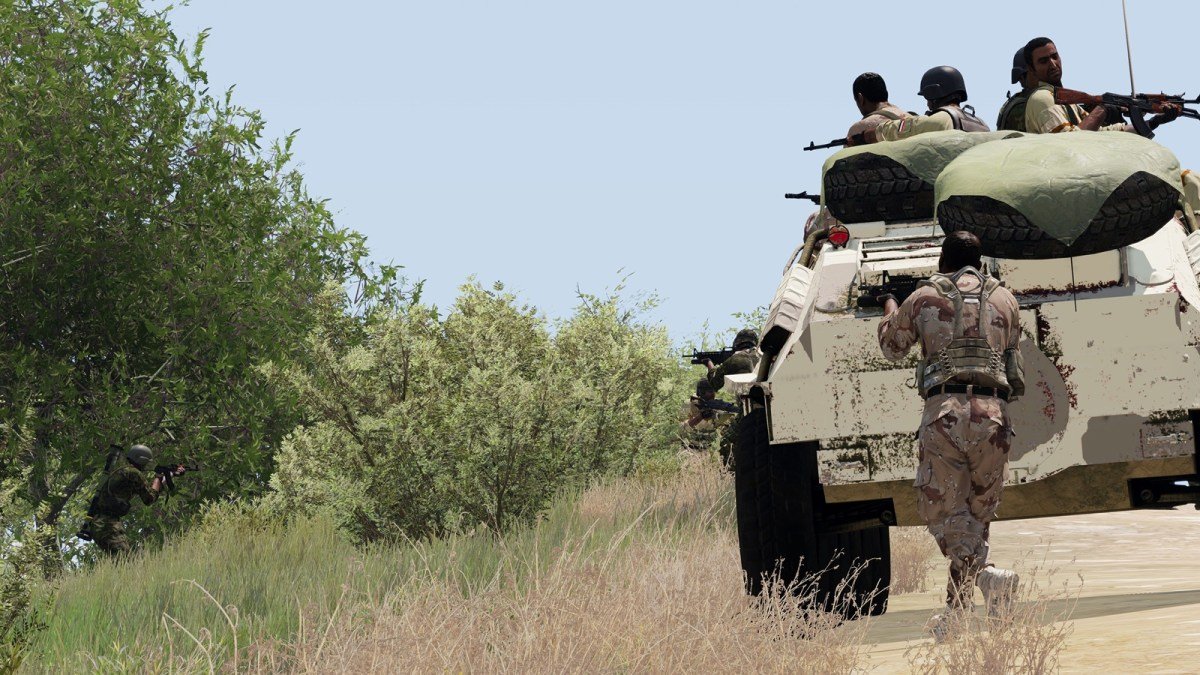
Header Image Used available at: filename: 45149762; caption: British Mastiff armoured vehicles on patrol during Operation Charge of the Knights-14 in Basrah City with the UK Military Transition Team (MITT) Group attached to 50 Brigade, Iraqi Army in June 2008; OGL License.
Sources Consulted
Why We Lost: A General’s Inside Account of the Iraq and Afghanistan Wars – Daniel P. Bolger
The Afghanistan Papers: A Secret History of the War – Craig Whitlock
Cobra II: The Inside Story of the Invasion and Occupation of Iraq – Michael R. Gordon and Bernard E. Trainor
The New Rules of War – Sean McFate
Only the Paranoid Survive: How to Identify and Exploit the Crisis Points That Challenge Every Business – Andrew S. Grove
Principles for Dealing with the Changing World Order: Why Nations Succeed and Fail – Ray Dalio
Strategy: A History – Lawrence Freedman
Iran’s Grand Strategy: A Political History – Vali Nasr
Armies of Sand: The Past, Present, and Future of Arab Military Effectiveness – Kenneth M. Pollack
Destined for War: Can America and China Escape Thucydides’s Trap? – Graham Allison
Margin of Victory: Five Battles That Changed the Face of Modern War – Douglas Macgregor
Reforging the Sword and Spectral Shadows – Donald E. Vandergriff
Facts and Fears: Hard Truths from a Life in Intelligence – James Clapper
The Great Courses
American Military History: From Colonials to Counterinsurgents – General Wesley K. Clark
Assessing America’s National Security Threats, taught by retired U.S. Army Lieutenant General and former National Security Advisor H. R. McMaster
Strategic Thinking Skills – Dr. Stanley K. Ridgley
Support Strategy and Wargaming
I do what I do in Strategy and Wargaming because I love to do this, and I’m never going to stop. If you would like to support me with that, you can buy me a coffee for a dollar if you’re feeling generous. If you can’t, no worries, Strategy and Wargaming will always be free, and I’d love to have you around!
