

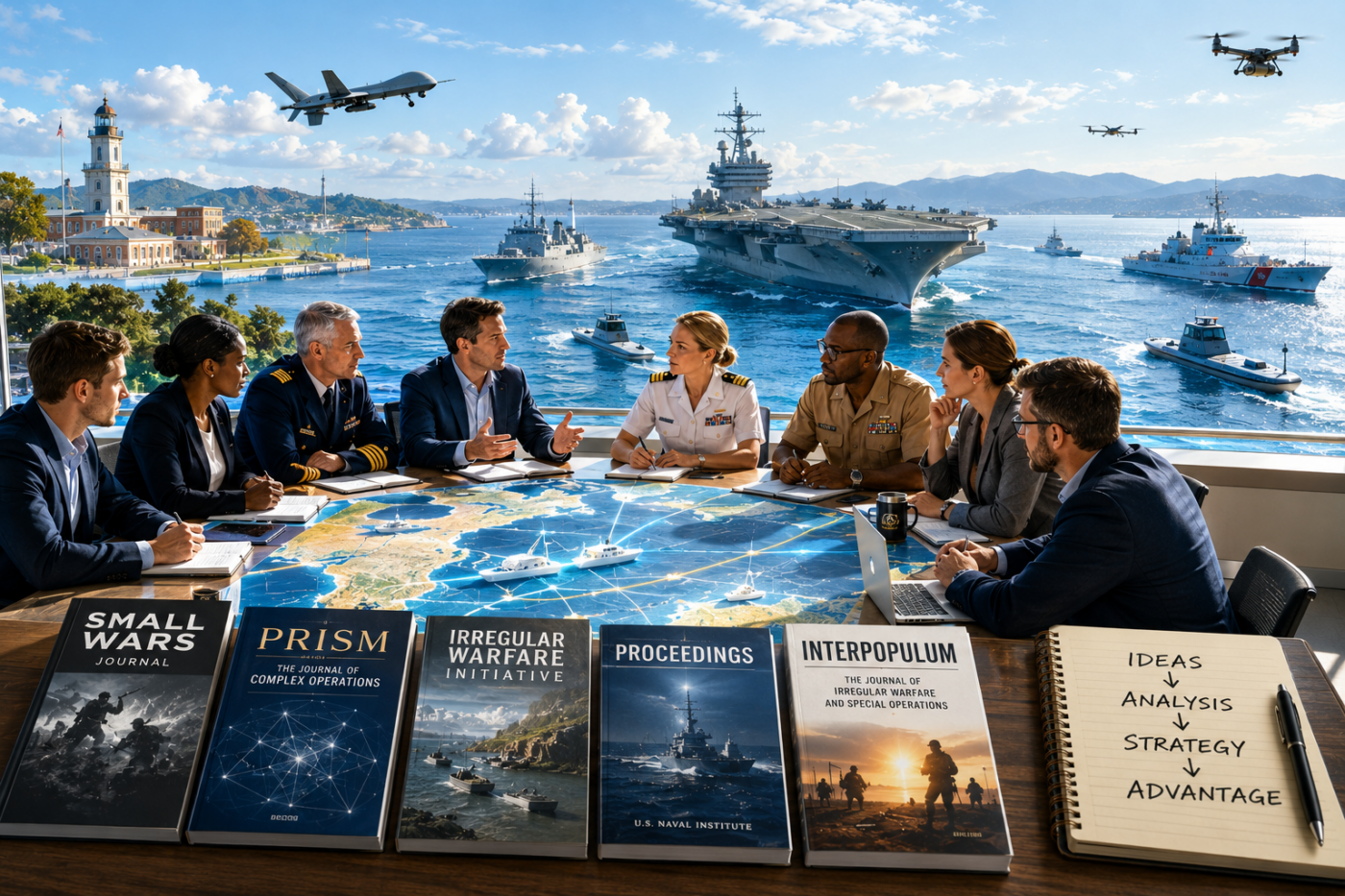
The 2026 Center on Irregular Warfare and Armed Groups (CIWAG) Maritime Symposium, Gathering Storms & Shifting Tides: Maritime Security and Seapower in an Era of Strategic Rivalry, demonstrated once again why the U.S. Naval War College has become one of the nation’s leading venues for advancing thought on irregular warfare in the maritime domain. Over three days in Newport, Rhode Island, military professionals, academics, policymakers, legal scholars, intelligence professionals, technologists, and industry leaders examined the changing character of maritime competition and the growing importance of irregular warfare at sea.
The symposium was a success not simply because of the distinguished speakers or the breadth of topics. It was successful because it fostered what every serious professional military conference should foster: informed debate, thoughtful disagreement, and the exchange of ideas across disciplines. The conversations should not end when the final panel concludes. They should begin there.
The next phase of the symposium is writing.
CIWAG’s Contribution
The Center on Irregular Warfare and Armed Groups was established to promote research, education, and professional dialogue on irregular warfare and armed groups in the maritime domain while bridging the gap between strategy, scholarship, and operations. Through conferences, workshops, podcasts, policy papers, and educational outreach, CIWAG has become one of the principal intellectual centers examining the increasingly complex problems that exist below the threshold of conventional war.
This year’s symposium reflected that mission perfectly.
The agenda addressed nearly every major challenge confronting maritime security today, including:
- Special operations
- Maritime security and governance
- Cartels and narcoterrorism
- Shadow fleets
- Maritime lawfare
- Homeland defense and port security
- Seizure and escort operations
- NATO and Arctic security
- Maritime autonomous systems
Together these discussions painted a picture of a maritime domain that is no longer defined solely by fleets, ports, and sea lines of communication. Increasingly it is shaped by influence operations, economic coercion, legal manipulation, proxy actors, sanctions evasion, autonomous systems, cyber capabilities, and strategic competition conducted below the threshold of declared war.
The Conversation Must Continue
Professional military and national security education does not end when participants leave Newport.
History demonstrates that conferences rarely change doctrine by themselves. Writing does.
The modern concepts of airpower, maneuver warfare, counterinsurgency, special operations, and joint all domain operations all evolved because practitioners captured ideas in articles, essays, journals, and books. They challenged assumptions. They refined concepts. Others criticized them. Better ideas emerged.
Irregular warfare requires precisely this kind of continuing discourse.
The maritime environment is changing faster than doctrine.
The operational lessons emerging from Ukraine, the Red Sea, the South China Sea, the Arctic, the Strait of Hormuz, and the global shadow fleet have not yet been fully incorporated into U.S. thinking. New technologies are changing the character of maritime competition while adversaries continue to integrate political warfare, information operations, economic coercion, cyber operations, and lawfare into comprehensive campaigns.
If practitioners do not write about these developments, someone else will define the intellectual terrain.
Where Should Participants Publish?
Fortunately, today’s practitioners have more opportunities than ever before to contribute.
Small Wars Journal remains one of the premier venues for advancing thought on irregular warfare, unconventional warfare, political warfare, special operations, and strategic competition and all forms of conflict.
PRISM: The Journal Of Complex Operations, published by the Irregular Warfare Center, provides an outstanding forum for rigorous analysis connecting policy, strategy, and operations.
The Irregular Warfare Initiative, to include its Maritime Focus Area, continues to publish timely articles on contemporary operational problems while encouraging new voices throughout the profession.
Proceedings, published by the U.S. Naval Institute, remains one of the military profession’s most influential journals and has shaped naval thought for more than 150 years.
Interpopulum: The Journal of Irregular Warfare and Special Operations, provides another important venue for serious scholarship on strategic competition, national security, and international affairs.
These journals are complemented by War on the Rocks, the Modern War Institute, Military Review, the Marine Corps Gazette, Joint Force Quarterly, and numerous service publications. Together they form an intellectual ecosystem that advances professional military education.
The profession needs more practitioners willing to contribute.
Ten Writing Challenges
Rather than simply summarizing conference discussions, participants should build upon them. The following ten writing prompts are intended to stimulate continued discussion and analysis.
- An Irregular Warfare Attention Index: Measuring What We Must Understand
Prompt:
Based on a keynote address that referenced the Maritime Attention Index, should the United States develop an Irregular Warfare Attention Index to educate policymakers, commanders, practitioners, journalists, and the public on where IW is shaping strategic competition? What indicators should it track: proxy activity, information warfare, lawfare, resistance potential, malign finance, illicit networks, cyber-enabled influence, gray-market logistics, sanctions evasion, and partner resilience? Who should manage it: the Irregular Warfare Center, CIWAG, NDU, SOCOM, a consortium, or an independent public-private body?
Key Question:
If we cannot see, measure, and explain IW activity, how can we compete before crisis becomes conflict?
- The New Maritime Great Game: How Irregular Warfare Shapes Strategic Competition at Sea
Prompt:
Traditional naval power remains essential, but strategic competition increasingly occurs below the threshold of armed conflict. Examine how states and non-state actors employ irregular warfare in the maritime domain. Analyze the use of proxies, shadow fleets, maritime militias, cyber operations, economic coercion, information campaigns, and legal warfare. What should be the U.S. maritime irregular warfare strategy for the next decade?
Key Question:
Is maritime superiority today determined more by control of narratives, networks, and commerce than by control of sea lanes?
- Chokepoints Under Pressure: Employing Irregular Warfare Capabilities to Counter Malign Actors at the World’s Strategic Maritime Bottlenecks
Prompt:
The Strait of Hormuz, Bab el-Mandeb, Suez Canal, Bosporus, Panama Canal, Malacca Strait, and key Arctic routes are increasingly vulnerable to coercion by state and non-state actors. Develop a framework for employing irregular warfare capabilities, special operations forces, partner networks, intelligence activities, resistance support, information operations, and economic measures to deter and counter malign actors threatening freedom of navigation and global commerce.
Key Question:
Can IW capabilities provide a lower-cost and more sustainable means of securing critical maritime chokepoints than the continuous deployment of conventional naval forces?
- The Shadow Fleet Challenge: Economic Warfare at Sea
Prompt:
Sanctions evasion, illicit shipping networks, dark fleets, and gray-market energy transportation have become instruments of statecraft. Assess how Russia, Iran, China, and other actors use maritime commercial networks to undermine sanctions and reshape the international order. What policy, intelligence, legal, and operational tools are required to counter these networks?
Key Question:
Should shadow fleets be viewed primarily as a maritime law-enforcement problem or as a national security threat requiring an integrated whole-of-government response?
- Autonomous Maritime Warfare and the Democratization of Seapower
Prompt:
Ukraine’s experience in the Black Sea suggests that autonomous maritime systems may alter long-standing assumptions about naval power. Examine how autonomous surface and subsurface systems, AI-enabled sensing, and commercial technologies are changing deterrence, sea denial, maritime security, and special operations. What lessons should the United States draw from current conflicts?
Key Question:
Will future maritime power be measured by the size of fleets or by the scale and adaptability of autonomous networks?
- Maritime Resistance and Partner Networks: The Future of Deterrence
Prompt:
Maritime security increasingly depends on allies, partners, commercial actors, local communities, coast guards, fishing fleets, and resistance networks. Explore how the concepts of resistance, resilience, and partner-enabled operations can contribute to deterrence and maritime security. Draw lessons from the Baltic, Arctic, South China Sea, Red Sea, Black Sea, and Korean Peninsula.
Key Question:
How can the United States build maritime ecosystems that remain effective even when traditional command structures are disrupted or denied?
- Counter-Lawfare as Strategic Influence: A Strategy and Campaign Plan for Commanders
Prompt:
Write a counter-lawfare strategy and campaign plan that treats adversary lawfare as a strategic influence operation, not merely a legal problem. How should commanders and operators expose false legal narratives, defend legitimacy, integrate legal counsel into operational design, and lead with influence before adversaries seize the narrative? What authorities, doctrine, training, and interagency mechanisms are needed?
Key Question:
How do commanders learn to lead with influence when the first battle is often over legitimacy, not lethality?
- Updating the Joint Concept for Competing for IW Strategy and Campaigning
Prompt:
How should the Joint Concept for Competing be updated to better inform irregular warfare strategy, campaigning, and operational design? Examine how competition, deterrence, influence, resistance, unconventional warfare, partner development, information operations, and economic pressure should be integrated into campaign plans below the threshold of war.
Key Question:
Does the Joint Force know how to campaign for strategic effect without waiting for crisis or war?
- Replacing the Gray Zone: ICAD and the Fight to Seize the Initiative
Prompt:
The term “gray zone” often concedes ambiguity to the adversary and obscures hostile conduct. Should the United States replace it with ICAD: Illegal, Coercive, Aggressive, and Deceptive activities? Assess whether ICAD better describes PRC/CCP behavior and helps policymakers, commanders, allies, journalists, and publics understand the threat. Address the institutional challenge: the only thing harder than getting a new idea into a military mind is getting an old idea out.
Key Question:
Does “gray zone” help us think, or does it help the adversary hide?
- From Maritime Attention to Maritime Action: Turning Conference Insights into Campaign Design
Prompt:
How can the lessons from CIWAG’s maritime symposium be converted into actual campaign plans for the Navy, Marine Corps, Coast Guard, SOF, allies, and interagency partners? Develop a practical framework that links maritime security, IW, special operations, lawfare, ports, shadow fleets, autonomous systems, and chokepoints into one integrated competition campaign.
Key Question:
What is the bridge between strategic thought at Newport and operational action in the fleet?
Writing as a Professional Responsibility
Every generation inherits strategic problems that previous generations could not fully anticipate.
Today’s irregular warfare maritime environment presents one of those moments.
Competition increasingly occurs below the threshold of war. Economic coercion is becoming a weapon. Legal arguments shape operational freedom. Autonomous systems are changing the balance between large and small powers. Criminal organizations increasingly intersect with state objectives. The distinction between military and civilian actors continues to erode.
These developments require more than new technology.
They require new thinking.
Professional military and national security education depends upon a healthy marketplace of ideas where assumptions are challenged, concepts are refined, and practitioners openly debate solutions. The maritime domain has become one of the principal arenas of strategic competition. Irregular warfare has become one of its principal characteristics.
The discussions in Newport should therefore be viewed not as the conclusion of a conference but as the beginning of a larger conversation.
The profession now has an obligation to continue that conversation through thoughtful writing, rigorous analysis, and constructive debate.
Ideas matter.
But only if they are written, shared, challenged, and improved.
