


By Suzy Button, director, Intelligence Consulting
How might a NATO mechanised infantry brigade fare against Russian electronic warfare capabilities on a future battlefield in the northern Baltic?
In September, Armada will publish a dedicated supplement entitled 9th May 2028 which will be distributed at this year’s EWLive exhibition to be held in Tartu, southern Estonia, between 15th and 17th September. The supplement considers a hypothetical, yet plausible, scenario of Russia performing a limited land invasion of Estonia and Latvia in May 2028. The focus of the supplement is how the spectrum battle may be fought by the Russian military as it performs electromagnetic manoeuvre in a bid to achieve Electromagnetic Superiority and Supremacy (E2S) early in the conflict. One of the targets of Russian Electronic Warfare (EW) is the fictious 429th Mechanised Infantry Brigade. This formation has been deployed to Estonia as part of the North Atlantic Treaty Organisation’s (NATO’s) Enhanced Forward Presence (EFP) in late 2027 to deter, and respond to, any Russian incursion into the former’s territory. In this article Suzy Button, a signals and cyberwarfare expert, and director of Intelligence Consulting, gives her assessment of how a mechanised infantry brigade-sized formation may cope against Russian EW at the tactical and operational level.
Introduction
By the late 2020s, the northern Baltic region is one of the North Atlantic Treaty Organisation’s (NATO’s) most likely flashpoints. As per Armada’s scenario discussed above, a reinforced mechanised infantry brigade is deployed as part of the alliance’s EFP in Estonia, facing a Russian combined arms formation supported by a dedicated electronic warfare brigade and additional EW assets from army and front level. This scenario examines how Russian land forces might employ tactical EW against a typical NATO brigade, where current vulnerabilities lie, and how these could be addressed.
Russian EW doctrine and capabilities
Russian military thinking treats electronic warfare as a core element of radio-electronic combat, integrated with cyber, deception, long-range fires and information operations. The principal aims are to degrade adversary Command and Control (C2), reduce the effectiveness of intelligence and precision weapons, and preserve the resilience of Russian C2 and targeting systems.
At the tactical and operational level Russian EW brigades field dense layers of systems designed to suppress communications, radars and navigation aids across High Frequency (HF: three megahertz/MHz to 30MHz), Very High Frequency (VHF: 30MHz to 300MHz) and Ultra High Frequency (UHF: 300MHz to three gigahertz) wavebands. Strategic level assets like the Murmansk-BN EW system can threaten HF and some datalink-dependent C2 over very long ranges, while brigade level complexes such as the 1RL257 Krasukha-4 and RB301B Borisoglebsk-2 are designed to suppress tactical and operational communications and radars within hundreds of kilometres.
A significant development is Russia’s introduction of automated EW C2 systems such as RB-109A Bylina. Bylina’s main role is the automated battle management of electronic warfare at the brigade level, integrating multiple EW platforms into a coordinated network that can classify emitters, prioritise targets and cue the most suitable jammers in near real time. In a Baltic conflict, this allows Russian forces to concentrate EW effects on high value NATO emitters at decisive moments rather than applying blanket jamming across all frequencies.
Experience from Ukraine suggests that Russian EW employment can be dense, with multiple electronic warfare assets deployed every few kilometres of front, and that EW is routinely used to disrupt artillery fire control, Uncrewed Aerial Vehicle (UAV) operations and local command nets. While some Russian EW systems have proven vulnerable to kinetic strike when detected, their mass, mobility and integration with fires remain a serious threat to NATO land manoeuvre.
NATO mechanised brigade communications architecture
A typical NATO mechanised infantry brigade in the late 2020s will still be structured around a hierarchical C2 network linking brigade headquarters (HQ), battlegroup HQs and company nodes. Communications rely on a mix of:
- V/UHF line-of-sight radios for tactical control of companies and battlegroups, increasingly with some Mobile Ad-Hoc Networking (MANET) capability.
- HF radios for longer-range resilient links, particularly to higher echelons and for backup C2.
- Satellite Communications (SATCOM) and other beyond-line-of-sight bearers for connection to division, corps and strategic C2.
- Datalinks and specialised nets for artillery, air defence, UAVs and situational awareness systems.
In many brigades, this architecture still depends on a relatively small number of high-value C2 nodes and gateways, with predictable emissions patterns and uneven adoption of advanced anti-jam and low probability of interception/detection features across the fleet. Mixed inventories of legacy and software-defined radios mean that some units are significantly more resilient to EW than others.
Vulnerabilities under massed Russian EW
In a 2028 Baltic scenario, Russian EW is likely to focus on three objectives: isolating the brigade from higher command, degrading internal brigade C2, and disrupting sensors and precision effects. Current vulnerabilities cluster around several areas:
Dependence on a small number of high-value C2 nodes
If the brigade relies heavily on one or two central C2 nodes with predictable locations and emissions, Russian EW can use direction finding and pattern analysis to locate and suppress them. Long-range systems can complicate HF and SATCOM-dependent links to higher command, while local jammers can isolate battlegroups from each other. The risk is not necessarily total communications collapse, but enough fragmentation and delay to degrade tempo, coordination and the ability to mass effects at the right place and time.
Predictable, signature-rich tactical radio nets
Many current tactical radio nets still use relatively static frequency plans, limited hopping and uneven emissions discipline. Against an adversary with automated EW C2 like Bylina, this creates high-value targets: company and battalion V/UHF nets essential for close control, datalinks used for situational awareness and fire coordination and UAV links can all be selectively degraded at key moments. Global navigation satellite system position, navigation and timing jamming and spoofing over the Baltic region can further degrade navigation, timing and some targeting functions across the brigade.
Mixed fleets and uneven EW resilience
By the late 2020s and early 2030s, NATO brigades will still operate mixed fleets of legacy and modern radios, with different levels of frequency agility, anti-jam capability and networking. Some units may have advanced software defined radios with MANET and robust waveforms; others may still depend on older, more easily targeted sets. Interoperability gateways and cross-band links become high-value targets because they concentrate traffic and have distinctive signatures. Russian EW planning explicitly aims at such weak points in C2 infrastructure, exploiting interoperability gaps to multiply effects.
Limited organic EW and spectrum manoeuvre at brigade level
NATO has long recognised shortfalls in organic tactical EW and in the ability to sense and manoeuvre in the spectrum at brigade-level and below. While Russian EW brigades can mass effects and coordinate them through automated C2 like Bylina, many NATO brigades still rely on higher-echelon support and national contributions for detailed Electromagnetic Spectrum (EMS) situational awareness and coordinated counter-EW action. In a fast-moving Baltic fight, that creates a mismatch: The adversary can sense, prioritise and act in the EMS at brigade level in near real time, while NATO’s response may be slower, more fragmented and dependent on external assets.
Addressing the vulnerabilities
The remedies are less about buying a single ‘magic radio’ and more about redesigning how the brigade uses spectrum, structures its C2 and integrates EW and cyber-EMS functions.
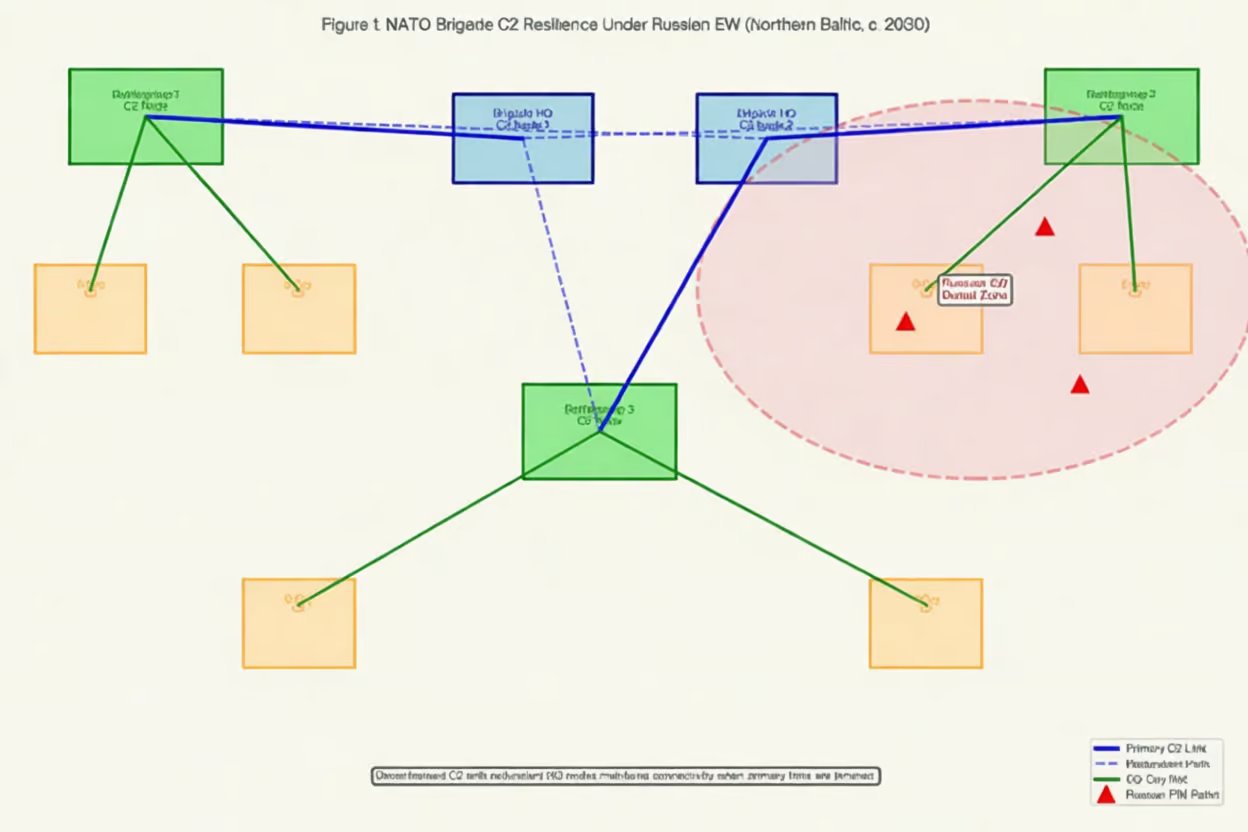
Decentralise and harden C2 architecture
Doctrinally, NATO already points towards looser, more resilient command structures that can operate under communications stress. For a mechanised brigade in the Baltics, that implies:
- More mission command and pre-delegated authority so that battlegroups and companies can continue fighting even if higher-level nets are degraded.
- Redundant, geographically dispersed C2 nodes with reduced and variable emissions profiles, making them harder to locate and target.
- Use of alternative paths (HF, SATCOM, line-of-sight mesh, even commercial bearers where policy allows) so that no single jamming solution can isolate the brigade.
Make spectrum manoeuvre a core brigade function
NATO doctrine treats EMS management as an operational function that must be planned, coordinated and deconflicted, not an administrative afterthought. At brigade level, that needs to become concrete:
- Embedded spectrum managers who understand both doctrine and technical EW effects, and who can advise commanders on emissions risk and spectrum options in real time.
- Dynamic frequency and waveform management tools that can adapt plans as the EMS picture changes, rather than relying solely on static frequency assignments.
- Integration of commercial and military spectrum sensing where possible, to improve awareness of both friendly and hostile emissions.
The goal is to let the brigade ‘move’ in the spectrum as it moves on the ground: shifting nets, changing parameters and exploiting under-used bands while staying within host-nation and coalition constraints.
Accelerate adoption of resilient, software-defined tactical radios
Technical resilience matters, but it must be aligned with how the brigade actually fights. Priorities include:
- Radios with robust anti-jam features, frequency agility and low probability of interception/detection characteristics, especially for critical C2 and fire-support nets.
- Software-defined platforms that can host multiple waveforms. These include national waveforms and multinational/coalition protocols like the European Secure, Software-Defined Radio, Second-Generation Anti-Jam Tactical UHF Radio for NATO and HF Automatic Link Establishment. Threse waveforms will need to be updated as threats evolve, reducing the risk of obsolescence against adaptive Russian EW.
- Network designs that assume intermittent connectivity and can degrade gracefully, using store-and-forward, local caching and autonomous re-routing rather than collapsing when a backbone link is jammed.
Integrate EW, cyber and EMS operations at the tactical level
Russian EW thinking explicitly integrates radio-electronic combat with cyber, deception and information operations to disrupt C2 and morale. NATO’s response should be similarly integrated, not siloed:
- Brigade level cells that fuse EMS, cyber and intelligence inputs to produce a single recognised electromagnetic picture for the commander, highlighting where emissions are creating risk and where opportunities exist.
- Exercises that routinely inject large-scale EW and cyber effects, forcing staff to practice operating under degraded communications and to test contingency procedures.
- Closer coupling between NATO’s limited organic EW assets, national EW contributions and C2 planners so that counter-EW actions are timed and targeted to protect key C2 functions rather than applied generically.
Exploit Russian EW weaknesses and constraints
Russian EW is formidable but not invulnerable. Experience in Ukraine shows that high-value EW nodes can be targeted and destroyed if they become detectable and are not well protected. Dense EW employment creates its own signatures and coordination challenges, especially when many systems must operate in proximity without degrading friendly communications. NATO can:
- Invest in better EMS sensing and geolocation to find and target critical EW nodes as part of the deep fight.
- Use deception, emissions control and multi-domain manoeuvre to force Russian EW to spread its effort, reducing its concentration at decisive points.
- Design brigades so that losing one or two C2 nodes does not equate to losing the brigade’s ability to fight, thereby reducing the payoff from Russian EW strikes.
Implications for the 2028 Baltic fight
In Armada’s scenario outlined in the 9th May 2028 supplement, the outcome will not be determined solely by who has the ‘best’ radios, but by who can best integrate spectrum, EW and C2 into a coherent operational approach.
A NATO brigade that decentralises its C2, treats spectrum as a manoeuvre space, adopts resilient software-defined radios and integrates EW and cyber-EMS functions at the tactical level can absorb Russian EW shocks and continue to operate effectively.
Conversely, a brigade that relies on a small number of high-value C2 nodes, static frequency plans and unevenly resilient radios risks being fragmented and delayed, even if it retains some communications capability.
The central challenge for NATO land forces in the northern Baltic by circa 2028 is therefore to redesign tactical communications and C2 so that Russian electronic warfare complicates rather than paralyses brigade operations.
