

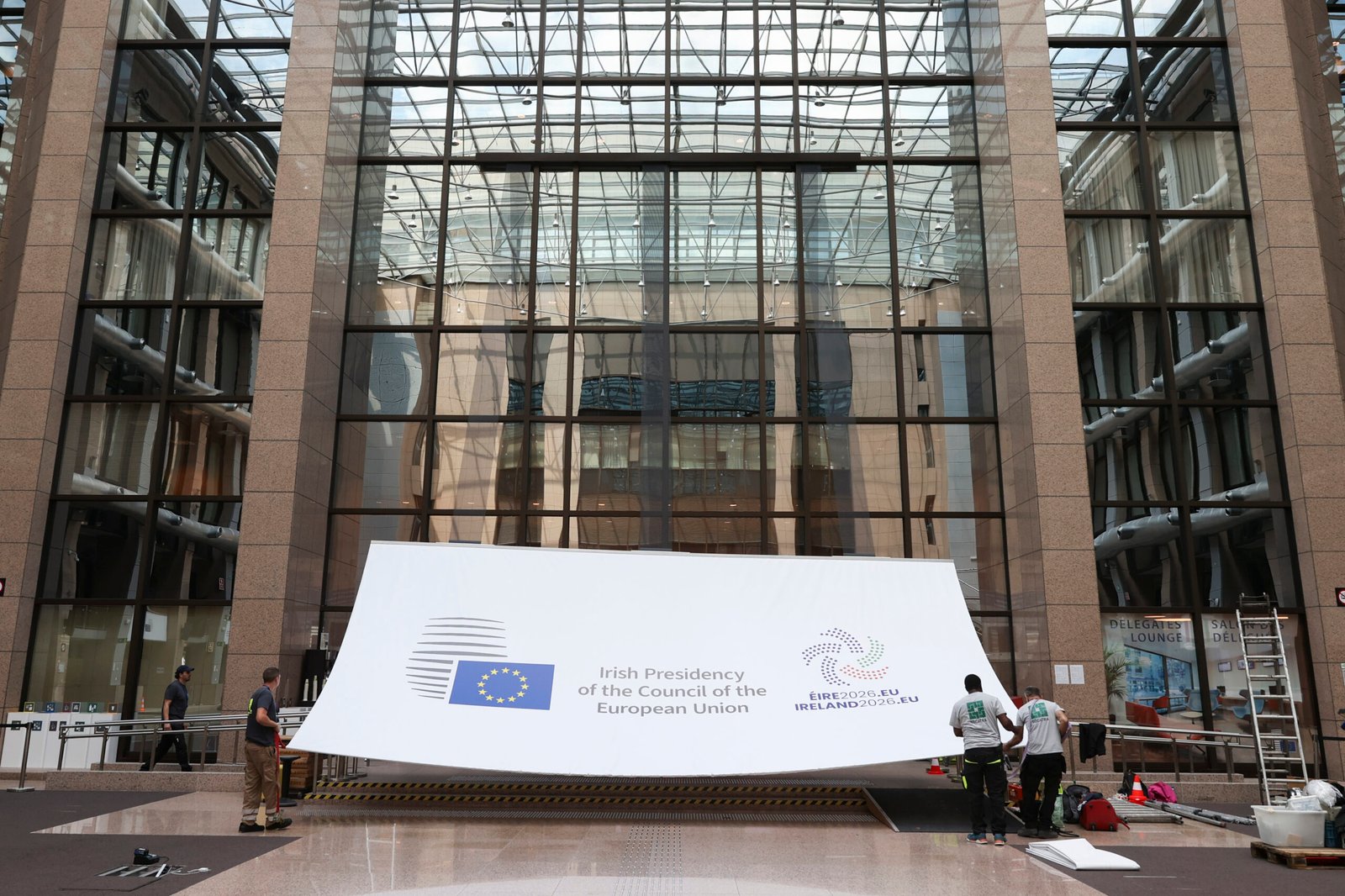
As Brussels is preparing for its traditional summer ‘slowdown’, Europe finds itself with little opportunity for pause. The handover of the Presidency of the Council of the European Union from Cyprus to Ireland on 1 July signals the end of one institutional chapter, but certainly not of the multiple crises that continue to define European policymaking. If anything, the first half of the year showed that security is no longer one priority among many; it has increasingly become the organising principle through which almost every major European policy is now viewed.
As Brussels empties, Russia’s ongoing war against Ukraine continues, with no immediate prospect of a settlement. And the ramifications of US military strikes against Iran continue to reverberate across the Middle East, raising questions over regional stability and Europe’s energy security. Meanwhile, transatlantic relations have become more tense and increasingly complex as President Trump’s administration pursues an almost exclusively transactional approach towards allies, reviving debates over burden-sharing and Europe’s strategic autonomy.
Against this turbulent backdrop, Ireland is assuming the Council Presidency for the remainder of 2026 with an agenda that extends far beyond managing traditional legislative files. By the time European institutions return from the summer recess, a packed autumn schedule awaits, in which decisions on defence investment, industrial capacity, enlargement and transatlantic cooperation will shape the Union’s strategic posture for years to come.

Ireland’s Presidency – Defined by Security
While Cyprus inherited a challenging geopolitical environment, few anticipated how dominant security would become during its six-months ‘in office’. And while the Presidency did advance the Union’s work on competitiveness, migration, the long-term budget and digital transformation, these issues ultimately became inseparable from the continent’s strategic concerns.
On a positive note, we have seen the implementation of the Readiness 2030 agenda and the Security Action for Europe (SAFE) instrument, which have moved discussions beyond simply providing emergency support for Ukraine, towards actually taking concrete steps to rebuild Europe’s own military capabilities. Joint procurement initiatives are gaining momentum, defence industrial production is expanding, and member states are increasingly treating capability development as a matter of collective resilience rather than national preference.
This all signals an important evolution. More than four years after Russia’s full-scale invasion of Ukraine, European defence policy is no longer driven solely by solidarity with Kyiv. Instead, the conflict has fundamentally reshaped how European governments assess their own vulnerabilities. This means that ammunition stockpiles, air and missile defence, military mobility, cyber resilience and critical infrastructure protection have all become permanent features of the EU security agenda.
By the end of the day, the Cyprus Presidency came to reflect a wider shift underway inside the Union itself. It was no longer just coordinating the routine flow of legislative work. Instead, it found itself operating as something closer to a crisis manager, constantly navigating overlapping geopolitical pressures—from the war in Ukraine to instability in the Eastern Mediterranean and the broader Middle East.
A New Strategic Reality
The defining characteristic of Europe’s security environment as we look ahead to the second half of 2026 is one of uncertainty; this is not just about Russia, but increasingly regarding the wider international order on which European security has depended for decades.
What is clear is that Russia will continue to adapt to what has become a prolonged war of attrition. Despite multiple EU sanctions packages and continued Western military assistance to Ukraine, Moscow has demonstrated an ability to sustain military operations through industrial mobilisation, expanded domestic production and support from international partners. European governments have increasingly accepted that the challenge is no longer simply helping Ukraine survive, but preparing for a long-term confrontation with an adversary capable of rebuilding its military strength even under economic pressure.
That understanding has triggered efforts to strengthen Europe’s own defence industrial base. And this emphasis has begun to move away from emergency deliveries to sustained production capacity, by expanding ammunition manufacturing, strengthening supply chains and encouraging greater cooperation between European defence industries. The objective is not merely to replenish stocks depleted by assistance to Ukraine, but to establish an industrial base capable of supporting credible deterrence over the coming decade.
Yet Russia represents only one dimension of Europe’s increasingly complex security environment.
The confrontation between the United States and Iran demonstrates just how rapidly crises beyond Europe’s immediate neighbourhood can reshape European strategic calculations. Although European capitals largely shared Washington’s concerns regarding Iran’s regional activities and nuclear ambitions, several member states expressed unease over the risk of escalation and limited (some say none) consultation preceding American military action. The conflict has also revived concerns regarding global maritime security, energy supplies and the vulnerability of trade routes on which European economies depend.
And perhaps more importantly, the conflict has reinforced a broader trend that has been developing since President Trump’s return to office: growing uncertainty regarding the future of transatlantic relations.
A Fragile Alliance
Despite these concerns, any predictions of a transatlantic rupture are misplaced. The United States remains a crucial European ally. American intelligence, strategic lift, advanced capabilities, logistics and nuclear deterrence continue to underpin NATO’s collective defence, while cooperation over Ukraine remains extensive despite periodic political disagreements.
However, the relationship has undoubtedly become more transactional.
Disputes over defence spending, tariffs, industrial subsidies and burden-sharing have intensified throughout 2026. Washington’s expectation that European allies should assume greater responsibility for their own defence is no longer viewed in Brussels as a temporary negotiating tactic, but as a central feature of US policy. At the same time, European policymakers are now conscious that shifts in US domestic politics can rapidly alter strategic priorities with global consequences.
Once politically divisive, the concept is increasingly understood not as an alternative to NATO, but as an insurance policy against uncertainty. The objective is not about independence from the United States, but rather the capability to act when American priorities diverge from Europe’s own or when Washington’s attention is directed elsewhere, as seen in the Middle East.
For many European governments, the question is no longer whether the United States remains committed to European security, but how predictable that commitment will be over the long term.
Ireland’s Challenge
It is obvious that Ireland has assumed the Presidency at a particularly demanding moment.
Dublin has identified competitiveness, innovation, and enlargement among its priorities. But like its predecessor, unforeseen events will dictate much of the agenda. Ukraine will remain front and centre of the Union’s security concern, while implementation of defence initiatives launched over the past two years will increasingly shift from political agreement to delivery.
The Irish Presidency therefore will also oversee politically sensitive negotiations on the next Multiannual Financial Framework, where defence spending, industrial competitiveness and enlargement are expected to compete for finite resources. At the same time, discussions on Ukraine, Moldova and the Western Balkans will continue reinforcing the increasingly accepted view that enlargement has become a geopolitical instrument as much as an accession process. And we see this in action with the announcement that NATO member, Montenegro will become the 28th EU member state in 2028.
Ireland’s long-standing policy of military neutrality adds an interesting element. Although not a NATO member, Dublin is now chairing a Council agenda in which defence and security cooperation dominate discussions to an extent unprecedented in modern EU history. The Irish Presidency’s success will therefore depend less on Dublin’s own security posture than on its ability to negotiate internally among member states, and by brokering consensus among increasingly diverse national positions.
An Autumn That Will Shape Europe’s Future
When European institutions reconvene after the summer, the agenda will be daunting. Decisions on defence procurement under SAFE, implementation of broader defence industrial initiatives, continued military support for Ukraine and further sanctions against Russia will all feature prominently.
Alongside these priorities, member states will face difficult discussions over financing Europe’s long-term security ambitions. Expanding defence capabilities, strengthening military mobility, protecting critical infrastructure, countering hybrid threats and enhancing cyber resilience all require sustained investment at a time when governments also face economic pressures and competing domestic priorities.
At the same time, instability stretching from Eastern Europe to the Middle East is not likely to diminish. Europe’s external environment is becoming increasingly interconnected, with developments in one region rapidly affecting another through migration, energy markets, and supply chains.
As a result, the second half of 2026 is likely to be judged not by the quantity of ‘regular legislation’ adopted, but by whether Europe continues translating political consensus into tangible capability.
The Cypriot Presidency closed on 30 June having overseen a period in which the EU moved further towards becoming a genuine security actor. Ireland now inherits the more difficult task: ensuring that this momentum survives an increasingly volatile geopolitical environment and an alliance with Washington that remains essential but increasingly unpredictable and fragile.
Brussels might be enjoying its summer recess, but for sure, the European continent’s security challenges will not be taking a holiday.
Stewart Whittaker
