

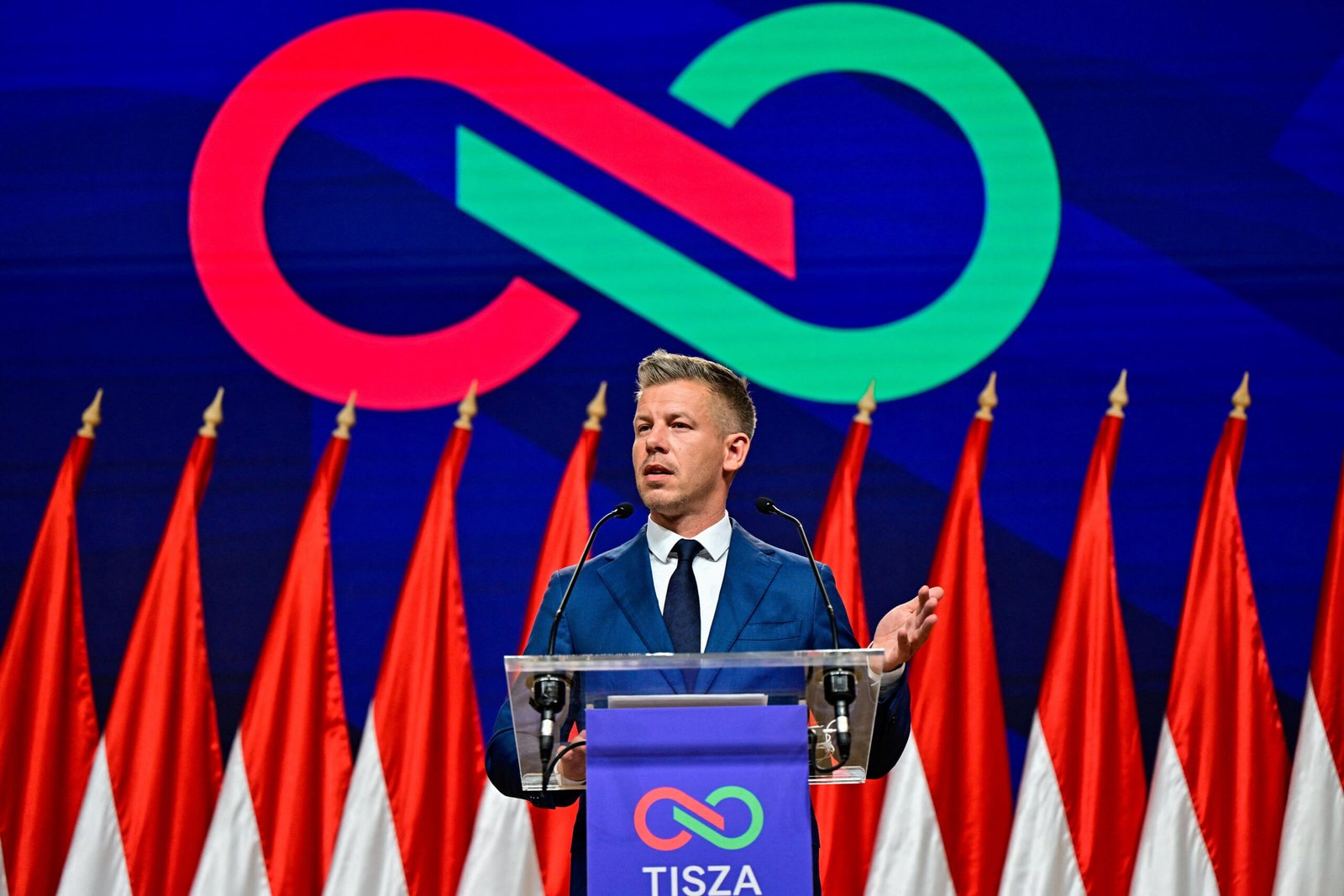
Sunday’s Hungarian parliamentary election brought the curtain down on Prime Minister Viktor Orbán’s sixteen years in power. Opposition leader Péter Magyar’s overwhelming victory paves the way for much-needed reform in Budapest and offers a clear alternative to Orbán’s antagonism toward Europe and Ukraine. However, policymakers in Brussels and Kyiv should not set their expectations too high, as Hungary under Magyar may still not be as forward-leaning on support for Ukraine as some might hope.
In a crushing repudiation of Orbán, Magyar’s center-right Tisza party won a supermajority of 138 seats from a total of 199 in Hungary’s National Assembly. The result puts the incoming government in a position to pursue ambitious reforms and roll back Orbán-era policies both at home and abroad. As Magyar indicated on Monday afternoon, there will soon be significant shifts in Hungary’s foreign policy, including the country’s relationships with the European Union and Russia.
That is reassuring news for Ukraine. Since the start of Russia’s full-scale invasion, Hungary has been the biggest and most constant obstacle to EU support for Ukraine. Orbán has continuously criticized Western efforts to aid Kyiv, accused the West of prolonging the conflict, and proposed restoring ties with Moscow. His government has repeatedly blocked EU sanctions on Russia while also working to disrupt financial assistance packages to Ukraine, delay military reimbursements to member states who supplied Ukraine with arms, and scupper Ukraine’s EU accession hopes.
In order to maintain its support for Ukraine, EU leaders have had to invent creative efforts to navigate around Orbán’s obstruction. This has not always proved possible. A much-needed €90 billion loan to Ukraine and formal accession negotiations with Kyiv are both currently blocked by Hungary.
Analysts are hopeful this pattern will now change. Magyar has already announced he won’t stand in the way of the EU’s €90 billion loan, potentially paving the way for the financial package’s approval and quick disbursement to cover Ukraine’s current budgetary shortfall. Further progress on Ukraine’s membership bid in the coming months also looks possible.
Stay updated
As the world watches the Russian invasion of Ukraine unfold, UkraineAlert delivers the best Atlantic Council expert insight and analysis on Ukraine twice a week directly to your inbox.
While Magyar’s election provides ample reason for optimism, there is also good cause to temper any expectations of Hungary now playing a leading European role in support of Ukraine. Throughout the recent campaign, Magyar remained ambivalent on a number of key Ukraine policies.
The new Hungarian leader has spoken out against fast-tracked EU accession talks for Ukraine and reaffirmed this position following his election victory. “It would be impossible for a country at war to be taken by the EU,” he commented on Monday. Magyar insisted all countries must go through the same accession process and said he’d hold a Hungarian referendum on Ukraine’s candidacy once this process was complete.
Magyar also told reporters that, though supportive of the EU loan to Ukraine, Hungary should retain its opt-out from the financial support package agreed in December. While Magyar’s position on Russia will be drastically different from his predecessor, he stated that he continues to seek “pragmatic” ties with Moscow, while acknowledging Ukraine as the clear victim in the ongoing conflict.
More importantly, Magyar’s attention is set to be focused primarily on the domestic front. His election campaign concentrated on domestic issues, which many consider as the main reason for his party’s success in Sunday’s vote.
Magyar’s commitment to addressing Hungary’s ailing economy aligned well with the Hungarian electorate, as 85 percent of Hungarians considered economic woes to be the largest issue facing the country. Meanwhile, Magyar’s main foreign policy goal will likely be to “bring home” €17 billion in EU funding for Hungary’s economic development, withheld due to allegations of corruption within Orbán’s government.
Hungarian public opinion will also likely constrain Magyar. While Orbán’s position on Ukraine was extreme, his stance had some popular support. More than half of Hungarians oppose financing military equipment for Ukraine, while only 41 percent support recognizing Ukraine as an official candidate for EU membership. Ukraine remains a highly polarizing issue in Hungary and it will be difficult to quickly change these dynamics.
Eurasia Center events

As the new government takes shape in Budapest, the EU should now proceed with a mix of cautious optimism and speed on some of the most urgent Ukraine files. At the same time, Brussels should not expect a wholesale reversal of Hungary’s previous positions. Instead, EU officials need to identify where they expect Hungary to be a productive player. For example, this could include European Peace Facility reimbursements or more flexibility on Russia sanctions.
For Ukraine, it is now time for a reset in the country’s relations with Hungary. Ukrainian President Volodymyr Zelenskyy should approach the new government in Budapest with tempered expectations. He must not let any residual or newfound frustrations regarding Hungarian opposition turn into antagonism and risk letting politics sour potentially productive engagements.
Finally, the US administration may be inclined to bemoan Orbán’s loss. But it should recognize that a more engaged Hungary is good news for Europe and the United States. A Hungarian government that engages on key issues instead of always playing spoiler can increase Europe’s agency and speed in critical decision-making processes. This could help fulfill the United States vision for a Europe “taking the lead in supporting Ukraine’s defense” as laid out in the US National Defense Strategy. Officials in Brussels, Kyiv, and across the Atlantic all have good reason to celebrate Magyar’s victory, but they must also have realistic expectations for the future.
James Batchik is an associate director with the Atlantic Council’s Europe Center. Eva Mulholland is a project assistant with the Atlantic Council’s Europe Center.
Further reading
The views expressed in UkraineAlert are solely those of the authors and do not necessarily reflect the views of the Atlantic Council, its staff, or its supporters.

The Eurasia Center’s mission is to enhance transatlantic cooperation in promoting stability, democratic values, and prosperity in Eurasia, from Eastern Europe and Turkey in the West to the Caucasus, Russia, and Central Asia in the East.
Follow us on social media
and support our work
Image: Peter Magyar, leader of the opposition Tisza Party, speaks during a press conference a day after the parliamentary election, in which Hungarian Prime Minister Viktor Orban conceded defeat, Budapest, Hungary. April 13, 2026. (REUTERS/Marton Monus)
