

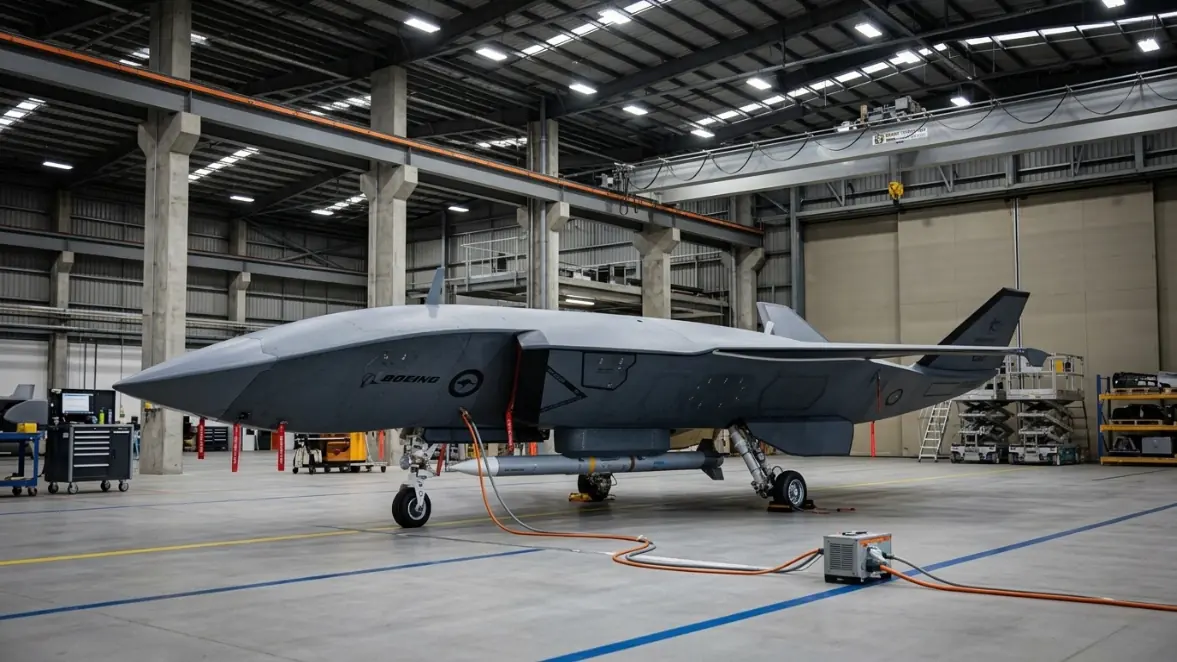
Defense Feeds – St. Louis. The Boeing Unveils MQ-28 Ghost Bat Drone Armed With AMRAAM Missiles announcement signals a major evolution in autonomous air combat capabilities as unmanned aircraft move beyond reconnaissance roles and increasingly take on direct combat missions.
Boeing has revealed new details about the MQ-28 Ghost Bat, showcasing the combat drone configured with internally carried AIM-120 AMRAAM air-to-air missiles and beyond-line-of-sight (BLOS) control capabilities.
The development represents a significant step toward transforming the aircraft from a surveillance and support platform into a fully integrated combat asset capable of operating alongside crewed fighter jets in contested airspace.
The MQ-28 was originally developed by Boeing Australia in partnership with the Royal Australian Air Force as part of the growing global push toward collaborative combat aircraft. Military planners envision these autonomous systems serving as force multipliers that can extend the reach, survivability and combat effectiveness of modern air forces.
Defense analysts believe the latest configuration demonstrates how rapidly autonomous combat aviation is advancing as militaries prepare for future conflicts dominated by networking, artificial intelligence and manned-unmanned teaming.
MQ-28 Gains Air-to-Air Combat Capability
The most notable aspect of Boeing’s latest MQ-28 presentation is the integration of internal AIM-120 AMRAAM missiles, one of the most widely used beyond-visual-range air-to-air weapons in Western service.
By carrying missiles internally, the Ghost Bat maintains a lower radar signature while improving survivability in contested environments. This approach mirrors design principles used on modern stealth fighters where internal weapon storage helps reduce detectability.
The addition of air-to-air weaponry significantly expands the drone’s operational role. Rather than functioning solely as a reconnaissance or electronic warfare platform, the MQ-28 can potentially participate directly in aerial combat missions while supporting crewed aircraft.
Military experts note that future fighter formations may consist of a smaller number of manned aircraft supported by multiple autonomous drones carrying sensors, weapons and electronic warfare payloads. Such arrangements could increase combat effectiveness while reducing risks to pilots.
The newly revealed beyond-line-of-sight control capability is equally important. BLOS connectivity enables operators to command and monitor the drone at greater distances, allowing it to operate across larger battlespaces while maintaining integration with broader military networks.
These capabilities move the Ghost Bat closer to becoming a true collaborative combat aircraft rather than simply an advanced unmanned aerial vehicle.
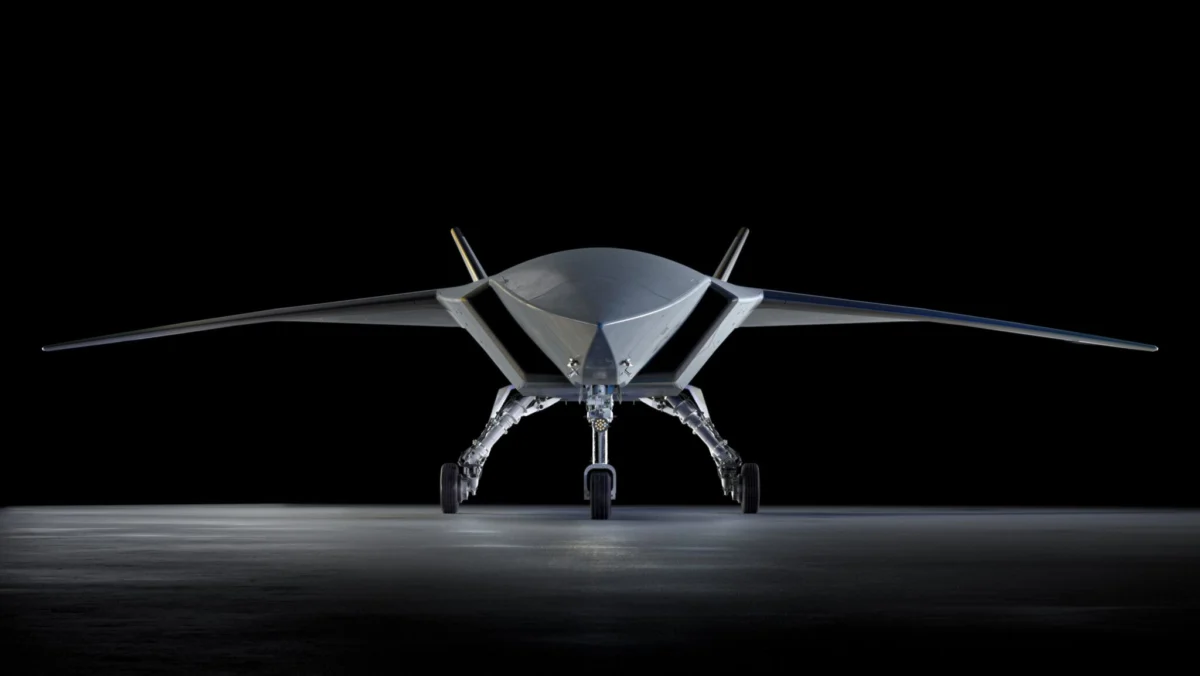
Autonomous Wingmen Become Key Element of Airpower Strategy
The MQ-28 program reflects a wider transformation taking place across military aviation.
Air forces worldwide are investing heavily in collaborative combat aircraft designed to operate alongside advanced fighters such as the F-35 Lightning II and future sixth-generation platforms. These autonomous systems are intended to enhance combat effectiveness while reducing operational costs and pilot workload.
The United States, Australia and several European nations are actively developing similar concepts as part of long-term modernization strategies. Military planners believe autonomous wingmen could perform reconnaissance, electronic warfare, strike missions and air defense tasks without placing human pilots in direct danger.
This approach is particularly attractive in high-threat environments protected by sophisticated air defense networks. Unmanned aircraft can be deployed ahead of crewed formations to gather intelligence, identify threats or engage enemy assets while preserving more valuable manned platforms.
The Ghost Bat has emerged as one of the most advanced examples of this concept currently under development. Its modular architecture allows operators to adapt the aircraft for different mission profiles depending on operational requirements.
Defense observers believe such flexibility will become increasingly important as future battlefields grow more complex and technologically demanding.
Future Air Warfare Driven by Manned-Unmanned Teaming
The latest MQ-28 reveal underscores how military aviation is evolving toward highly networked operations involving both human pilots and autonomous systems.
Future air combat is expected to rely heavily on information sharing, distributed operations and artificial intelligence-supported decision-making. Aircraft capable of working together seamlessly across large operational areas will likely hold significant advantages against less connected adversaries.
Autonomous combat drones are viewed as critical components of this future force structure. They can expand sensor coverage, carry additional weapons and absorb risks that commanders may be unwilling to accept with crewed aircraft.
The integration of AMRAAM missiles into the Ghost Bat demonstrates that these systems are no longer limited to support roles. They are increasingly being designed to contribute directly to combat operations and air superiority missions.
At the same time, advances in beyond-line-of-sight control and secure communications are helping overcome traditional limitations associated with unmanned systems. Greater autonomy and connectivity enable drones to operate more independently while remaining linked to broader command networks.
For Boeing and its defense partners, the MQ-28 represents a glimpse into the future of military aviation. The combination of stealth characteristics, air-to-air weaponry and autonomous operation positions the Ghost Bat as a potentially valuable asset in next-generation air combat concepts.
As major powers continue investing in autonomous technologies, aircraft like the MQ-28 are expected to play an increasingly prominent role in shaping the future balance of airpower. The latest configuration suggests that the era of armed autonomous wingmen is rapidly moving from concept to operational reality.
