

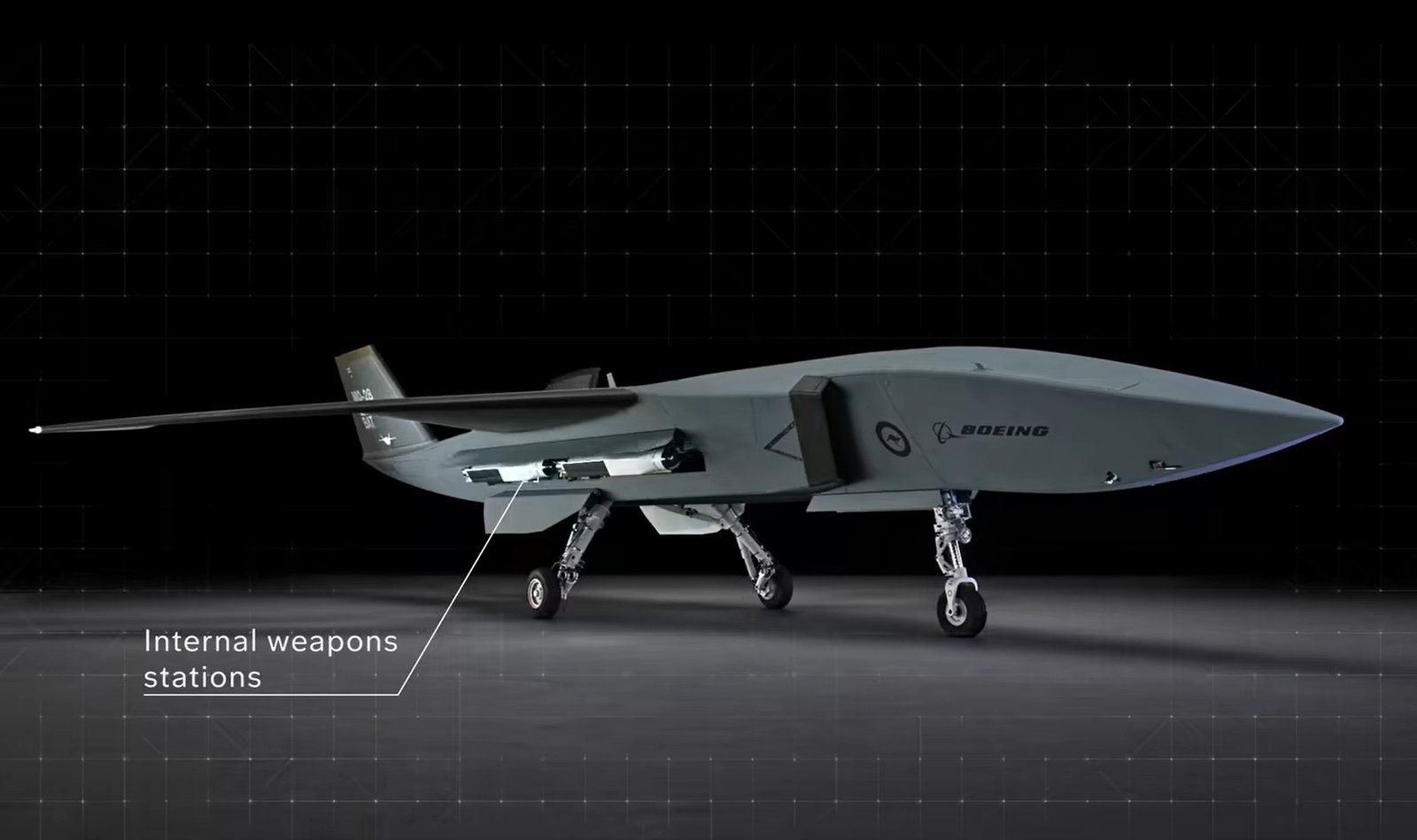
On 10 June, Boeing unveiled enhanced capabilities for its MQ-28 Ghost Bat when the ILA Berlin Air Show opened in Germany. The company highlighted upgrades to its collaborative combat aircraft’s (CCA) range, payload and mission flexibility.
New features include 25%-larger wings, which allow the MQ-28 to carry an additional 900kg of fuel, stores and mission payloads compared to baseline versions.
The larger wingspan also allows the maximum take-off weight to increase from 4,535kg to 5,443kg, with a useful payload of more than 2,040kg.
It will also have an internal weapons bay that can be provisioned to carry two AIM-120 AMRAAM missiles or four small diameter bombs. An MQ-28A Block 1 aircraft conducted the type’s first air-to-air, live-fire test in Australia last December, launching an AMRAAM missile from an external pylon.
“That additional capacity gives operators freedom to balance payload and endurance to configure for the mission at hand, whether that means carrying extra fuel for longer-range operations, increasing weapons carriage or any combination of both,” said Glen Ferguson, the MQ-28 Global Program Director.
He continued: “These features, developed in partnership with the Royal Australian Air Force (RAAF), will be progressively released to the fleet through a spiral upgrade programme, and are available to interested allied countries.”
While Boeing did not identify the specific configuration of the MQ-28 announced in Berlin, it is believed to represent the Block 3 variant – or at least incorporating features planned for that version – which the RAAF is expected to field as part of its operational Ghost Bat fleet.
So far, eight MQ-28A Block 1 aircraft are supporting testing and evaluation with the RAAF. The first three Block 2 aircraft are currently under assembly and are expected to roll out by the end of 2026, while a further six Block 2 aircraft and one Block 3 aircraft were added to the RAAF order book last year.
Other new MQ-28 capabilities announced include significant improvements to open-architecture software to enable an operator to tailor weapons, payloads, mission autonomy and command and control, an upgraded missionised nose for increased payload options, and the introduction of a beyond-line-of-sight capability for command and control.

The unveiling of the enhanced MQ-28 in Berlin is likely aimed at Germany’s CCA requirement, where it hopes to introduce a platform from 2029. On 31 March, Rheinmetall and Boeing Australia announced a partnership to compete for the programme with the MQ-28 Ghost Bat.
Boeing is also eyeing CCA opportunities in the Asia-Pacific region. Speaking to Asian Military Review at the Singapore Airshow in February, Ferguson said the company was “having a conversation with a lot of potential customers about how they might determine, field or deliver a CCA capability”.
He identified Japan as one of those countries. Then, in April, Australia and Japan signed an agreement enabling the latter to collaborate on CCA research using the MQ-28A, providing it with greater insight into CCA operations and manned-unmanned teaming technologies.
This development comes as Boeing announced in May that an MQ-28 had recently completed operational flight tests at the Point Mugu Sea Range off California, validating autonomous operations and demonstrating rapid deployment and sustained operations from an allied location.
It is expected the MQ-28 could conduct similar trials in the Indo-Pacific region in the near future, potentially as part of a higher-intensity exercise environment.
by Roy Choo
