

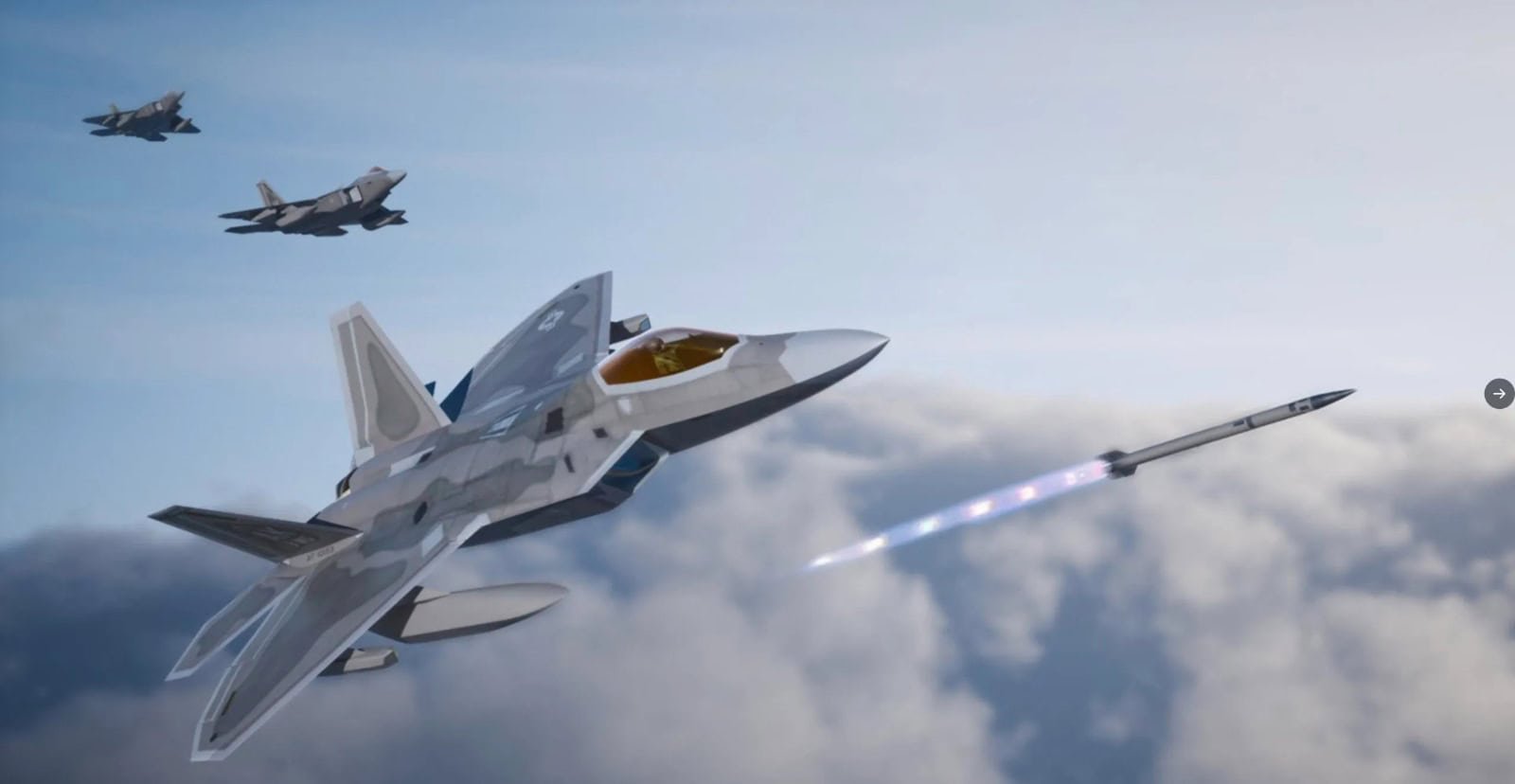
Australia will be the first export customer of the highly secretive Lockheed Martin AIM-260A Joint Advanced Tactical Missile (JATM).
The announcement was made by Minister of Defence Richard Marles on 6 August on the sidelines of Exercise Pitch Black, Australia’s premier international air combat exercise held in the Northern Territory.
A press release said the air-to-air missiles will be acquired via US Foreign Military Sales at a cost of US$528.37 million. These will be integrated first onto the Royal Australian Air Force’s (RAAF) F/A-18F Super Hornets, followed by its F‑35A Lightning IIs and EA-18G Growlers.
No quantity of missiles was announced, although on 17 March 2026 the US government had approved a possible deal comprising up to 450 AIM-260A all-up rounds, five AIM-260A test vehicles and 30 AIM-260A guided test vehicles at a cost of up to $3.16 billion.
The smaller order announced by Canberra in August suggests it could be pursuing a multi-batch acquisition.
The announcement is notable, since testing of the AIM-260 is ongoing and the missile is yet to enter operational service with either the US Air Force or US Navy (USN).
“This announcement is the latest milestone in the delivery of long-range, high‑tech capabilities for our defence force,” Marles said.
The National Defence Strategy and Integrated Investment Program unveiled earlier this year identifies the requirement to invest in a layered air and missile defence architecture capable of detecting and countering threats.
Concerns within the US Department of Defense that Chinese long-range, air-to-air missiles – particularly the PL-15, reported to have a range exceeding 200km – could outrange Raytheon’s AIM-120 AMRAAM, spurred development of the AIM-260.
The missile has been under development since 2017, with flight testing believed to have begun several years later.
The first image of the missile emerged only in May this year. A USN F/A-18F operated by Air Test and Evaluation Squadron 31 was photographed taking off from the Eglin Air Force Base test facility while carrying a JATM on its right, engine intake weapon station.
The AIM-260 is understood to retain a form factor similar to the AIM-120, while offering a significantly greater engagement range, rumoured to be 200km or more. This allows existing aircraft to carry the same number of missiles without reconfiguration or sacrificing performance.
For the RAAF, the AIM-260 will provide increased lethality for its combat fleet. Its longest-ranged beyond-visual-range missile in service is the AIM-120D-3, which is believed to have a range exceeding 160km.

However, with the extended reach the AIM-260 provides, the RAAF may have to re-examine its find, fix, track and target capabilities, as well as tactics and techniques, to fully exploit the missile’s range.
The AIM-260 is understood to be designed from the outset to operate within highly distributed, networked kill chains and kill webs, rather than as a standalone legacy weapon system.
The RAAF would also need to evaluate its sensing ranges and capabilities. It already benefits from a combat fleet equipped with active electronically scanned array (AESA) radars on its F-35As, F/A-18Fs and EA-18Gs, but it could also potentially benefit from infrared search and track (IRST) systems as well.
IRST sensors enable passive detection and tracking of targets, including low-observable aircraft. When used in concert with AESA radars, they provide complementary sensing and targeting capabilities.
Collaborative aerial engagements are another area that could be examined. Such engagements typically rely on networked, third-party sensors to provide targeting data, including those aboard other fighters, airborne early warning and control aircraft, and land- and sea-based platforms.
With its multirole electronically scanned array radar, the RAAF’s Boeing E-7 Wedgetail aircraft can help coordinate and provide targeting data for such long-range engagements.
The RAAF’s F-35As operating in low-observability mode could also act as “quarterbacks”, collecting targeting data and passing it to F/A-18Fs for engagement.
In the future, unmanned MQ-28 Ghost Bats could similarly extend the RAAF’s sensing reach, with IRST-equipped aircraft acting as forward, passive-sensor nodes, and passing targeting data through the network for exploitation.
by Roy Choo
