

The Indo-Pacific region is poised to witness a dramatic shift in its security landscape, driven by the rapid development and deployment of hypersonic-missile technology.
These emerging weapons – capable of travelling at speeds exceeding Mach 5 (6,174km/h), and possessing the ability to manoeuvre mid-flight across significant distances – potentially eliminate the tyranny of distance that has often provided some degree of natural protection for regional countries.
If successfully fielded, hypersonic missiles represent unprecedented challenges to existing regional air defence systems. Their speed, manoeuvrability and unpredictable flightpaths render them extremely difficult to detect and intercept using currently fielded systems.
Broadly speaking, there are two main types being pursued today: hypersonic cruise missiles (HCM) and hypersonic glide vehicles (HGV, or waveriders). The former is equipped with an onboard, air-breathing engine such as a scramjet or ramjet to travel under its own power to its target, while the latter uses a re-entry vehicle that uses a booster such as a rocket to accelerate into space before “gliding” down to its target using the shockwaves of its own extreme-speed descent.
Zhu Feng, a senior researcher at a Beijing-based defence and security research institute, told Asian Military Review: “Regional concern over the possible proliferation of hypersonic weapons stems from the fact that there’s currently no operational missile defence system that is capable of intercepting these weapons here, which is why the present race to develop hypersonic weapons – with countries such as Australia, China, Japan, India, Russia and the US involved in their respective national efforts of engaging in collaborative development – is to be closely watched.”
“Of these, China, Russia and the US appear to be the furthest along with their developments, and have performed significant testing in recent years,” explained Zhu. He noted that Russia’s air-launched, nuclear-capable Kh-47M2 Kinzhal missile has a claimed range of more than 2,000km and a maximum speed of Mach 10. However, the performance of the Kinzhal has been called into question by several successful intercepts by US-made but Ukrainian-operated Patriot air defence systems, as Russia seeks to subjugate Kyiv via sustained long-range unmanned aerial vehicle and missile attacks.
China
China is widely acknowledged as a frontrunner in the regional hypersonic-arms race. It has invested heavily in research and development for more than a decade, conducting numerous tests, including successful demonstrations of both HCM and HGV capabilities.
One such example is the experimental DF-ZF HGV, which has reportedly been tested on at least eight occasions since being first documented in 2014. Earlier reports suggested a DF-ZF prototype – earlier identified by the US Department of Defense as the WU-14, and which is believed to comprise a DF-17 medium-range ballistic missile with an HGV payload – successfully completed a November 2017 demonstration from the Jiuquan Satellite Launch Centre in Inner Mongolia. The HGV reportedly travelled approximately 1,400km following its atmospheric re-entry phase, achieving speeds exceeding Mach 9 (11,265km/h) during its flight.
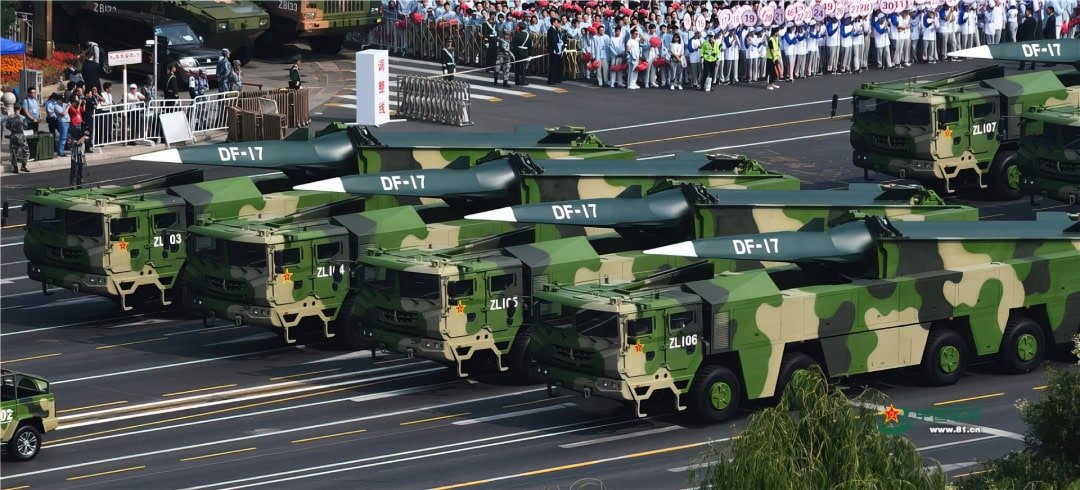
The DF-17 system was first revealed to the public on 1 October 2019 during the 70th-anniversary military parade to mark the country’s founding. The maximum estimated range for the DF-17 varies in open sources from 1,800-2,500km. US intelligence sources note that at least several DF-17 test flights were conducted by the People’s Liberation Army Rocket Force in November 2017.
State-owned organisations such as the China Aerospace Science and Technology Corporation and the China Academy of Aerospace Aerodynamics play pivotal roles in China’s hypersonic programmes, developing advanced technologies like scramjet engines, high-temperature materials and sophisticated guidance systems. China’s advancements in this area are driven by its desire to project power, deter potential adversaries and overcome existing missile defence systems, particularly those of the USA.
Japan
Japan’s hypersonic developments represent a shift toward a more assertive defence posture. This is being driven by evolving security concerns, particularly regarding China and North Korea. The Hyper-Velocity Gliding Projectile (HVGP) programme is a key focus, with both anti-ship and land attack variants under development. Tokyo is also collaborating with the USA on the Glide Phase Interceptor (GPI), a defensive system designed to counter hypersonic threats.

In July 2024, Japan’s Acquisition, Technology and Logistics Agency announced that it had conducted two preliminary tests of an HVGP developed by Mitsubishi Heavy Industries (MHI) in March and April to validate some key subsystems. The HVGP was originally expected to enter service in 2029. However, Japan’s perceived deterioration of its security environment prompted defence officials to accelerate development by three years. The Japan Ground Self-Defense Force is expected to eventually field two HVGP battalions.
Once fielded in 2026, the HVGP will be launched from a truck using a booster, after which the warhead separates and glides towards its target. The initial, high-supersonic Block I version of the HVGP is expected to have a maximum range of 500km, while the subsequent Block 2 variant fielded around 2030 will offer a range of 3,000km and travel at hypersonic speeds.
Japan and the USA signed an agreement in May 2024 to jointly develop the aforementioned GPI by the mid-2030s, this being a next-generation missile defence system capable of defeating hypersonic missiles deployed by China and Russia, and which are under development in North Korea.
The US Missile Defense Agency and Japan’s Ministry of Defense (MoD) selected US company Northrop Grumman as the prime contractor in September, with the MoD then contracting MHI to lead work on the Japanese side. Japan’s workshare is understood to comprise the second-stage rocket motor and second-stage steering system, as well as the steering gear, rocket motor and seeker window for the missile’s kill vehicle. In contrast, the USA is responsible for overall system integration as well as the GPI’s first-stage booster, third-stage rocket motor, the kill vehicle’s outer shell, guidance control and seeker.
South Korea
Facing an emerging hypersonic missile threat from North Korea, South Korea is investing in missile defence capabilities too. Development of the next-generation Long-range Surface-to-Air Missile (L-SAM) II and the Low-Altitude Missile Defence (LAMD) systems were identified as key priorities to counter North Korea’s ballistic and cruise missile capabilities, including potential hypersonic weapons.
South Korea’s Defense Acquisition and Program Administration (DAPA) officially launched the L-SAM II’s development in January 2025, noting that a KRW567.7 billion (US$389.8 million) investment is earmarked for L-SAM II development through till 2028. The effort also involves the state-run Agency for Defense Development (ADD) and about 19 companies.
The agency noted that L-SAM II will be capable of intercepting missiles at higher altitudes and longer ranges than the original L-SAM system. Development of the L-SAM was completed in mid-2024, with serial production expected to commence this year. The original L-SAM was designed to intercept ballistic missiles up to 150km away and at altitudes between 40km and 100km. The system has been under development by the ADD and LIG Nex1 since 2019.
An L-SAM battery comprises a multifunction radar, a command-and-control centre, a combat control station and four truck-mounted launchers, two of which are equipped with antiaircraft missiles and the other two with anti-ballistic missiles.
DAPA announced in April 2023 that it had approved funding worth KRW2.71 trillion (US$1.86 billion) to develop the L-SAM II from 2024-35. This would also entail the research and development of a gliding-stage interceptor missile aimed at countering some of North Korea’s latest hypersonic weapons and intercontinental ballistic missiles.
South Korea is also accelerating development of the LAMD system – nicknamed the “Korean Iron Dome” by some observers – by a year as a countermeasure against North Korean long-range artillery. DAPA noted in January 2024 that further development and production of the LAMD system would be carried out from 2025-28.
The effort is being led by the ADD with its industrial partner LIG Nex1, which began conceptualisation and early development of the system in early 2022. Core developmental activities were completed around June 2023.
Australia
Australia is bolstering its hypersonic capabilities through the trilateral AUKUS partnership with the UK and US under the Hypersonic Flight Test and Experimentation (HyFliTE) programme. This collaboration signifies Canberra’s deep commitment to accelerating the development and testing of hypersonic systems, and enables Australia to leverage the expertise and resources of its partners to enhance its own sovereign capabilities in this critical area.
Under AUKUS Pillar II, the HyFliTE Project Arrangement will enable the three countries to share testing facilities and technical expertise to accelerate development, testing and evaluation of offensive and defensive hypersonic technologies. According to Australia’s Department of Defence, development of hypersonic technologies is a key priority identified in 2024’s National Defence Strategy.
“It is a capability that can hold time-critical and heavily defended targets at risk from increased ranges, enhancing the survivability of the Australian Defence Force against potential threats,” Defence stated. “HyFliTE will leverage our collective expertise and innovation enterprises to deliver hypersonic capabilities at pace.”
Meanwhile, the Royal Australian Air Force (RAAF) is integrating the US Air Force’s (USAF) Hypersonic Attack Cruise Missile (HACM) with its Boeing F/A-18F Super Hornet fighters through a collaborative agreement to develop and test hypersonic cruise missile prototypes under the Southern Cross Integrated Flight Research Experiment (SCIFiRE). Through this SCIFiRE programme, Australia and the USA commissioned three companies – Lockheed Martin, Boeing and Raytheon – to develop designs for the HACM. Raytheon was eventually selected to build the HACM for the USAF.

“The new weapon will be a Mach 5-class precision strike missile that is propulsion-launched and powered by an air-breathing scramjet engine,” the RAAF states on its website, noting that the missile will be capable of being carried by the service’s tactical fighter aircraft such as the F/A-18F Super Hornet and EA-18G Growler, Lockheed Martin F-35A Lightning II, as well as the Boeing P-8A Poseidon maritime surveillance aircraft.
India
India’s hypersonic programme has achieved notable progress, demonstrated by successful tests of scramjet engine technology and a long-range hypersonic missile. Motivated by regional rivalries, particularly with China and Pakistan, India aims to develop hypersonic weapons as a deterrent and to bolster its strategic strike capabilities.
The Indian MoD’s Defence Research and Development Organisation (DRDO) plays a crucial role in advancing Delhi’s hypersonic ambitions. This agency’s Defence Research and Development Laboratory successfully tested a scramjet technology demonstrator in January, which achieved continuous operation of 120 seconds during a ground test.
According to the MoD, the test was the first of its kind in India and constitutes a crucial milestone in indigenous hypersonic-missile development, noting that the trial demonstrated the potential of the scramjet combustor for operational use in hypersonic vehicles.

In November 2024, the DRDO conducted a flight test of India’s first long-range hypersonic missile from Dr. APJ Abdul Kalam Island, Odisha on India’s eastern coast. According to the MoD, the prototype hypersonic missile is designed to carry various payloads to distances of 1,500+km.
United States
The USA is actively pursuing hypersonic capabilities, albeit facing challenges in trying to catch up with China and Russia. Several programmes are under way, including the Air-launched Rapid Response Weapon (ARRW), the Hypersonic Air-breathing Weapon Concept (HAWC) and the Common Hypersonic Glide Body (CHGB). The US faces budgetary and technical hurdles, and its programmes have experienced setbacks. Nevertheless, the USA remains committed to developing hypersonic weapons to maintain its military edge and deter potential adversaries in the region.
In March 2024, a USAF B-52 strategic bomber flying from Andersen Air Force Base on Guam test-launched an all-up-round AGM-183A ARRW at the Reagan Test Site on Kwajalein Atoll in the Marshall Islands. The test was especially noteworthy, since previous ARRW tests have been conducted off the continental USA.

The ARRW, which is intended to attack “high-value, time-sensitive, land-based targets,” comprises a rocket booster motor and an HGV carrying a conventional warhead. Given the visibility of the ARRW deployment in Guam, it is believed the demonstration was intended to be seen by China. Previous testing of the ARRW occurred in August and October of 2023, with the first successful test having been achieved in December 2022.
“The air force gained valuable insights into the capabilities of this new, cutting-edge technology,” the USAF said in a statement following the demonstration, but it did not disclose specifics on missile performance or test results. Despite the latest effort, the fate of the ARRW programme remains unclear, as no further funding had been allocated in spite of a US$150 million request in FY2024.
by Jr Ng
