

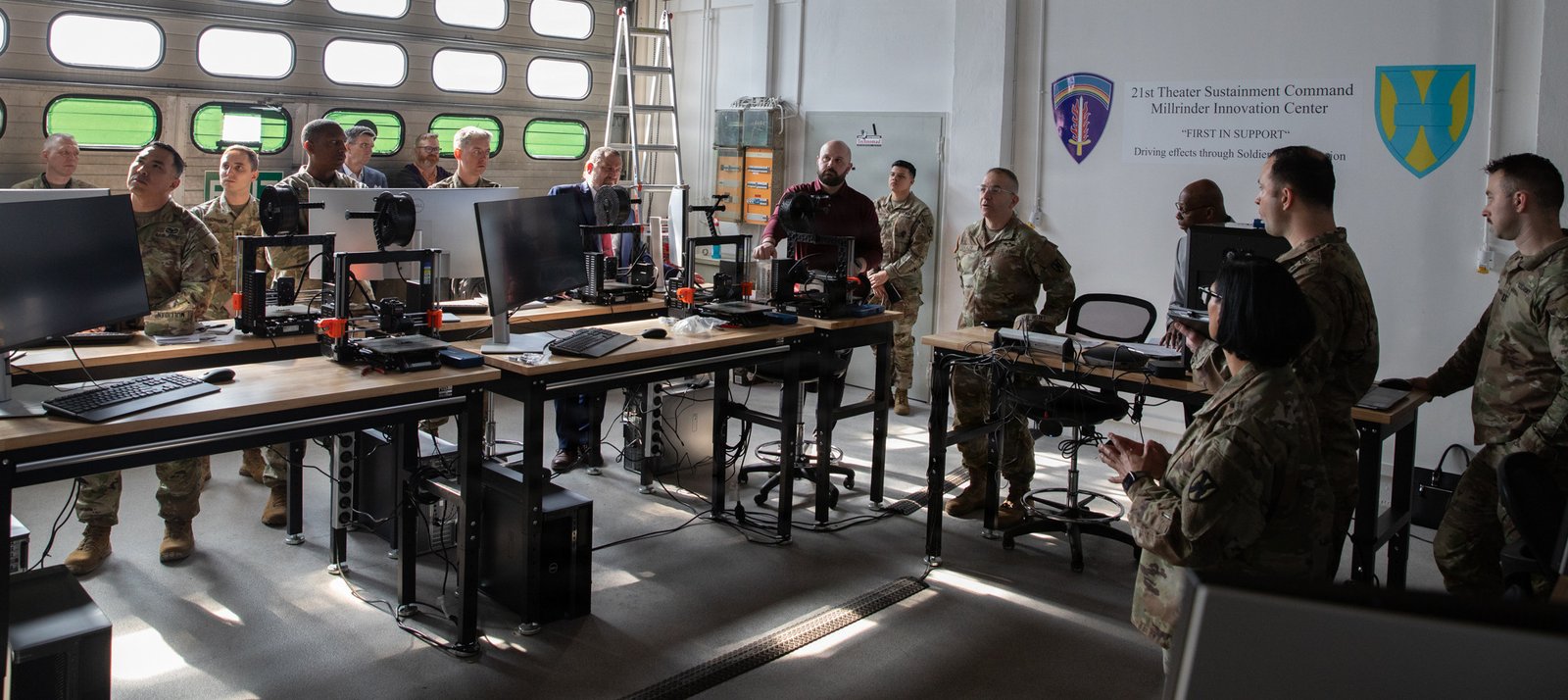
Terry Gerton I want you to first tell us about this 21st Theater Sustainment Command Innovation Lab. Why are you setting up a makerspace in Europe?
Maj. Ron White Absolutely. So again, I’m Maj. Ron White, the chief of innovations for the 21st Theater Sustainment Command. I just want to talk to you about the way we solve problems by establishing a true culture of innovation across the theater. And that’s a really big part of it. We’re going to accomplish this through two big and connected efforts. The first one is an innovation program to culminate and cultivate ideas from every single soldier. And the second is an Innovation Center where we can bring those ideas to life with solutions to some of our most critical capability gaps, and that’s through soldier-led innovation.
Terry Gerton And so you’ve described this place, the center, as a space where soldiers can bring their ideas to life and solve problems closest to the mission. What kinds of challenges are you thinking this lab will tackle first?
Maj. Ron White This really can be anything from developing new equipment or training methods, leveraging AI and data, or adapting the existing equipment for new purposes. And really at the end of the day, the only thing that’s limiting our innovations is our own imagination.
Terry Gerton You also said it: “innovation culture.” Tell me about what’s going on behind the scenes so that soldiers really do feel like they can bring their creative ideas forward.
Ron White We started by establishing an innovation program at the 21st TSC, and then we established that in every single brigade and battalion within our formation. And key to that is soldiers who are executing missions every day, they’re the closest to the problem and they’re the best ones to solve it. The program gives them really a pathway to do that. When we say innovation, we mean soldiers solving our biggest problems. The big power of that is when every soldier in our formation starts thinking about how to improve the organization. That’s really how we drive lasting change.
Terry Gerton So when I think about a makerspace, I’m thinking about things that get created in three dimensions, like a spare part or a new tool. What kinds of problems are you thinking that they’re going to bring to you? Is it supply, is it medical, is it maintenance across the board?
Maj. Ron White The innovation center is going to have three pillars, and that’s going to be built on innovation, training and readiness. And really, when we look at the readiness piece of that, the initial focus is going to be on the high-demand areas like ground automotive repair parts and small unmanned aerial systems.
Terry Gerton This is a joint effort with the Army Research Laboratory under DEVCOM. So how does that partnership help you move soldier ideas from, say, a sketch on a whiteboard into something the Army can actually prototype, test and field?
Maj. Ron White With our unit partnership that we have with Army Development Command and having the first operational makerspace in Europe, we’re partnering with them. We actually have one of the CMI2 — the Civil Military Innovation Institute, it’s a nonprofit organization that’s partnered with ARL — we actually have one of them here with us on staff and they’re going to be helping us cultivate soldier ideas, soldier-led projects, and really walking them from the beginning with the idea to the end when we get to the solution.
Terry Gerton How difficult has it been, or what challenges have you faced in actually trying to build the lab itself?
Maj. Ron White Over the last couple of months, what we’ve been doing is we found a 10,000-square-foot space here in Kaiserslautern, Germany. And what we’d been doing with that space over the last couple months is really renovating it and making sure that that is prepared to receive all the equipment that’s going to be in the lab. And I would say probably the biggest challenge with that was power, but we were able to overcome that.
Terry Gerton I’m speaking with Maj. Ron White. He’s the chief innovation officer of the Army’s 21st Theater Sustainment Command. So you’ve got the space, you’re getting the equipment. Will soldiers come from all over Europe to the lab or will they send their ideas and someone at the lab will prototype for them?
Maj. Ron White Soldiers from all across Europe will be able to participate in this program. Once they submit their idea — they can do that through their innovation officers in their units; we have an innovation portal where they can submit their ideas — and then every two weeks we have an innovation council where we meet, we review those ideas, we reach out to those commands, to those soldiers and we can actually partner with them. And those soldiers can come to the to the lab and first, when it comes to the training piece, we’ll actually train them on advanced manufacturing techniques, robotics, things like AI, and then also soldier-led innovation and kind of how the program works. And then once they’ve learned all those critical skills, then they can actually go through our program and our innovation center and bring those ideas to life. We have a senior allied trades warrant officer for all of Europe who’s embedded in the lab, we have the DEVCOM engineers that are going to be in there, and they’ll really help bring those ideas to life. And the soldiers will be there from start to finish.
Terry Gerton Tell me more about the innovation council itself. Who sits on it? How will they evaluate the different proposals? Do they have particular goals or targets that they’re working with?
Maj. Ron White All the brigade innovation officers are part of the council. We have the senior allied trades warrant officer, again, our DEVCOM ARL CMI2 engineers in there, our commanding general sits in it, also part of that approval process. So when they go in there, there’s really two different pathways they can take, depending on what the solution is for. If it’s a hardware solution, then it comes to the Innovation Center. If it’s a data solution, then we have, we call it the DAG, it’s our data analytics group. They would take those data ideas and then if it’s an actual new way to do something or a planning effort, then it goes into our commander’s initiatives group to go into our collaboration cell to kind of be worked on.
Terry Gerton Walk me through the pipeline process. The innovation council gets a proposal, they like it, they invite the soldier, the soldier comes and works it out. What happens then? How do you go from concept and testing into production and complete distribution?
Maj. Ron White It really depends on what the solution’s for, but the real power in this and being partnered with Army Development Command and Army Research Laboratories is all of the centers are connected. So when 18th Airborne Corps or 82nd comes up with an idea, or if we here at 21st TSC come up with an idea, or if 101st comes up an idea, those ideas are shared with everybody that’s part of that program, so we can all benefit from it.
Terry Gerton So are there similar makerspaces in other places?
Maj. Ron White Yes, there are quite a few of them throughout the United States. It’s just that this is the first operational makerspace that will exist in Europe.
Terry Gerton What’s your vision for, say, the first year? What would success look like? What should soldiers and their commanders know about participating in these initiatives?
Maj. Ron White For success for us, really the benefit there is when we have every single soldier in our formation focused on innovation and we get to the point where we have all these ideas coming through the portal, and we get to a point where we have a bit of a backlog. That’s what we’d like to see inside of the innovation center. Because what that really means is we’re getting after a lot of these critical capability gaps. And for me, I think that’s where success would be, and that’s the buy-in into the program and then also being able to produce for soldiers and show them results. The way we look at that is, soldier brings their idea, it gets voted on, it gets accepted; they come, they work for 90 days on their program, or however long it takes to get it completed, and then they come up with the solution, and they solve whatever that problem was. For me, that’s truly what success will be.
Terry Gerton Maj. White, this approach really flips the script. I mean, within the military, directions and change have often come from the top down, and this is going to try to drive innovation in a better way of skinning the cat — from the bottom up. How is that going to play out in what you hope to see here?
Maj. Ron White When we say innovation, we mean soldiers solving our biggest problems. The power in that is when every soldier in our formation starts thinking about how to improve the organization. And this is really how we start driving a lasting change. This is not just about a program or a building. It’s about driving tangible readiness effects for the warfighter. It’s empowering our people and being able to harness the collective ingenuity of the entire formation to solve our most critical capability gaps.
Copyright
© 2026 Federal News Network. All rights reserved. This website is not intended for users located within the European Economic Area.
