

This is the fourth part of our series (I, II, III) looking at how Carthage’s complex, multi-ethnic armies were raised and structured. Last week, we looked at Carthage’s unusual system for raising vassal forces: long-serving Carthaginian generals could inhabit positions within the personalist, non-state mobilization systems of Numidia and Iberia, enabling them to access military resources (mostly manpower) as a non-state ‘Big Man’ would, through kinship and patronage networks.
Merging Carthage’s state-based conscription system with the non-state mobilization systems of Numidia and Iberia would already be a remarkable achievement and would have given Carthage an ‘all call’ peak mobilization somewhere north of 125,000 men, easily eclipsing the military mobilization potential of the major powers of the Hellenistic East. But of course Carthage isn’t fighting the heirs of Alexander in the third century. Carthage is fighting Rome.
So they are going to need more.
That means recruiting from outside of the territory that Carthage notionally controls (directly or indirectly), which in turn means allies and mercenaries. Fortunately for us, most of the peoples who are going to end up as Carthaginian allies at one point will serve in their armies as mercenaries at other points.
But first, as always, raising large armies of mercenaries, subject conscripts, vassal warlords and allies is expensive! If you too want to help me invade Italy with a multi-ethnic army of diverse origins in a doomed effort to stop the Roman Republic, you can help by supporting this project over at Patreon. If you want updates whenever a new post appears or want to hear my more bite-sized musings on history, security affairs and current events, you can follow me on Bluesky (@bretdevereaux.bsky.social). I am also active on Threads (bretdevereaux) and maintain a de minimis presence on Twitter (@bretdevereaux).
The System in Schematic
Now untangling conscript subjects vs. vassals vs. mercenaries vs. external allies is quite complicated and as noted, our sources often do not give us a lot of information to help us separate this out. Worse yet, the status of individual groups changes over time: as we’ve already seen, the Iberians go from being mercenaries to being vassals as a result of the Barcid conquests in Spain.
However, we do get, in a very strange way, a ‘snapshot’ of the different categories in the system, during the Second Punic War. Hannibal, you will recall, invades Italy in 218 and wins major victories at Trebia (218), Trasimene (217) and Cannae (216). This was a major enough sequence of events that other powers were paying attention and in this case, the ruler of Macedon, the Antigonid king Philip V saw an opportunity here. Rome was a potential rival for him in the Adriatic, after all and by 218 Rome had already developed significant influence in coastal Illyria. So in 215, Philip V sends ambassadors to Hannibal to conclude a treaty with Carthage and then in 214, jumps into the war on Hannibal’s side.
In practice, this comes to relatively little right away – the Roman navy keeps Philip V stuck on the far side of the Adriatic and this First Macedonian War (214-205) produces no major engagements between Rome and Macedon, though it does set the stage for future wars. So this is a very important event for the future of the Greek East and the Roman Republic in the second century, but not a crucial turning point in Hannibal’s war or Carthage’s future.
But it provides us a fascinating bit of evidence for the structure of Carthaginian power in the Second Punic War, because a fragment of Polybius preserves most of the text of the treaty (Polyb. 7.9). Ancient treaties are both political and religious documents – the gods are called to witness them (in this case, both Greek and Carthaginian gods!) – and so they tend to be quite precise for religious as well as political reasons. And that’s handy for us because it means that Philip V’s ambassadors and the Carthaginians both are going to want to be very precise about exactly who is and is not covered or obligated by their treaty. That gives us the following passage; the participants of the treaty are actually spelled out twice (once for a list of who Philip V is going to help and then again in reverse as a list of who is going to help Philip V), but I’ll just include the first list for brevity. I’ve translated this myself because I found that the generally available translations (particularly W.R. Paton’s translation) often fudge the literal meaning a fair bit in order to convey the general meaning, but here I want to be precise (Polyb. 7.9.5-6):
…that King Philip and the Macedonians and the other Greeks in so far as they are allies of him shall protect the Carthaginian lords and Hannibal the general and those with him and those subject to Carthage, in so far as they share the same laws, and the Uticans, and such cities and peoples as hearken to Carthage, and the soldiers and the allies and all the cities and peoples with whom we are in alliance in Italy and Gaul and Liguria and anyone we may enter into friendship and alliance in these lands.
The formula gets repeated with only a slight alteration again going the other way in Polyb. 7.9.7, but we needn’t repeat it here. So we can see the two sets of parties to this treaty. On the one side, we have the Macedonian side: Philip V himself (as king), the Macedonians (his people) and his Greek allies, which in the original Greek takes just 13 words to spell out. It is relatively simple. On the other side, we have the complex mess that is Carthage, which in the original Greek takes some sixty-eight words in Greek (73 in English) to express. So let’s take a minute to break these categories apart and see if we can’t figure out who exactly is meant by each.
First we have, “the Carthaginian lords and Hannibal the general and those with him.” Paton includes here ‘the Carthaginians’ as well, but they are notably absent in the actual text: the Carthaginian people are not part of the first clause (those to be protected by Philip) but do show up for the second one (those to do protecting of Philip), which might speak to the text’s understanding of how political power in Carthage works. The ‘lords’ here must be the Carthaginian adirim, representing Carthage as a whole, so Philip is promising to protect the Carthaginian state (and Hannibal and Hannibal’s army), represented by the adirim but to be protected by the Carthaginians as a people. In any case, this group’s role in the treaty is clear: these are the actual Carthaginians.
Next we have, “those subject to Carthage, in so far as they share the same laws, and the Uticans.” Here we evidently have some precise legalese the exact meaning of which is somewhat lost to us, but it seems clear that these are the North Africans (sans Numidia), Carthage’s subjects. I think the ‘in so far as they share the same laws’ bit is meant to divide out three groups: the vassals (coming in the next bit), the Punic and Libyan subjects (who are the ones sharing laws), and Utica. Utica was, after Carthage, the next largest and important Phoenician colony in North Africa and the fact that the Uticans are broken out here implies to me that unlike the rest of Carthage’s North African subjects, they still maintained some degree of autonomia (‘autonomy,’ literally ‘self-laws’), which is to say the ability to make their own laws internally (whereas the other communities just had to do what Carthage told them, that is, ‘they share the same laws’ in the sense that Carthage makes the laws for everyone). So then those ‘subject to Carthage’ who also share the same laws are Carthage’s fully subordinate North African dependencies, the various other Phoenician, Libyan and Liby-Phoenician communities.
Then we have, “and such cities and peoples as hearken to Carthage.” The word here is ὑπήκοος (hupekoos), an adjective meaning ‘hearkening, answering, obeying,’ which gets used in other authors (Xenophon, Thucydides, etc.) to mean ‘subjects’ or even ‘subject allies.’ This, I think, is intended to encompass Carthage’s ‘vassals’ – Numidia and the Iberian communities – which do not share the same laws as Carthage (they’re internally autonomous) but who ‘obey’ or ‘listen to’ Carthage when Carthage commands. We’re thus recognizing that Carthage has different classes of dependent communities: Utica, subject but self-governing, then the other North Africans, subject and non-self governing, then the vassals – cities and peoples hearkening to Carthage – who still have their own polities, but who obey Carthage.
Finally, we have “and the soldiers and the allies and all the cities and peoples with whom we are in friendship in Italy and Gaul and Liguria and anyone we may enter into friendship and alliance in these lands.” We ‘we’ here is in the text and the ‘we’ is clearly the Carthaginians, but it is an odd grammatical quirk to shift from the third to the second person here. In any case here, I think, we have our allies and mercenaries. The need to specify here that the treaty considers for groups with whom there is philia, ‘friendship:’ the soldiers and the allies and all the cities and peoples with whom there is an alliance (the relative clause, to my reading, is picking up all four groups: soldiers, allies, cities and peoples) speaks to the diverse range of Carthage’s coalition in Italy.
As I take it, the soldiers and allies here includes the men actually serving in arms under Carthage and is framed to capture both men serving for money (the soldiers) and those serving because their home polity has thrown in with Hannibal (the allies). Meanwhile, the cities and peoples then captures those home polities themselves; that distinction might matter because of course by this point some of Hannibal’s soldiers have been with his army and away from home for some time and – in the fragmented structure of non-state polities – may understand themselves to have a direct relationship with Hannibal apart from their community’s alliance with him. As we’re going to see, the cities are probably Hannibal’s newfound Italian allies (revolting from Rome) while the peoples are probably Hannibal’s only-slightly-older allies in Gaul and Liguria. Finally, we get a rider that should Hannibal contract new allies (which in 215 he stills hopes to do, peeling away Rome’s alliance system), they too are included.
So who are all these allied peoples and cities? The answer is largely ‘Gauls and Italians,’ but lets take a closer look.
The Gauls
Like the Iberians, we hear about Gauls in Carthaginian armies long before Carthage was projecting significant military power directly into their homelands. The first report we have of Gallic mercenaries in Carthaginian armies is the first meaningful point at which we can assess Carthage’s armies: the Battle of Himera (480), (Hdt 7.165). A century later, Diodorus has the Carthaginians enlisting Gallic and Ligurian mercenaries (the Ligurians were a non-Gallic people heavily influenced by Gallic neighbors; they fought in the same manner) in 341 in their war against Timoleon of Syracuse (Diod. Sic. 16.73.3). Gallic mercenaries are fairly common additions from that point onward to Carthaginian armies. Thus, Gauls and Ligurians are a component of the Carthaginian army that revolts at the start of the Mercenary War in 241 (Polyb. 1.67.7). In short, Carthage is recruiting mercenaries from the Gallic world from basically the moment we can see them clearly.
Again we’re not well-informed about how Gallic warriors would have been recruited as mercenaries, but something along the lines of what we hypothesized in Iberia – recruitment through aristocrats using access to Carthage’s imported prestige goods as the incentive as much if not more than money – would be what I’d expect. Imported prestige goods are a real presence in middle and late La Tène sites, with goods from the broader Mediterranean world – Greek/Roman/Eastern artwork, fine pottery, wine, etc. – clearly commanding a status premium.
Once again, this system – such as it was (given how imperfectly we can observe it) – is clearly fundamentally altered by the Barcids, although in this case by Hannibal rather than his father Hamilcar. Hannibal’s decision to march his army from Spain through southern Gaul (modern Occitania and Provence) over the Alps and into Italy meant taking a Carthaginian army through the territories of multiple Gallic civitates. That is naturally going to change the way these polities relate to Carthage. In practice, the first part of Hannibal’s march – before he gets to the Alps – is bumpy. We don’t have the space here for all the twists and turns, but essentially despite Hannibal sending ambassadors ahead to try to arrange for free passage, at several points he has to fight his way through and between that fighting and the Alps themselves, he loses close to half of the army he departed with.

However, he drops out of the Alps into what the Romans would call Cisalpine Gaul – northern Italy in the Po River Valley, which was at the time inhabited by a number of Gallic peoples as well as some non-Gallic peoples heavily influenced by Gallic culture (like the Ligurians or Veneti). Hannibal seems to be counting on these fellows to refill his ranks and he has good reason to bet on this: the Romans control of this region was relatively recent, the result of campaigning in the 220s (most notably the Battle of Telamon in 225). The Gallic civitates still had their own governments, though it is clear our sources understand them as at least somewhat under the ‘thumb’ of Rome – recently conquered, restive and ready for a rematch. Which Hannibal promptly supplied. Indeed, Polybius presents Hannibal as acutely aware that he needs to rack up big victories quickly in order to get these Gauls to shift durably to his side and stay there, but of course he does win big victories and the region rises against the Romans (except for the Cenomani, who seem to have been, for whatever reason, the most pro-Roman of the Cisalpine Gauls).
However Hannibal does not replicate the Iberian system in Cisalpine Gaul. The Gallic civitates of Cisalpine Gaul are going to be supporting Hannibal actively, militarily for a decade and a half, but we hear no reports of diplomatic marriages of the sort we saw in Spain (which, mind you, the Barcid system in Spain was only 19 years old at most when Hannibal crossed the Alps, so these aren’t wildly different time frames), no declarations of Hannibal as supreme general of the Gauls or anything like that.
Instead, as we’ve seen, the treaty with Philip V pretty clearly sets the Gauls in their own category as allied ethne, ‘peoples.’ And that equally fits with Polybius’ repeated suggestion that Hannibal himself is concerned about the fragility of those alliances until Cannae. Presumably after Cannae, the Gauls all recognize that they are ‘in for a penny, in for a pound’ and must be at open war with the Romans no matter what, cementing the alliances that will largely hold for the rest of the war. So the Gauls of the Second Punic War seem to be external allies of Carthage – they are in Carthaginian armies because their polities are allied with Carthage, rather than because they have become subjects (although one imagines that may have happened had the Carthaginians won). Indeed, in some cases we’re told that Hannibal forms formal alliances with these civitates, as with the Boii, for instance (Polyb. 3.67).
As we discussed when we looked at ‘tribal’ armies, the non-state Gallic mobilization system could put out a lot of military power relative to the small size of Gallic civitates, and we see that here. The Cisalpine Gauls were hardly ‘fresh’ in 218 – remember, they’re just coming off of losing a major war with the Romans quite badly – but Hannibal is able to acquire substantial troops from them. Hannbial absorbs something like 9,000 Gallic infantry and 5,000 Gallic cavalry – that’s a lot of horse-born aristocrats – by the Battle of Trebia and by Cannae his army probably has around 16,000 Gallic infantry in it. Hannibal’s Gallic contingent does seem to wane over time – after Trasimene, he moves south in Italy, effectively cutting himself off from his Gallic recruiting grounds in an effort to spur a larger revolt in Italy. That said, Hasdrubal’s army, defeated at the Battle of the Metaurus (207) attempting to repeat Hannibal’s crossing of the Alps to reinforce him, also has something like 8,000 Ligurians and Gauls in it, so recruiting never wholly ceased.

In terms of how these Gauls would fight, we’ve actually discussed the La Tène military kit before. Common Gallic warriors generally fought unarmored (although only quite rarely nude) or perhaps with only textile armor of some kind, simply because these were fairly poor societies. Instead, they protected themselves with a large oval shield (a relative of the Roman scutum), using spears as their primary weapon and long one-handed straight-edged slashing swords as their backup weapon. Gallic infantry sometimes carried javelins, but very much functioned as ‘line infantry,’ expecting to engage in close combat in large formations with closed ranks. Rather than the sort of ‘barbarian mob’ of popular imagination, we probably want to imagine Gallic battle lines as similar to other shield walls, like the hoplite phalanx. Evidently, the onset of their charge was fearsome, but the lack of armor meant that they often lacked the ‘staying power’ of more heavily armored Roman, Greek or African forces. Aristocratic Gallic cavalry would, by this point, often have been mailed and made effective shock cavalry.

We’ll look in more detail at some tactics next week, but the role of Gauls in Carthage’s armies in the Second Punic War was an unenviable one: Carthaginian commanders seem to consistently treat their Gallic troops as expendable and deploy their armies to concentrate losses among them. We’re told that nearly all of Hannibal’s losses at Trasimene were from his Gallic troops (Polyb. 3.74.10). At Cannae, Hannibal throws both his Iberians and Gauls forward, but once again more than half of his losses were of his Gallic troops – 4,000 Gauls, 1,500 of Iberians and Africans combined and 200 cavalry – suggesting his Iberians were somewhat more sheltered by his deployment and that his very exposed center must have been mostly Gauls (Polyb. 3.117.6). At the Metaurus, Hasdrubal seems not to trust his Gallic and Ligurian troops, placing them on a hill on the wing with orders merely to endure while he tried to win the battle elsewhere (Livy 27.48). And at Zama, Hannibal again throws his Gallic and Ligurian troops forward to endure the brunt of the initial Roman attack, before it could reach the troops (Africans, Carthaginians, his veterans) he actually cared about (Polyb. 15.11; Livy 30.33).
I should note that Luc Baray has pushed back a bit on this point, arguing that the lightness of Hannibal’s African and Iberian troops demanded placing the Gauls to take the brunt of Roman attacks, but that simply doesn’t work: the Iberians were no lighter than the Gauls and the Africans much heavier. And the source tradition is – as Baray admits – just really quite clear. There is, in fact, something of a striking comment here on Carthage’s relationship with its allies and subjects as compared to Rome: whereas Roman armies place Roman citizens in the center where they share in the heaviest fighting (and the socii on the wings), Carthaginian armies seem – our evidence is limited, of course – but seem to have an established practice of intentionally shield citizen and African troops from the heaviest fighting by expending vassal, mercenary and allied troops.
However, as noted above, the role of Hannibal’s Gallic allies really crests in importance at the Battle of Cannae and then declines somewhat as he moves south. For their part, the Romans remain militarily active in Cisalpine Gaul, fighting the Gallic civitates there directly, though a full effort at reconquest will have to wait until after Hannibal has been defeated at Zama. But Hannibal, in moving south is aiming at other potential sources of manpower.
Greeks and Italians in Carthaginian Armies
Finally, we have the available military manpower of southern Italy and Sicily: Greeks and (southern) Italians. The Greek colonization beginning in the 8th century created a bunch of Greek colonies along the coast of southern Italy and Sicily, with those communities in some case remaining very ethnically distinct (e.g. Tarentum, Syracuse, etc.) and in other cases ending up meaningfully blended with the locals (e.g. Campania). Meanwhile the uplands of southern Italy (and some of the coastal areas) remained with their earlier inhabitants, a variety of Oscan-language speaking peoples, like the Samnites or Lucanians.

This part of Italy had remained independent of Rome the longest: the Samnites had only been pulled under Roman control in the Third Samnite War (298-290), but had revolted during the Pyrrhic War (281-275) and had to be reconquered. The Pyrrhic War, of course, was also primarily a war about Tarentum, the most important of the Greek settlements still independent in southern Italy. These were thus peoples only beginning to really come solidly under Roman control during the early third century and the relative thinness of Roman control shows.
We do not hear a lot about Greek mercenaries in Carthaginian service, but it clearly happened. Very famously the Carthaginians, on the back foot against the Romans in 255 during the First Punic War, hire a Spartan commander, Xanthippos, with a small band of mercenaries, to whip their army into shape (Diod. Sic. 23.16; Polyb. 1.32). Polybius also offers a strange comment at the start of his narrative of the mercenary war when listing off the troops Carthage had, that they included, “not a few half-Greeks” (μιξέλληνες, mixellenes, very literally ‘mixed/half-Greeks’), “of whom, most were deserters or slaves” (Polyb. 1.67.7). It’s an odd comment, especially with the preemptive dismissal of them as mostly deserters or (former) slaves, which almost sounds defensive, as if Polybius is anxious to head off the notion that any proper Greek would serve in a ‘barbarian’ army (for the Carthaginians, as non-Greek speakers, were very much barbaroi in the Greek imagination).
That said, the Carthaginians had been fighting back and forth on Sicily, against Syracuse, as we’ve noted, for centuries at this point. The Sicilian Greeks were not always a united block against Carthage during that fighting either: quite often there were Greek communities under Carthaginian control or else amenable to Carthage because they feared Syracusan dominance. It makes sense: if you are a community in Sicily that isn’t Syracuse (or Carthage), your interest is that these two keep fighting, enabling you to retain some measure of independent in the context of that conflict, rather than that one of them wins and subjugates you. It would be surprising if there weren’t Greek mercenaries in Carthaginian armies.
Carthage also pulled modest numbers of mercenaries from Italy proper, particularly from Campania. Pre-Roman Campania was demographically complex: the initial population was Oscan, but the region had seen a wave of Etruscan colonial foundations (Salerno, Nola, etc.), followed (and somewhat overlapped) by a wave of Greek colonial foundations (Naples, Cumae, Paestum, etc.), followed by a reassertion of Samnite and Lucanian (that is, Oscan-speaker) power in the region in the fourth century, leading eventually to Rome moving into the region as a counterweight to the Samnites and thus the Samnite Wars (343-341, 327-304, 298-290). So it is fair to say the region is complex.
We see Campanian mercenaries in Carthaginian service in Sicily as early as 408 (Diod. Sic. 13.44.1-2) where the Campanians were there because they had originally been hired as part of Athens’ failed war with Syracuse (the Sicilian Expedition, 415-413) and had evidently stuck around. From that point forward, Campanian mercenaries show up on Sicily in modest numbers but with some regularity, with the Carthaginians installing them here and there in this or that town. The Carthaginians were hardly alone – the Syracusans also hired Campanians from time to time. Of course the most famous of these fellows are the Mamertines, a group of Oscan-speaking Campanian mercenaries hired by Syracuse who end up setting up shop in Messina and accidentally sparking the First Punic War. Though Polybius does mention Italians as a group during the Mercenary War (241-237), we do get one Campanian mercenary named Spendius (yes, really), an escaped slave, who evidently escaped to Carthaginian service (Polyb. 1.69.4) and it certainly seems plausible to suppose he wasn’t the only one.
The wars of the early third century – particularly the Third Samnite War (298-290), the Pyrrhic Wars (281-275) and the First Punic War (264-241) – seem to have largely cut Carthage off from these mercenary sources, however. Rome’s military system in Italy never threw off substantial numbers of mercenaries (the rare military adventurer, but not much more) and so as it expanded to encompass the Campanians, their presence seems to drop off, with the Mamertines as a sort of ‘last gasp’ of that pattern of mercenary service. Then, of course, Roman victory in the First Punic War banished Carthaginian influence from Sicily, removing their access to Greek recruitment.
Nevertheless, of course, there is a brief resurgence of Italian service in Carthage’s armies during the Second Punic War. Hannibal’s strategy, after all, was to foster large-scale revolt among the Roman socii. Hannibal’s initial campaigning to try to produce this effect among the socii north of Rome didn’t bear fruit, but after Cannae he presses into southern Italy and is able to spark a large-scale revolt, bringing over the Samnites, Lucanians, parts of Campania (most importantly Capua) and Tarentum. Suddenly Carthage had access to southern Italian manpower again.

Or rather it might have. In practice, Hannibal isn’t able to get a whole lot of military potential out of these fellows. The first problem he faces is that no region goes over completely to him: every region splits. Michael Fronda discusses this in depth in Between Rome and Carthage (2010) which is very much due for a fireside recommendation (it has a reasonably priced paperback). The thing is, the Roman conquest of these regions had ‘frozen’ ongoing local rivalries, but they had hardly passed out of memory. So when Capua goes over to Hannibal, for instance, suddenly all of the other Campanian communities have to think hard about their choices, because if Hannibal wins and Roman influence is removed, they’re suddenly very exposed to Capuan influence (backed by Carthage). That process repeats in Apulia (fear Tarentum!) and Samnium (where the Samnites split on the question) and Bruttium (where Rhegium holds to Rome) and so on.
That in turn creates a sticky operational problem because now each revolting community has other loyal communities nearby and the threat that Roman armies – which are now avoiding engaging Hannibal directly – might attack where he is not. And Hannibal cannot be everywhere. The consequence is that the Italians who side with Hannibal mostly raise forces for their own defense and are broadly unwilling to detach large forces for any collective effort. Hannibal is thus never able to get a lot of manpower out of these fellows – not enough to challenge Rome on multiple fronts effectively (efforts to do so mostly involve his smaller armies getting picked off). In that 215 ‘peak’ figure, revolting Italian socii only supply some 17,000 troops in the field.
One honestly wonders if Hannibal might not have been better off staying focused on Cisalpine Gaul, but of course his real problem here is a lack of operational mobility once the Romans shift to a strategy of containment: he cannot get back to Cisalpine Gaul, because the Romans have by that point hopelessly complicated his logistics. Hannibal thus may not have made a conscious choice to focus on southern Italy over Cisalpine Gaul, but simply found himself, after Cannae, ‘stuck’ on a strategy focused on the south.
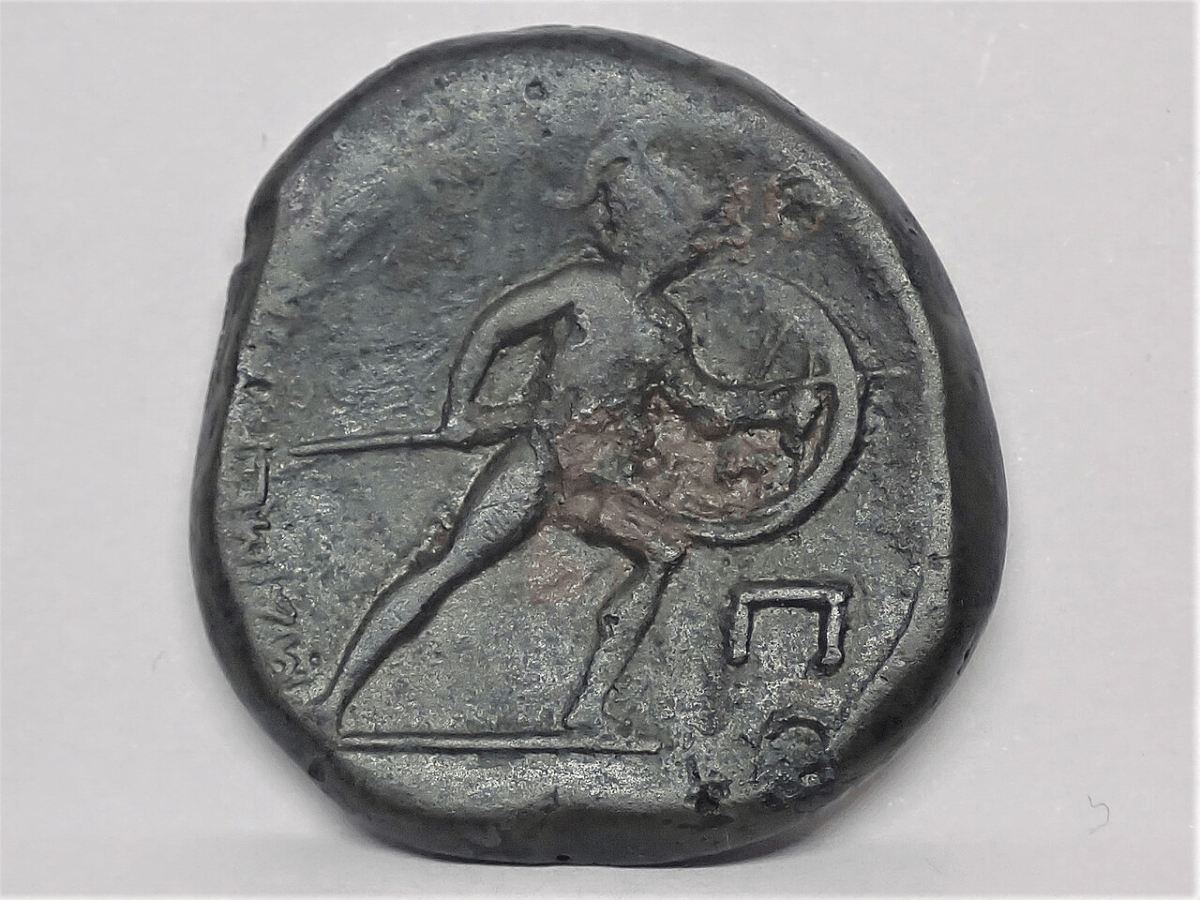
In any case, the upshot of all of this is that Greeks and Campanians (especially Campanians) show up frequently in Carthaginian armies, but generally in limited numbers. They’re clearly less prominent than Carthage’s more common sources of external troops (Gaul, Iberia), though it is possible they had outsized importance because they would have been substantially heavier troops. The Mamertines were in Messina long enough to mint coins and some of these issues (e.g. BMC 26, 27, 29 etc. ) have on their reverse a warrior with an aspis and a long spear, heroically nude (not because Campanians fought nude, but because they’re evoking the heroic nudity common in Greek art).

A Barcid Strategy?
We now have, for the most part, our cast of characters who – in varying arrangements – regularly make up Carthaginian armies (we’ll start next time by cleaning up some odds and ends as well). Next time we’re going to close out by looking at how we see Carthaginian generals using these different forces in battle, focused mostly on the Second Punic War, which is where we get to see the Carthaginian military system most clearly.
But first, I want to point something out, though I am hardly the first to notice it: there is something of a consistency to the Barcid approach post-237, which may or may not represent something like an intentional strategy.
Prior to 241 and the Carthaginian loss of Sicily at the end of the First Punic War, the major sources of Carthaginian mercenary manpower outside of Africa, in rough order of importance were Iberia, followed by Gaul, followed by Campania. And what is striking is that over two generations (Hamilcar, followed by his sons (and one son-in-law)), the Barcids seem to systematically move down the list, securing more direct Carthaginian control over those recruiting grounds. First, Hamilcar moves on Spain, securing relatively direct ‘overlordship’ (if not full control) as a ‘warlord of warlords’ over the Iberian recruiting ground, enabling Carthage to extract far more manpower than it ever had before.
Then, when time comes to fight Rome, Hannibal attacks through Gaul, quite clearly aiming to drop out into Cisalpine Gaul where he hoped to find ready allies (and did). Now of course we might regard Hannibal’s rout as forced by the relative lack of a Carthaginian navy, but as we’re going to discuss at some point, Carthage did have a navy in the Second Punic War and certainly could have attempted to make another effort at taking Sicily. Indeed, that was what the Romans expected. Hannibal’s decision to prepare for a land war was thus a decision, an intentional choice made and it is striking that once he made that decision, he went straight for Carthage’s next most important mercenary recruiting zone. Once again, it seems certain that doing so enabled Hannibal to get a lot more military resources out of this region. It is hard to get a clear sense of how many Gallic mercenaries Carthage might regularly pull in, but the number is clearly well south of the well over 20,000 who move through Hannibal’s army between 218 and 215.
Finally, of course, once he secured the alliance of nearly all of the Cisalpine Gauls, his next stop is Southern Italy. One wonders if he was thinking particularly of those Oscan-speaking Campanian mercenaries that Carthage had utilized in the past (though it is worth noting he tries to pry away the Etruscans – not traditional friends of Carthage – first). Once again, the strategy, in a sense, bears fruit: we don’t often get secure numbers for the Campanian mercenaries involved on Sicily, but they seem to be a sort of ‘high hundreds’ kind of force (e.g. 800 at Diod. Sic. 13.44.1-2). By contrast, in 215 Hannibal has detached an army under Hanno of some 17,000 infantry, almost entirely Bruttians and Lucanians. Hannibal is thus drawing more than a full order of magnitude more military power from the region.
The result was a vastly expanded Carthaginian military machine, albeit composed of really diverse parts. And I think it is worth stressing that the resulting mobilization was, by ancient standards, very successful. Indeed, in the ancient Mediterranean, this is probably the second most successful mobilization effort. The problem, of course, is that it is pitted directly against the largest mobilization effort in the pre-modern Mediterranean.
In practice, the weakness this system had were two. The first, which we’ll revisit in the next part, was that while the force it raised – again, nearly 165,000 men under arms at once – was very large, it was also comparatively light, composed of a lot of ‘mediums’ and ‘lights’ compared to much heavier Roman armies. Had it been fighting something like a Hellenistic army (which also employed lots of ‘mediums’) this might not have been a problem, but again: Hannibal was fighting Romans.
But the other weakness was far more profound: this system was fragile, while the Roman system was durable. Part of that was simply age – the Roman system was many decades old in much of Italy, so there had been time to consolidate the system and to accustom its members to collective action under Roman direction. But equally, part of it was structure: the Roman system relied much more heavily on incentives than on direct coercion. We may note the contrast: Rome had no equivalent to the Barcids’ stockpile of hostages held in New Carthage, for instance. Consequently, when pressured the Roman alliance system mostly holds together, while the Carthaginian system of vassalage comes apart in both Spain and Numidia.
Alas for the Barcids, that was probably not a problem they could fix in the time frame they had to work with.
