

SEOUL, Republic of Korea — October 2026 — South Korea is placing greater emphasis on artificial intelligence, manned-unmanned teaming, advanced command and control and new interception technologies as it moves to reshape its armed forces for a more technology-intensive battlefield.
In an Armed Forces Day address on October 1, the South Korean government identified AI, drones, robotics, space and cyber technologies as forces that are changing the nature of warfare and called for the accelerated development of future military capabilities.
The government specifically highlighted plans to advance AI and manned-unmanned teaming systems, restructure the force around a more technology-intensive model, and accelerate work on AI-enabled command-and-control systems, high-energy laser interceptors and high-powered missile capabilities. It also proposed a 2027 defense budget of KRW 73 trillion, an increase of 8.2% from the previous year.
The priorities point toward a military modernization effort in which sensors, networks, autonomous platforms and effectors are increasingly expected to operate as connected elements rather than stand-alone systems.
That direction is already visible in acquisition activity.
On October 6, the Defense Acquisition Program Administration announced a second preliminary briefing for an R&D program to develop a Command and Control Information Sharing System. The project is intended to integrate data, common services and terminals currently operated across joint and individual service C4I systems through a cloud-based architecture.
The project provides one example of how South Korea is seeking to strengthen the digital infrastructure behind future military operations, alongside wider investment in AI-enabled decision support and connected combat systems.
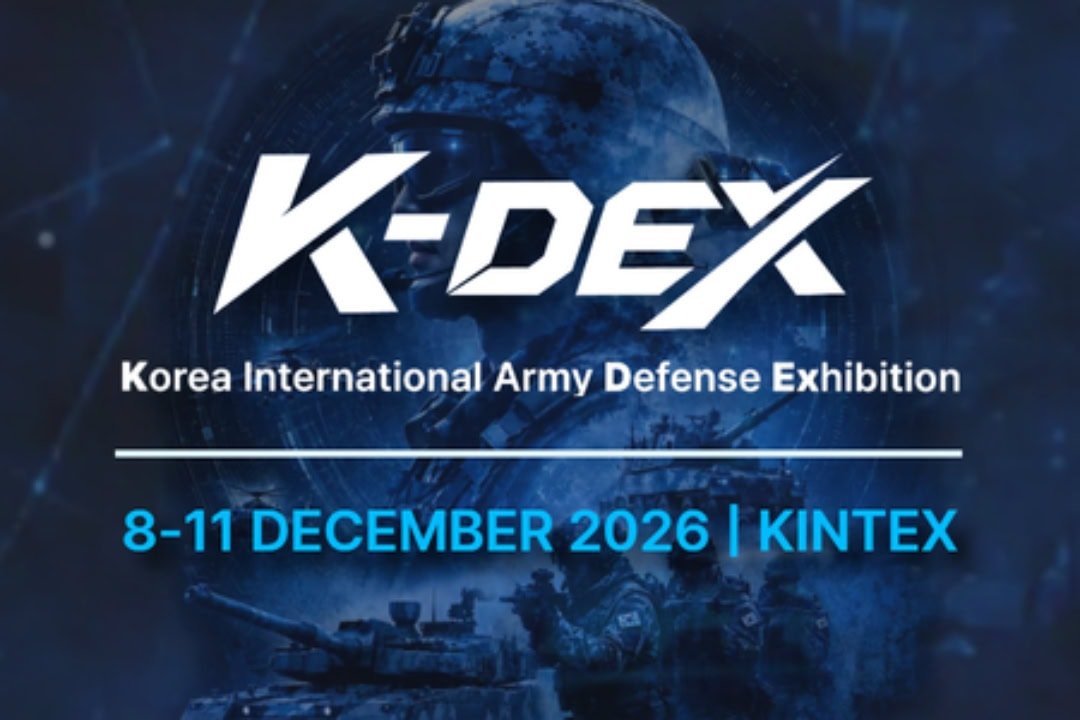
Those priorities will also be reflected at K-DEX 2026, the Korea International Army Defense Exhibition, which will be held from December 8 to 11 at KINTEX Exhibition Center 2 in Goyang, Republic of Korea.
The exhibition’s five technology themes include autonomous and manned-unmanned teaming systems, hyper-connected networks and intelligent command and control, long-range precision strike and sustained operations, drone and counter-drone systems, and smart military infrastructure.
The overlap between current modernization priorities and the exhibition themes gives K-DEX a timely focus as South Korea prepares to increase the role of advanced technologies across its future force.
AI-enabled command and control will be one of the key areas. Modern operations increasingly depend on the ability to collect information from multiple sensors, process large volumes of battlefield data and distribute relevant information rapidly across units and command structures.
K-DEX will place those technologies alongside autonomous ground and aerial systems, advanced reconnaissance platforms, precision-strike capabilities and technologies designed to detect, identify and neutralize unmanned threats.
Drone and counter-drone technology is expected to be particularly prominent. K-DEX lists the sector as one of its five principal exhibition themes, covering technologies ranging from unmanned and swarm systems to integrated detection, identification and neutralization solutions.
The exhibition will also provide an opportunity to examine how these technologies connect with more traditional elements of ground warfare.
Rather than presenting AI, autonomy, networks and unmanned systems as isolated technology sectors, the exhibition program is structured around their application to broader military functions including reconnaissance, command and control, strike, logistics and force protection.
K-DEX 2026 will be the first edition held following the integration of KADEX and DX KOREA. The exhibition will occupy Halls 6, 7, 8 and 9B at KINTEX Exhibition Center 2, bringing Korean and international defense companies together with military, government and procurement stakeholders.
For overseas companies, the event will provide a view of the technologies receiving increasing attention in South Korea while creating opportunities to engage with Korean manufacturers, government and military stakeholders and potential industrial partners.
For Korean companies, the exhibition offers a platform to demonstrate technologies against a defense environment that is placing greater emphasis on intelligent systems, autonomous operations and connected battlefield capabilities.
Visitor pre-registration for K-DEX 2026 is now open. General buyers who complete advance registration and payment are eligible for a discounted admission rate, while active-duty military personnel and other eligible categories may receive free admission. Advance registration also provides a faster entry process at the venue.
As South Korea moves to accelerate the development and integration of future military technologies, K-DEX 2026 will provide an opportunity to see how priorities including AI, autonomy, intelligent command and control and counter-drone capabilities are moving from policy agendas toward operational systems.
Visitor pre-registration is available through the official K-DEX 2026 website.
