

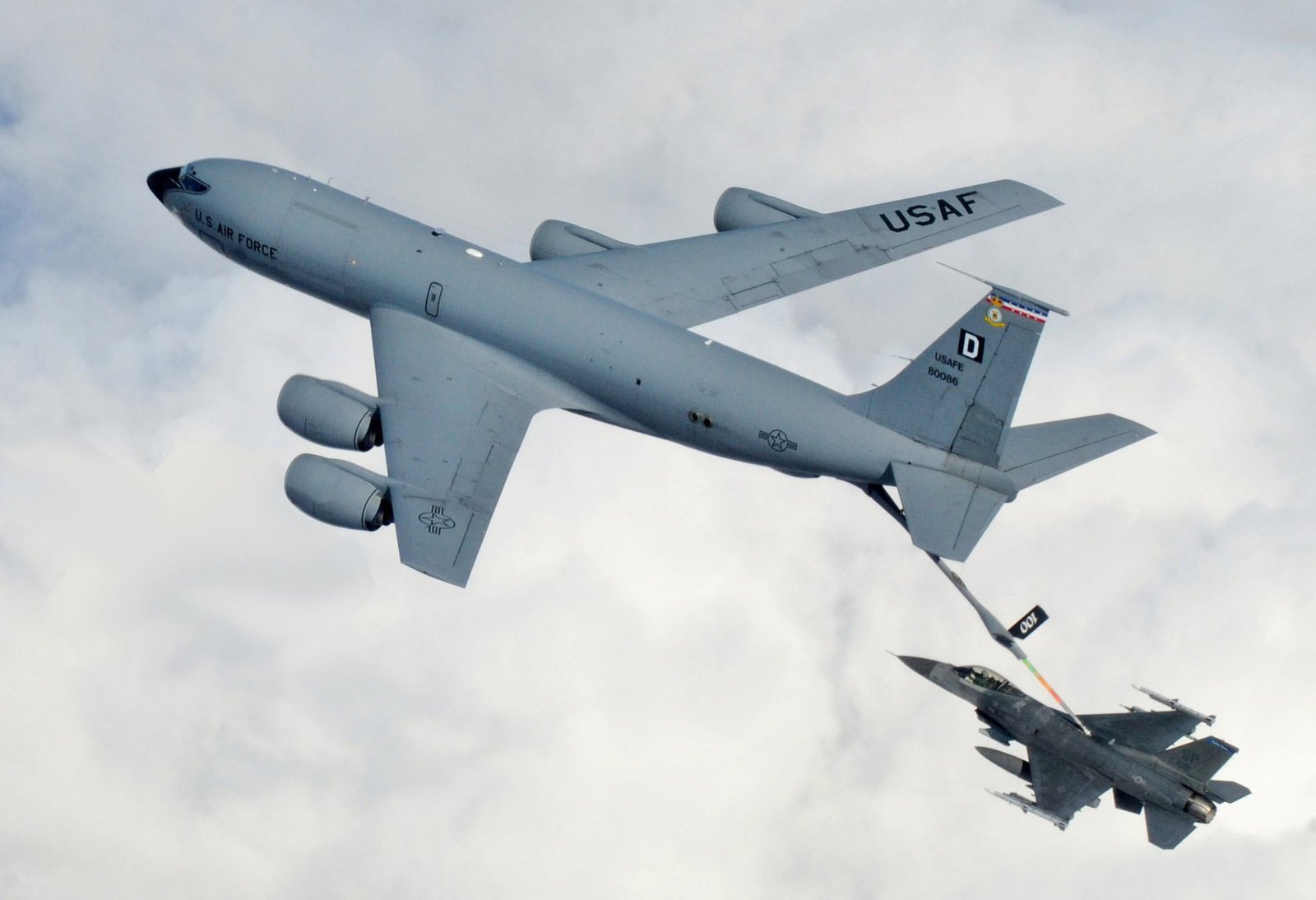
The concept of aerial refuelling dates back more than a century. After first being conceptualised in 1917, air-to-air refuelling became a reality in 1923 when US Army Air Service lieutenants transferred fuel between two Airco DH.4B biplanes using a gravity-fed hose. The method worked, but it was dangerous and impractical for military operations.
A major step came in 1934 with the establishment of Flight Refuelling Limited, which helped lay the groundwork for modern aerial refuelling. What began as a basic fuel transfer technique has since developed into sophisticated tanker aircraft equipped with boom or hose-and-drogue systems and advanced fuel and flight controls.
Today, aerial refuelling is fundamental to long-range strike, persistent surveillance, distributed operations and force projection. It allows military aircraft to remain airborne longer and operate far beyond their unrefuelled range.
Why aircraft range alone is no longer enough
For decades, aircraft designers have sought to improve fuel efficiency and maximise operational range. Combat missions can involve extended loiter times, multiple engagements, dynamic rerouting and long-distance deployment – all of which can quickly consume onboard fuel. Aerial refuelling allows aircraft to remain on station longer, reach distant areas of operation and sustain missions without having to return to base.
Recent military operations offer clear evidence that refuelling adds to the ability of aircraft to sustain missions without having to return to base for refuelling. In June 2026, US Boeing KC-135R Stratotankers conducted repeated aerial refuelling missions across the Middle East, supporting air operations over the Strait of Hormuz. Earlier in the year, NATO exercises in the Arctic relied on air-to-air refuelling to extend the endurance of F-35 fighters operating in demanding cold-weather conditions.
The requirement is equally relevant to long-range and coalition operations. KC-135 tankers have supported missions involving B-1B bombers and F-35s in the Indo-Pacific, while a US-Chile exercise demonstrated cross-national tanker support for fifth-generation fighters. The US Air Force’s (USAF) B-21 Raider has already undergone aerial refuelling trials, reinforcing the continuing role of tanker support in long-range force projection.

Combat aircraft require tankers the most
Air-to-air refuelling supports combat aircraft, airborne early-warning platforms, helicopters and unmanned aerial vehicles (UAV). Amongst all these, combat aircraft account for more than 80% of global aerial refuelling systems demand. There are growing requirements across the world as air forces strengthen their long-range combat capabilities.
Programmes in India and Japan, alongside developments in the USA, are supporting the adoption of precision boom control, probe-and-drogue interfaces, etc. The dominance is also tied to the preference for long-range missions, high-speed transit, combat manoeuvres and extended time on station. Of course, fuel consumption rises sharply during high-speed operations.
Similarly, many medium-altitude and high-altitude, long-endurance UAVs are designed primarily for persistence rather than speed. Platforms such as the MQ-9 Reaper can remain airborne for 27+ hours, while the MQ-9B SkyGuardian exceeds 40 hours of endurance. The RQ-4 Global Hawk can operate 30+ hours without aerial refuelling. Consequently, most UAV fleets generate considerably less aerial refuelling demand than combat aircraft, despite their expanding operational roles.
Operational flexibility keeps hose-and-drogue ahead
Among available aerial refuelling technologies, hose-and-drogue and boom-and-receptacle systems remain the two dominant approaches.
The boom system continues to serve the USAF’s strategic refuelling architecture, supporting high-demand platforms such as the B-52, B-2, C-17, F-15, F-16, F-22 and F-35A through a tanker fleet that includes the KC-135 and KC-46. This method’s primary advantage lies in rapid fuel transfer, making it well suited for heavy bombers and large transport aircraft.
On the other side, aircraft such as the F/A-18 Super Hornet, Rafale, Eurofighter, F-35B/C and Su-30 routinely operate with hose-and-drogue tankers, including the Airbus A330 MRTT, KC-130J and Il-78. This system is widely used across NATO air arms, the Royal Air Force, French Air and Space Force, Indian Air Force and several Asia-Pacific operators.
The broader global market increasingly favours the hose-and-drogue approach. According to Stratview Research, hose-and-drogue systems account for 60+% of the global aerial refuelling systems market. The reason is largely structural: most naval aviation fleets, multirole fighters, helicopters and many unmanned platforms are designed around probe-equipped refuelling.

Tanker expansion puts Asia-Pacific on a faster growth path
North America remains the largest and most established aerial refuelling market, supported by the USAF’s extensive KC-135 fleet and ongoing KC-46 Pegasus programme. Europe also remains ahead of Asia-Pacific in current market size and fleet maturity.
But Asia-Pacific is expected to record the highest compound annual growth rate between 2025 and 2034, making it the fastest-growing regional market. The region is witnessing rapid expansion in aerial refuelling capabilities, driven by vast geographic distances, island chain defence strategies and intensifying geopolitical peer competition.
The region’s vast operating distances are putting greater emphasis on tanker capacity. Japan operates the KC-46A Pegasus and KC-767, South Korea has added the A330 MRTT, India operates the Il-78MKI while considering additional tanker capacity, and China continues to build out its fleet with the Y-20U. Together, these investments point to a wider regional requirement: keeping combat aircraft on station and extending their reach across the Indo-Pacific.
The next chapter: Automation and unmanned operations
Aerial refuelling is moving towards autonomy, digitalisation and multi-mission operations, with several technologies already advancing.
The MQ-25 Stingray, widely regarded as the world’s first operational autonomous tanker programme, completed major autonomous flight milestones in 2026 and is progressing towards carrier integration. It is designed to refuel fighters without an onboard crew, freeing manned aircraft for combat missions.
Tankers are taking on additional roles as well. The KC-46 Pegasus, for instance, can support data sharing, communications and Joint All-Domain Command and Control (JADC2) connectivity alongside fuel transfer. The KC-46 is also seeing improvements in refuelling precision. Boeing’s RVS 2.0 has completed key flight testing, with 4K imaging, advanced sensors, improved depth perception and enhanced 3D visualisation.

Availability emerges as a critical concern for tanker fleets
While advancements in refuelling technologies continue to improve tanker capabilities, ensuring aircraft availability remains an equally critical challenge.
Tanker readiness rates continue to face pressure from maintenance complexity, spare-parts shortages and ageing fleets. As many air forces operate tanker aircraft for decades, sustaining fleet availability becomes increasingly resource-intensive, leading to longer maintenance cycles and reduced operational readiness.
Infrastructure limitations further compound these challenges. Inadequate hangar capacity and maintenance facilities often force aircraft to remain outdoors for extended periods, exposing them to harsh environmental conditions.
The future of reach, endurance and airpower
The aerial refuelling systems market may not be among the fastest-growing defence segments, but its strategic importance is increasing rapidly. According to Stratview Research, the global aerial refuelling systems market was valued at more than US$658 million in 2025, with the annual market size projected to cross US$801 million by 2034. Over the 2025-34 period, total global market sales are estimated at greater than US$7.3 billion.

Looking ahead, as countries continue to expand and modernise their aerial refuelling capabilities through autonomous tankers, artificial intelligence-assisted refuelling, advanced digital vision systems, etc., the demand for aerial refuelling systems is expected to grow in parallel.
These investments underscore the increasing importance of tanker fleets in enabling long-range power projection, expeditionary operations and coalition interoperability across increasingly contested and geographically dispersed theatres.
