

Early June saw ESD travel to Ankara in Türkiye for a press facility organised by Turkish defence industry leader Aselsan. The author of this article had not been to Ankara for more than 34 years, so this chance to see the evolution of the Turkish capital was certainly worthwhile. More importantly, the opportunity to find out more about Aselsan was impossible to ignore, bearing in mind such factors as the growth of the company, the rapid expansion of their capabilities and their increasing success in export markets.
The night of arrival and the first day in Ankara it became clear that this was an advanced modern city. Ankara reflected a country that had rapidly modernised and made tremendous economic progress. Modernisation and progress are also key words that could describe the evolution of the defence industry in Türkiye, something that is certainly true of Aselsan. The company was established in 1975 with just four engineers, with the objective of providing the Turkish Armed Forces with a sovereign capability to meet their military communications needs. By 1980 the company had made first deliveries of manpack and tank radios to the Turkish Armed Forces.
By the end of the 1980s, Aselsan had made its first significant export contract, supplying Pakistan with tactical radio systems and then transferring the technology to allow local manufacture in Pakistan. Aselsan was growing and expanding its range of products, it was also growing in personnel terms. In 1983 the company had 1,434 personnel, including 186 engineers, by 1990 they had 2,000 personnel, including 330 engineers. By 1995, Aselsan would have exported systems and equipment to 19 different countries.
The Aselsan of today is far more formidable in personnel terms, employees number more than 14,000, with over 10,000 engineers. The company state that the average age of their work force is 33, with workers having an average of 10 years of experience. They also note that they have taken on 5,600 employees within the last three years, whose average age is 28. What is particularly significant is that there is a waiting list of qualified people who are looking to join Aselsan! Indicating that the company has the ability to choose the best of the best, and is seen as a highly prestigious place to work.
From starting with one export client at the end of the 1980s, today the company has 95 international clients. Its economic importance both domestically and internationally is demonstrated by the fact that the company generated US$4.5 billion in revenue and has a backlog of some US$20 billion. Aselsan continues to invest significant amounts in Research & Development (R&D), having some 11 separate R&D centres. It is also investing heavily in facilities, expanding its manufacturing plants to meet growing demand for domestic and international clients.
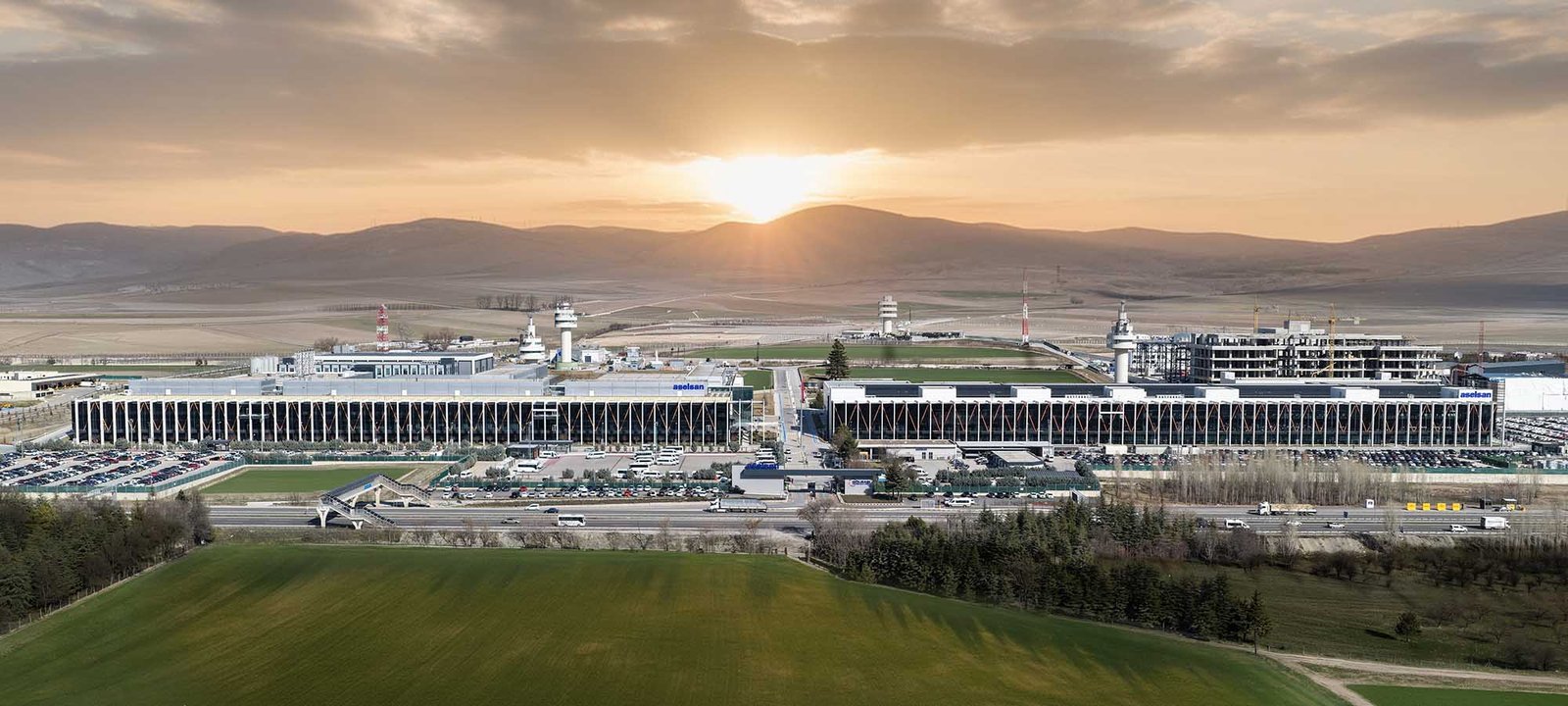
The visit to Aselsan started with a journey to their Gölbaşi Campus, situated just outside of Ankara. The campus was built between 2012 and 2014 and is absolutely enormous, what is striking is the construction taking place to further expand the size of Gölbaşi. In total Aselsan has six major production facilities in Türkiye. Mention should also be made of the fact that Aselsan has international locations in 25 different countries. The Gölbaşi visit also including a fascinating lunch with Aselsan CEO Ahmet Akyol.
As currently organised, the activities of Aselsan are divided into six business areas;Air Defence, Naval and Weapon Systems, Radar and Electronic Warfare, Communications and Information Technologies, Microelectronics and Electro-Optics, Avionics and Guidance Systems Technologies and, lastly, Transportation, Security, Energy and Healthcare. An overview briefing on the areas that Aselsan is involved in made the magnitude of their equipment and systems offering clear. Also noted was the fact that Aselsan builds in compliance with NATO standards. It was later revealed that NATO Secretary General Mark Rutte had visited Aselsan earlier in 2026 and had provided a positive endorsement of the company saying: “This spring, I spoke with talented young engineers at Aselsan, Türkiye’s largest defence electronics company. They are driving Türkiye’s defence industrial revolution, which will benefit every member of our Alliance.”
A walk around the Gölbaşi facility was instructive, the phrase “a hive of activity” came to mind. Countless systems were being built or tested prior to delivery, the Turkish Navy has seven Istanbul class (also known as the Istif class) frigates in service or on order, being built at four different shipyards. While the lead ship of the class has been delivered, the other six units are at various stages of construction, hence Aselsan has major involvement in this programme with lots of activity at Gölbaşi. Aselsan is supplying various radar, electro-optical, sonar, ESM/ ECM and decoy systems, as well as 35 mm CIWS and 25 mm gun systems. Aselsan is also playing a role in Turkish space programmes, such as the TURKSAT 6A satellite, where they provide multiple systems and subsystems. They are also a key part of the Kaan future fighter programme, providing the AESA radar as a part of Integrated Radio Frequency System (IRFS), the Integrated Electro-Optical System (IEOS), Helmet-Mounted Display, communications and navigation system, plus a range of guidance kits for standoff weapons with ranges from 12 km to over 100 km. Other major national programmes that include Aselsan are the Altay, Firtina artillery system, UAS activities and upgrade and modernisation programmes for land, air and naval requirements.
One of the most significant programmes in Türkiye where Aselsan is at the centre of events is the Steel Dome, a comprehensive integrated air defence system for the Turkish military that incorporates sensors, effectors and command and control technology. Steel Dome is designed to provide Drone Defence, Tactical Air Defence, Operational-level Air Defence and Strategic-level Air Defence. The inclusion of a C-UAS capability in the Steel Dome system reflects the experience of Türkiye in facing a number of different UAS threats in recent years.
The last element of this Aselsan press facility was the opportunity to see how some of Aselsan’s C-UAS effectors operate in the field. Available C-UAS solutions include gun systems, Gökberk laser systems and the Ejderha High-Power Microwave (HPM) system, as well as associated sensors/EW and UAS systems for interception. Targets in the test included FPV and fibre optic UAS, with changeable weather conditions providing a challenging test environment. Target UAS systems were successfully engaged, but clearly the optimum defensive solution, as chosen by Aselsan, is to have laser, HPM, EW and gun systems, attached to a range of sensors and all properly integrated with a command and control overlay. All things considered, this visit to Aselsan was important in discovering a highly successful company that on top of major national programmes, has the ability to be competitive in export markets at the highest technology level.
Author: David Saw, Editor-in-Chief of ESD
Click here to read the latest issue of ESD.
