

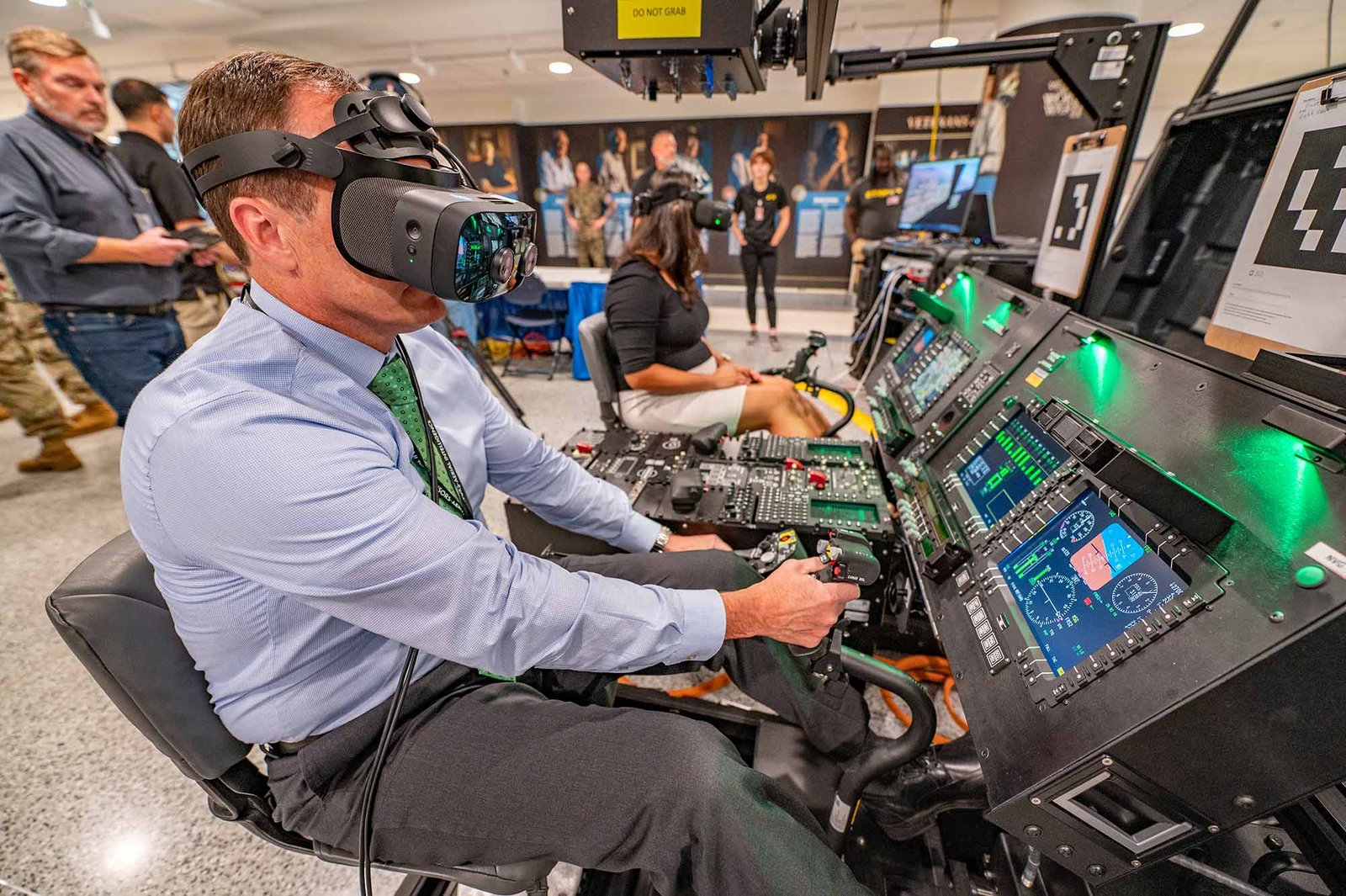
The arrival of low-cost, high-resolution and wide field-of-view head mounted displays combined with high-definition XR visual systems has revolutionised training. Such systems provide a new era of portable training that can be used at the conventional training centre or deployed on operations for air, land and sea training applications.
nVIDIA defines Extended Reality (XR) as an umbrella or collective term that encompasses a spectrum of immersive technologies that include Virtual Reality (VR), Augmented Reality (AR) and Mixed Reality (MR). Focussing more closely on these technologies, VR immerses the user in a virtual environment; AR sees VR rendered images overlaid on the real world so for example, VR images of vehicles, aircraft or personnel are overlaid onto the real world, be that actual military equipment or terrain. The next step is to create a seamless integration of the real-world and rendered graphics that is referred to as MR. This can feature mixing virtual objects into the real world or real-world objects into virtual worlds.
Over recent years, these technologies have added major capabilities to military training and simulation capabilities. First on the scene was VR that was initially used for flight simulation and saw computer generated images (CGI) projected onto screens or viewed using collimated display systems (CDS). These systems were extremely expensive and by modern standards, were lacking in fidelity, but in 1981 CAE received a contract to develop its Fibre Optic Helmet Mounted Display (FOHMD) system. Providing full colour images to the wearer and generating a wider field-of-view (FoV) than competitor monochrome devices, FOHMD was adopted by customers including NASA and the US Army.
The major shortcomings of FOHMD were its weight, head movement restrictions caused by its tether and a restricted FoV that was provided by its ‘pancake’ lenses. These early design limitations started to become addressed by companies such as HTC and Oculus with their HTC Vive and Oculus Rift head mounted displays (HMD) in 2012 and 2015 respectively. Leveraging developments in general computing power, the rapid growth of the gaming industry and the emergence of, and commercialisation of new materials and design capabilities such as computer aided design (CAD), the HMD became a viable and accepted addition to military simulation that has successfully transitioned from experimentation to reality.
Training: Technology Benefits
As well as military applications, there is a growing interest in adopting XR/HMD training in the conservative world of commercial pilot training. If adopted this would add a massive seal of credibility to the technology. The Royal Aeronautical Society says that there are, “major changes taking place in pilot training, such as the move towards high-fidelity Flight Training Devices and Extended Reality (XR/VR) as practical alternatives to Full Flight Simulators. As airlines aim for growth, finding the right balance between live and synthetic training is becoming a real procurement challenge for 2026, not just a technical debate.”
Clearly then, the XR industry has arrived at an exciting and potentially transitional time as Finnish HMD manufacturer Varjo points out in its 2026 State of XR in Simulation Training Industry Report.
“Virtual and mixed reality simulation solutions offer a way to address the growing training needs and rising costs in the defence sector,” says the report. “The idea of complementing screen- and dome-based simulators with virtual and mixed reality technologies has been around for a long time, but it is only in recent years that technological advancements have enabled the real utilisation of headset-based virtual and mixed reality.”
One of the key benefits of XR is that it provides a lower-cost and more portable training solution. Such devices also provide smaller footprints that again add to cost savings not only in terms of simulation hardware but also to the buildings that house them as well as to the services required to keep them running. The other benefit that is argued by many, including users, is that XR provides improved training and knowledge retention.
For example, such technology is now a key part of the solution for the US Air Force’s Undergraduate Pilot Training (UPT) programme and the UK’s Military Flight Training System (MFTS). The latter sees XR used at RAF Valley to train fast-jet pilots on the Hawk T2 and Texan T1. According to a UK MoD press statement in late April 2026, the RAF stated that the recently adopted technology, “should increase the number of combat- ready pilots to front-line squadrons each year and save up to £4 million annually in training costs.”
The US Navy is also a keen user of what it calls XR Immersive Training Devices (ITD) for its undergraduate pilot training programme that uses the T-6B Texan II and T-45C Goshawk. In January 2026, Vertex Solutions received a follow-on contract for an additional 13 T-6B devices along with 50 modernisation kits to update devices that are already in service. Retrofit packages will be fielded at NAS Corpus Christi and NAS Whiting Field. The Vertex team comprises Varjo, Australian training device manufacturers, Ryan Aerospace, desk-top trainer specialists TakeFlight Interactive, and audio simulation company, ASTi. Vertex Solutions’ domestic success has not been lost on foreign air arms. In December 2025, it was confirmed that the company had been selected to supply ITDs for Thailand’s AT- 6TH and Vietnam’s T-6C fleets. Initially comprising eight and 12 aircraft respectively, on 26 January this year the Royal Thai Air Force (RTAF) lost an aircraft near its Chang Mai air base.
Another major player involved in bringing XR to the military training and simulation market is Aechelon. The company says that of over 1,000 of its delivered simulators, 200 of them features XR solutions. The company has delivered training devices for various military branches, including the US Marine Corps AH-1/UH-1, US Navy TH-73, and US Air Force F-35 and F-22.
The company’s USAF programmes are being conducted under the remit provided by the service’s Virtual Test and Training Center (VTTC)/ Joint Integration Test & Training Center – Nellis (JITTC-N) at Nellis AFB. Aechelon says that it is “helping establish VTTC, a large-scale MR program supporting the US National Defense Strategy Readiness [initiative]. Initial plans for the VTTC include F-35 and F-22 simulators, eventually expanding to all USAF platforms. These ‘simulators in a box’ are deployable to ships and forward-deployed bases. Compared to traditional dome display systems, the VTTC offers a more efficient and cost-effective solution.” The company notes that the VTTC core agile architecture “accommodates MR, machine learning, and advanced sensor simulation, ensuring high-fidelity correlation for visual, EO/IR, NVG and radar systems.”
Grounded Applications
But it’s not all about flight simulation. In Germany, Rheinmetall has developed an XR driving simulator. The company says that with, “the ability to blend real and virtual elements, XR brings the best of both worlds: it offers the tactile realism of [vehicle cabs and] cockpits [with actual] haptics alongside the limitless possibilities of virtual environments. By allowing XR to be applied across a variety of reconfigurable platforms, teams can transform equipment from static assets into dynamic, plug-and-play training tools.”
As well as driver training, maintenance training can also benefit from immersive training. Working with Varjo as part of the Nordic defence collaboration initiative, Norwegian company Fynd Reality first developed an immersive training system for Ukraine’s Leopard 2 A4 main battle tanks three years ago. Today, using the Varjo XR-4 Secure Edition HMD, the training being provided covers familiarisation, procedural training and maintenance training across multiple vehicle types based on Fynd’s CORE XR training platform.
The training systems have been delivered to Ukraine under the Norwegian Nansen Programme that is managed by the Norwegian Defence Material Agency (NDMA). The contract is valued at NOK 82.5 million (€7.2 million/US$ 8.1 million) and sees 39 systems scheduled for delivery to Ukraine over the coming months.

This is an important programme on a number of levels. Technically, the Ukrainian MoD will conduct future courseware development in country thereby adding to their own technology base. Secondly, Ukraine has not got the luxury of having spare vehicles away from the frontline on which to carry out training and so XR becomes a vitally important solution to a strategic issue. “Together with Varjo, we enable learning four times faster from basic understanding to confident, operational capability,” explains Knut Henrik Aas, CEO of Fynd Reality.
Other companies to exploit HMD for maintenance training include a partnership between US players, JF Taylor and DiSTI Corporation. In late 2025, they announced their CH-47 Chinook Mixed-Reality Maintenance Trainer. The trainer provides tactile interaction with repurposed CH-47 Control Display Units (CDU), whether functional or non-functional, embedded within a fully interactive digital cockpit environment.
“By combining physical aircraft components with a dynamic virtual environment, we’ve created a scalable platform that delivers realistic practice and data-driven performance insights, without the logistical challenges of traditional fullscale trainers,” explained John Hayward, CEO at DiSTI.
Future XR Growth
Although HMD delivered XR is becoming the simulation technology of choice for many armed forces around the world, this adoption is also being assessed by many other potential users. According to Varjo’s 2026 Report, a number of “organisations remain in the development and evaluation phase. Over a third of respondents (37.7%) report having fully deployed immersive systems in operational environments, while another 33% are working through the prototype or proof-of-concept stages. Only 12.3% remain in early exploration, and fewer than 2% are not yet engaged – indicating that immersive technology is rapidly moving from experimentation to mainstream operational use.”
There is also another application of HMD combined with XR that allows training to cross over into the operational sphere. Ukraine shows us on a daily basis how HMD are being used to assist operators in controlling UAVs by displaying flight parameters and tactical data. Many nations are also using HMDs to undertake mission rehearsal and to aid decision making; virtual sand tables providing a case in point. These two growth areas are likely to be accelerated by AI-driven performance analysis and adaptive learning and these enhancements are likely to drive the adoption of XR and HMD even faster. The same benefits are also set to enhance the design and prototyping of many different types of military platform.
XR is not just about the virtual training domain. The technology can be used to provide another dimension to live training and this is exemplified by Red 6 and its Advanced Tactical Augmented Reality System (ATARS).

“Built on a low-latency, network-agnostic architecture, ATARS delivers high-resolution, full-colour synthetic entities without compromising performance or safety,” explains Daniel Robinson, Co-Founder and CEO of Red 6. “The system supports next-generation collaborative combat aircraft (CCA) development, enables training in constrained airspace, and generates structured datasets to objectively assess pilot readiness.”
In essence, pilots view ATARS entities such as other aircraft and missile launches/plumes through an Enhanced Visual Environment (EVE) headset. The company has had some notable successes including integrating ATARS with the RAF’s Hawk T2 platform, the US Air Force’s T-38, MC-130 and F-16 fleets as well as with Boeing’s AH-64E Crewstation Advance Technology Testbed (CATT) aircraft. As to the future, Leonardo and Red 6 recently signed a contract for the integration of ATARS with the M-346 training aircraft. The system is also being offered by Sierra Nevada Corporation as part of that company’s bid of its Freedom Jet for the US Navy’s Undergraduate Jet Training System (UJTS) requirement to replace the T-45C Goshawk.
Although the general consensus is that the emergence of XR/HMD has been positive for the reasons highlighted above, the elephant in the room is the question of simulator or cyber sickness. A recent study was conducted at NASA Ames Research Center at Moffett Field, California featuring pilots with MR – HMD in its Vertical Motion Simulator. Four conditions were applied: no motion, small hexapod motion, large hexapod motion and finally, full motion.
The paper generated by the experiment stated that despite improvements to visual and HMD technologies, “limitations remain” and “the…implications of using VR/MR for pilot training are still largely unknown as research is limited.”
ESD put these findings to Varjo and the company Chief Product Officer, Patrick Wyatt said, “Varjo headsets are designed to eliminate simulator sickness at the hardware level through various advanced features, such as high-refresh-rate displays, high-fidelity and low-latency video pass-through mixed reality, exceptional display resolution, and automatic IPD (inter-pupillary distance) calibration for each user to eliminate the sensory conflict that can cause nausea and disorientation.
“At the end of the day, the MR headset is just one part of the overall simulator – and [the NASA study] shows that it needs to be designed together with the motion platform, tracking system, and image generators to create the best experience.”
Conclusions
XR and HMD undoubtedly represent the future for military simulation & training (S&T). Compared to earlier generations of virtual S&T training systems that demanded CRT or laser projectors, or collimated displays that were supported by large CGI systems, all housed in specialist, large and air-conditioned purpose-designed buildings, current XR-based training systems cost a fraction of their predecessors. This means that more systems can be purchased therefore increasing the opportunity for increased training to be made available.
As we have seen, XR can be used not only for pilot training but also for training army and naval personnel with the former being exemplified by the US Army’s RCVT programme. Although not a panacea, current HMD XR training systems provide a clear indicator of where military training is heading in the future with more armed forces set to adopt the technology.
Author: Dr Trevor Nash
Click here to read the latest issue of ESD.
