

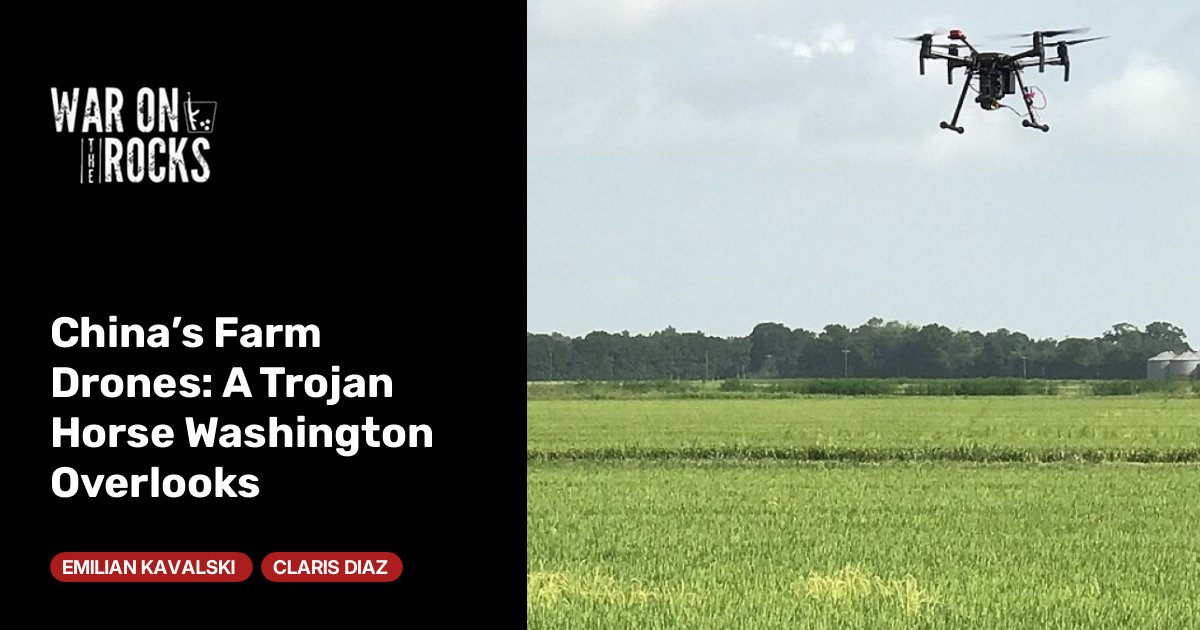
In 2024, Emilian Kavalski and Claris Diaz argued in “Beyond TikTok – The National Security Risks of Chinese Agricultural Drones” that the national debate over foreign social media platforms risked becoming too narrow, potentially causing Washington to overlook other foreign technologies embedded in critical systems. Two years later, we asked them to revisit their arguments.Image: MB-one via Wikimedia CommonsIn your 2024 article, you argued that TikTok’s data collection risks were overhyped and that fixating on them distracted the United States from more serious Chinese technology threats, like agricultural drones. Two years and several TikTok ban cycles later, has your view held up? Have security professionals shifted their focus to other threats, or is media/social media still dominating the conversation?Security professionals have certainly become more attentive to supply chains, data infrastructure, unmanned systems, and dual-use technologies since our original article was written. However, the public conversation still tends to gravitate toward social media because it is familiar, emotionally charged, and easy to frame as a consumer privacy issue. Agricultural drones, by contrast, are quieter. They operate far from Washington and Silicon Valley, yet they gather information about land use, crop health, chemical inputs, yields, and production vulnerabilities.The original point was not that TikTok presented no security concerns, but that the U.S. debate risked becoming too narrowly focused on one platform and one category of data. TikTok became a political symbol, while less visible technologies embedded in critical sectors received far less public attention.The more important question is not whether one app is dangerous, but whether the United States has a coherent framework for assessing foreign technology embedded in critical systems. In that sense, the TikTok debate was useful but incomplete. It exposed the problem of data dependency without fully addressing the deeper issue: strategic dependence on technologies that shape how critical
Members-Only Content
This article is reserved for War on the Rocks members. Join our community to unlock exclusive insights and analysis.
In 2024, Emilian Kavalski and Claris Diaz argued in “Beyond TikTok – The National Security Risks of Chinese Agricultural Drones” that the national debate over foreign social media platforms risked becoming too narrow, potentially causing Washington to overlook other foreign technologies embedded in critical systems. Two years later, we asked them to revisit their arguments.Image: MB-one via Wikimedia CommonsIn your 2024 article, you argued that TikTok’s data collection risks were overhyped and that fixating on them distracted the United States from more serious Chinese technology threats, like agricultural drones. Two years and several TikTok ban cycles later, has your view
