

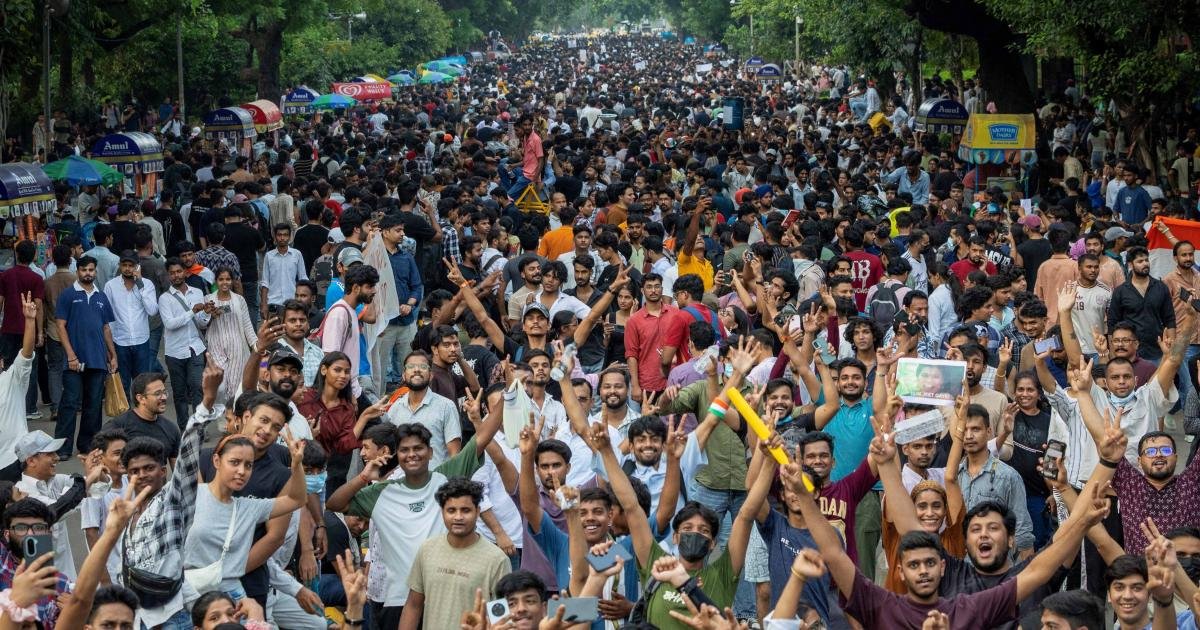
India is in rebellion. At stake is the very future of the country’s democracy and the potential of its renewal. The mass protests that have unfolded in Delhi since July and flared again this month are nothing less than a contest over the foundations of the Indian state and whether it lives up to its constitutional commitments.
Demonstrations began in the summer as students decried perceived unfairness in the country’s examination system. They have now widened to a struggle over the integrity of India’s elections, after authorities began to purge over 130 million people from draft voting lists over the last year. Many of those stripped from the electoral rolls are appealing their removal—an often laborious process—but the possibility of mass disenfranchisement is real. Tens of thousands of mostly young people have taken to the streets in Delhi in the past week, with protests now spreading to other major cities. The demonstrators are demanding the resignation of India’s chief election commissioner and questioning the credibility of India’s ostensibly independent institutions. And they are holding Indian Prime Minister Narendra Modi directly responsible, accusing him of “stealing democracy.” In their rejection of the country’s current trajectory, the protests pose the most significant challenge to Modi’s authority since the prime minister came to power in 2014.
The main opposition parties, which have never come close to dislodging Modi in national parliamentary elections, put up a united front under Rahul Gandhi, the leader of the Congress party, and an impressive show of force at a rally in Delhi on October 12. But the real heart of the protest is the intense political energy and inventiveness shown by Gen Z students. These young people have defied prohibitions on protest, breached draconian security clampdowns, and endured detentions to relentlessly question the government’s authority.
The government, for its part, also sees this confrontation as an existential battle. This is evident in its determination to contain the protests, deploying over 40,000 security personnel, closing down metro and train stations, barricading central Delhi, suspending mobile Internet, and detaining over 7,000 people. It has doggedly defended the chief of the Election Commission and it has refused to talk to the opposition or the youthful protesters about their demands.
Modi is in no danger of falling; this will not be a rerun of recent Gen Z protests in neighboring Bangladesh and Nepal that successfully toppled governments. But the Indian government faces a subtler danger: its writ no longer carries unequivocal sway. A strongman such as Modi likes to project unquestioned personal authority. Since 2014, his ruling Bharatiya Janata Party (BJP) has consolidated and centralized power to an unprecedented degree. For the government, the open defiance of young people—who come from all class, religious, and caste backgrounds and cannot easily be dismissed or stigmatized as belonging to an “antinational” group—is an unprecedented challenge. It makes the Modi government’s once adamantine grip on power seem more fragile. The future of Indian democracy hinges on whether this contest opens up more democratic space or leads to greater repression.
THE PROMISE OF EQUALITY
Modern India is founded on two legitimizing institutions: elections and exams. Since its independence in 1947, India has maintained a reputation for conducting free and fair elections. The Election Commission of India, an independent constitutional body, has sweeping powers to ensure that the polls remain beyond reproach. The credibility of the commission has been central to the credibility of Indian democracy.
India also conducts recruitment for public-sector jobs and admissions to public and several private colleges through competitive national exams. For millions of young people, the stakes in these exams are high. Success can send candidates scrambling up the ladder of opportunity, but failure can consign them to never climbing it at all. It is important, therefore, that these exams be conducted fairly and have the imprimatur of honesty and impartiality.
India remains a doggedly unequal society in which money, kinship, and power distort almost all institutions. In this context, elections and exams are the only two processes that make the state’s promise of equal treatment tangible. Elections give even the poorest Indians the prospect of dignity and agency, and as a result, voter turnout rates are routinely high. Exams sustain a parallel promise: they keep alive the idea that academic diligence and performance can trump other forms of social capital. To be sure, the staging of both elections and exams has never been perfect, but the overall integrity of the processes has never been in doubt.
Over the last year, however, the actions of the Indian government have cast doubt on elections and exams. In 2024, the main nationwide entrance examination for medical schools was engulfed in controversy over a slew of irregularities, including the advance leak of the exam’s questions. Protests ensued, and students raised serious questions about the reliability of the examination system. The episode also put the National Testing Agency, the central body that under Modi had become responsible for conducting many important exams, under intense scrutiny. Centralization was meant to ensure greater efficiency and regularity. Instead, it made the crisis deeper by concentrating responsibility at the level of the federal government. In July, antigovernment protests forced the resignation of the education minister over frustrations with the examination system.
Similarly, over the last year or so, the Election Commission decided to undertake what is known as a Special Intensive Revision, or SIR, an assessment of India’s voter lists to ensure their accuracy. The exercise is well within the powers of the Election Commission; the last such revision was conducted between 2002 and 2004. But the process has become quite controversial this time because of concerns that it places excessive burdens on citizens to prove their eligibility to vote; the lack of transparency about why names are being added or deleted from the lists; and the use of new software that has given the Election Commission the ability to strip citizens from the voter rolls on trivial grounds, often overriding established procedures and the recommendations of those local officials who do the actual verification.
According to his critics, Gyanesh Kumar, the chief election commissioner, acted unilaterally and recklessly in pursuing the revision of voter rolls in ways that violated normal procedures. Since June 2025, the SIR has tagged roughly 130 million names for removal from the voter rolls. Although many of the deletions were duplicates and the names of people who had died or left the country, millions of Indians have found themselves stripped of the right to vote and now burdened with the difficult task of appealing to a tribunal to prove their citizenship. In this light, the protests have already had one constructive effect: the election commission is trying to placate its critics by making it easier for those excluded to lodge appeals.
Gandhi has alleged that the SIR is an instrument for manipulating elections. Already, in the state of West Bengal, where nine million names were taken off, millions of Indians found themselves unable to participate in state elections in March because their appeals were yet to be heard. The elections brought Modi’s BJP to power in the state for the first time. But even if the Election Commission is not systematically targeting voters based on their identity or their political preferences, the exercise still risks disenfranchising millions through sheer ineptitude.
To make matters worse, India’s Supreme Court, another vital democratic institution, has also played an unfortunate role in this train of events. The Supreme Court effectively collaborated in the disenfranchisement of voters in West Bengal by blithely claiming that those whose petitions were under appeal could just vote in the next election after their appeals had been adjudicated; it didn’t matter if they missed voting in the current election.
The sense of the Supreme Court’s callousness was compounded in May after Surya Kant, the chief justice, compared a group of young lawyers pressing for change to “cockroaches.” That stray remark precipitated a social movement, with the creation—initially as a joke but then in earnest—of the “Cockroach Janata Party,” a group that has galvanized young Indians both on social media and in the streets. It played a key role in forcing the resignation of Dharmendra Pradhan, the education minister, in July, after mass protests in Delhi and across the country. It is now driving young Indians to call for the resignation of Kumar, the chief election commissioner.
Most significantly, it has linked the credibility crisis directly to Modi, encouraging a veritable explosion of public mockery of the prime minister on social media and the Internet. That has punctured Modi’s carefully cultivated image of an invincible leader who delivers on every promise. He has prided himself on his dominance of social media, but the loss of control over the political narrative, especially on the image-sharing platform Instagram, was palpable. The prime minister has feebly tried to make his own reels in response, but that failed to stem the tide of public irreverence. The ridicule was noteworthy not simply as political satire. It lifted the pall of fear that had hung over Indian democracy since Modi became prime minister, as critics have been silenced through intimidation and opposition leaders targeted through legal proceedings. In mocking power, young people found their voice.
The threat they pose to Modi is significant. These young Indians are not saddled with the historical baggage of ties to conventional opposition parties. The issues they focus on—exams and elections—cut across social divides and even partisan political affiliations. And the protesters’ grit, wit, inventiveness, and fearlessness have dented Modi’s authority like nothing else has in the past 12 years.
THEIR OWN FUTURE
The movement must still contend with the brute reality of state power, which has been evident in the streets of Delhi this past week. Authorities tried to physically suppress and contain dissent by prohibiting it and preventing protesters from entering certain public spaces. That in turn has given young Indians another reason to go to the streets, to protest the right to protest and reclaim public spaces. The government has deployed thousands of security forces in the national capital, as if it were facing some invading foreign army, not young people making reasonable demands, and all signs are that Modi will continue to maintain a hard line on the protests.
For the government, the movement’s principal demand, the resignation of Kumar, is not simply a question of one official’s tenure. Modi has secured extraordinary loyalty within his BJP through an implicit assurance that those who act at the government’s behest will be protected from the consequences of their actions. If that assurance begins to fray, ministers and party functionaries may worry about what might happen when they can no longer take for granted the protection of the leadership. Modi’s defense of Kumar, then, may be less about the SIR than about preserving loyalty to the government within the ranks of his party.
Moreover, Modi has built much of his political persona around turning perceived slights into demonstrations of strength. To yield in the face of public mockery would be especially difficult and out of character. Kumar’s removal could be read as an admission of guilt. Such a retreat could then embolden Modi’s rivals and encourage further protests—and raise the prospect that a galvanized opposition might finally unseat the prime minister in the next parliamentary elections scheduled for 2029.
The danger facing the Indian government is that it comes to believe its own propaganda.
To be sure, the future electoral consequences of the protests remain uncertain. Public anger does not automatically translate into votes. The Election Commission may yet blunt the controversy by admitting voters whose appeals are pending or by making procedural concessions that reduce the immediate grievances. The BJP may still benefit from a fractious opposition and from the fact that voters in a country as large as India are rarely united in their motivations and perceptions of the political stakes. The next major electoral test, in the state of Uttar Pradesh, is still some months away, in March 2027. A victory there for the BJP would allow the party to claim that its authority remains intact; a defeat would make it much harder to contain the political implications of the present controversy. The government is likely to double down on repression against dissenters nationwide, trusting that it can succeed in limiting public expressions of anger.
The BJP is hoping that the more disruptions there are in Delhi, the more it can cast the current upheaval as the work of rabble-rousers and anarchists and rally Indians behind the prime minister. The government and its supporters are already seeking to discredit the movement as the work of foreign hands, invoking conspiracy theories and examples of alleged malign foreign intervention in the youth demonstrations in Bangladesh and Nepal that ousted sitting governments.
Yet the greater danger facing the Indian government is that it comes to believe its own propaganda and ignores genuine discontent. In both Bangladesh and Nepal, the depth of popular grievance was obvious for anyone willing to look—as it is in India. Despite India’s headline growth rates, young people worry about their economic future. Graduate unemployment is at 23 percent, white-collar job growth has slowed to a creeping one percent this year, and nearly a quarter of Indians between the ages of 15 and 29 are not in employment, education, or training programs. The very institutions that were meant to secure their future—elections, courts, and independent agencies—are losing their trust. The strongman is failing, even as the opposition struggles to inspire a great deal of conviction and enthusiasm. What is powerful about this moment, then, is the spectacle of young people who, lacking many good options, are still choosing to fight for their democracy the only way citizens can when it is in peril: with energy, aspiration, and the belief that they can craft their own collective future, wherever that may lead.
Loading…
